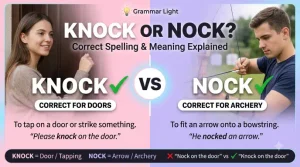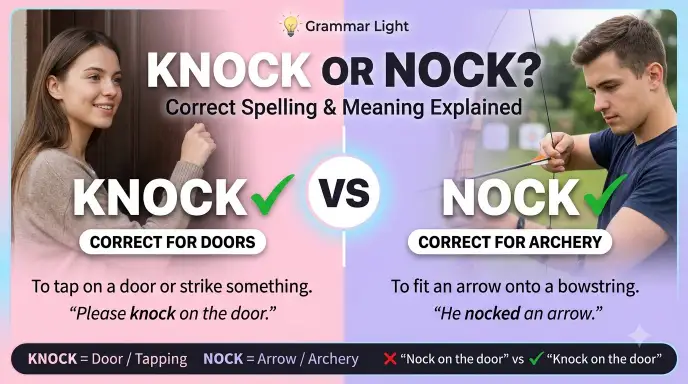
Have you ever wondered If to write “knock” or “nock”? The correct word depends on what you want to describe. Knock is the common English word used when someone taps on a door, makes a short striking sound, or hits something. Nock, on the other hand, is a specialized term mainly used in archery. It refers to the notch at the rear of an arrow or the act of fitting an arrow onto a bowstring.
Although these words sound exactly alike, their meanings and uses are different. Choosing the wrong spelling can confuse readers, especially when writing instructions, describing everyday actions, or discussing archery equipment. For example, you would knock on a door, but an archer may nock an arrow before shooting.
Both words are spelled correctly, so neither is automatically wrong. The important thing is to understand the context in which each word belongs. This guide explains the meanings of knock and nock, their origins, common mistakes, and practical examples to help you use them confidently in everyday English and specialized writing.
Knock or Nock : Quick Answer
Knock is the correct choice when you mean tapping on a door, striking a surface, or producing a short sound. Nock is used primarily in archery to describe the notch at the back of an arrow or the action of placing an arrow on a bowstring.
| Word | Meaning | Example |
| Knock | To tap, strike, or make a short sound | Please knock on the door. |
| Nock | The notch at an arrow’s rear or to fit an arrow onto a bowstring | The archer nocked an arrow. |
Remember this simple distinction: knock is an everyday word, while nock is mainly an archery term.
Definition and Meaning of Knock and Nock
Understanding each word’s meaning is the easiest way to avoid spelling mistakes. Although their pronunciation is identical, they serve different purposes in a sentence.
What Does Knock Mean?
Knock is a common English word that can function as both a verb and a noun. As a verb, it usually means hitting or tapping something to produce a sound. As a noun, it can refer to the sound or action of striking.
Common uses of knock include:
- Knocking on a door: Tapping on a door to announce your presence.
- Knocking on a window: Tapping on glass to attract someone’s attention.
- Knocking something over: Hitting an object so that it falls.
- Knocking against something: Accidentally striking an object or surface.
- A knock: The sound or action of a person or object striking something.
Examples:
- Please knock before entering my room.
- Someone gave the door a loud knock.
- I accidentally knocked my cup off the table.
- She heard a knock at the front door.
- Be careful not to knock your head against the shelf.
In informal English, knock can also mean to criticize someone or something. For example, “Don’t knock his idea before you understand it” means not to criticize the idea too quickly.
What Does Nock Mean?
Nock is a specialized word most commonly associated with archery. It refers to the notch at the rear of an arrow that fits onto the bowstring. It can also be used as a verb meaning to place an arrow onto the bowstring in preparation for shooting.
The word is useful when discussing archery equipment, shooting techniques, and instructions for using a bow and arrow.
Examples:
- The archer carefully nocked the arrow.
- Check the arrow’s nock before shooting.
- She learned how to nock an arrow correctly.
- The arrow’s nock fitted securely onto the bowstring.
In these sentences, nock is correct because the context involves arrows and archery.
Key point: Do not use nock when describing an ordinary door tap. Likewise, use nock rather than knock when referring specifically to fitting an arrow onto a bowstring.
The Origin of Knock and Nock
The histories of these words help explain why their spellings differ despite their identical pronunciation.
The Origin of Knock
The word knock comes from older forms of English and related Germanic languages. Historically, it referred to striking, beating, or making a knocking sound. Over time, it became a familiar word for tapping on a door or hitting a surface.
Today, knock appears in many everyday expressions, including “knock on the door,” “knock something down,” and “knock it off.” Its meaning can vary depending on the phrase, but the basic idea often involves striking, hitting, or making an impact.
The Origin of Nock
The word nock developed as a specialized term associated with bows and arrows. It describes the part of an arrow that engages with the bowstring, as well as the action of placing the arrow in position for shooting.
Unlike knock, which is used in many everyday situations, nock is most familiar to archers, equipment manufacturers, and people who study traditional or modern archery.
Although the two words sound alike, their meanings developed in different contexts. Their shared pronunciation does not make them interchangeable.
British English vs. American English Spelling
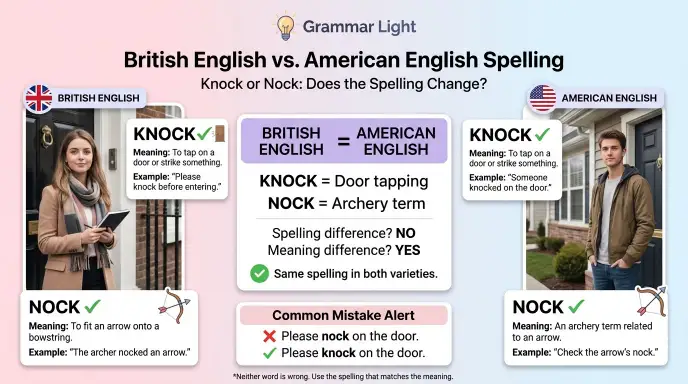
Some English words have different spellings in British and American English. For example, colour is common in British English, while color is standard in American English. However, knock and nock do not follow this pattern.
| Language Variety | Correct Everyday Word | Correct Archery Term |
| British English | Knock | Nock |
| American English | Knock | Nock |
| Australian English | Knock | Nock |
| Canadian English | Knock | Nock |
The spelling remains the same across these varieties of English. The difference depends on the meaning, not the country or regional spelling convention.
For example, a British speaker would write “Please knock on the door,” just as an American speaker would. Similarly, an archer in either country could write “Nock the arrow before drawing the bow.”
Do not treat knock and nock as British and American spelling alternatives. They are separate words with different definitions.
Common Mistakes When Using Knock and Nock
Because these words are homophones, writers can confuse them when relying only on pronunciation. A homophone is a word that sounds the same as another word but has a different meaning or spelling.
Mistake 1: Writing “Nock on the Door”
Incorrect: “Please nock on the door before entering.”
Correct: “Please knock on the door before entering.”
Why? The sentence describes tapping on a door, so knock is the correct word. Nock is primarily associated with archery.
Mistake 2: Writing “Knock an Arrow”
Incorrect: “The archer knocked an arrow onto the bowstring.”
Correct: “The archer nocked an arrow onto the bowstring.”
Why? The intended action is placing an arrow onto the bowstring. In archery, the correct verb is nock.
Mistake 3: Assuming One Word Is Incorrect
Incorrect assumption: “Nock is always a spelling mistake.”
Correct understanding: Both knock and nock are valid English words. Their accuracy depends on the sentence’s meaning.
For example, “I heard a knock” is correct in an everyday setting, while “The arrow’s nock was damaged” is correct in an archery context.
Mistake 4: Confusing the Noun and Verb Forms
The same spelling can serve different grammatical roles.
- Knock as a noun: “There was a loud knock at the door.”
- Knock as a verb: “Please knock before entering.”
- Nock as a noun: “The arrow’s nock was loose.”
- Nock as a verb: “He will nock the arrow.”
Pay attention to what the sentence describes. This helps you choose the right word even when both sound identical.
Knock or Nock in Everyday Examples
The best way to remember the difference is to see each word used in a natural sentence.
Examples of Knock
- Please knock before you enter the office.
- I heard someone knock on the front door.
- He accidentally knocked the glass off the table.
- There was a gentle knock on the bedroom door.
- She knocked on the window to get his attention.
- The ball hit the shelf and knocked a book onto the floor.
- Don’t knock his work until you have seen the results.
- Someone gave the wooden door three quick knocks.
Examples of Nock
- The archer nocked an arrow before aiming.
- Check the nock for damage before using the arrow.
- She learned to nock an arrow safely.
- The arrow’s nock did not fit the bowstring properly.
- He carefully placed the arrow in position and nocked it.
- The instructor explained how to inspect an arrow’s nock.
- The archer replaced the damaged nock on the arrow.
- Before releasing the arrow, make sure it is properly nocked.
Easy memory tip: If the sentence involves a door, a tap, or a physical impact, you probably need knock. If it involves an arrow and a bowstring, you probably need nock.
Knock vs. Nock: Key Differences Explained
Although knock and nock sound the same, their meanings, contexts, and everyday uses are different. Understanding these differences helps you choose the correct spelling when writing messages, stories, instructions, or technical descriptions.
| Feature | Knock | Nock |
| Main meaning | To tap, strike, or make an impact | To fit an arrow onto a bowstring |
| Part of speech | Noun and verb | Noun and verb |
| Common context | Doors, windows, objects, sounds | Archery and arrow equipment |
| Everyday use | Very common | Specialized |
| Example | Knock on the door. | Nock the arrow. |
The most important distinction is the situation being described. Knock belongs to ordinary actions involving tapping or striking, while nock belongs mainly to archery. Neither spelling is incorrect when used in its proper context.
When Should You Use Knock?
Use knock when describing a tapping sound, a physical impact, or the action of striking something. It is the word most people need in everyday conversations and general writing.
1. When Someone Taps on a Door
People commonly knock to let someone know they are outside a room or building.
- Please knock before entering.
- I heard someone knocking on the door.
- She gave the door a gentle knock.
2. When Something Hits an Object
Knock can describe an accidental or deliberate impact.
- I knocked my elbow against the desk.
- The wind knocked a branch down.
- He knocked the bottle off the counter.
3. When Talking About Sounds
The noun knock can describe the sound produced by tapping or striking.
- A loud knock interrupted the meeting.
- We heard three knocks from upstairs.
- There was a soft knock at the window.
4. When Criticizing Something
In informal English, knock can also mean to criticize or speak negatively about something.
- Don’t knock the plan before hearing the details.
- People often knock new ideas without giving them a chance.
Remember: If you are writing about doors, tapping, striking, or criticism, knock is usually the appropriate choice.
When Should You Use Nock?
Use nock when discussing archery, particularly the part of an arrow that attaches to the bowstring or the action of positioning an arrow for shooting.
1. When Preparing an Arrow
The verb nock describes placing an arrow onto the bowstring in the correct position.
- The archer nocked an arrow before aiming.
- She learned how to nock an arrow properly.
- He carefully nocked the arrow onto the bowstring.
2. When Describing an Arrow’s Parts
As a noun, nock refers to the notch or fitting at the rear of an arrow that engages with the bowstring.
- The arrow’s nock was damaged.
- Inspect the nock before using the arrow.
- The replacement nock fitted the arrow correctly.
3. When Writing Archery Instructions
Specialized instructions may use nock to describe a step in preparing equipment.
- Check the arrow before you nock it.
- Make sure the arrow is properly nocked before shooting.
- The instructor demonstrated the correct way to nock an arrow.
Remember: If the subject is an arrow, a bowstring, or archery equipment, nock may be the word you need.
Knock or Nock: Synonyms and Related Words
Learning related words can help you understand each term’s meaning. However, not every synonym can replace the original word in every sentence.
Synonyms for Knock
Depending on the context, related words include:
- Tap: To strike lightly, often to attract attention.
- Rap: To strike sharply, such as rapping on a door.
- Hit: To strike something with force.
- Strike: To hit something deliberately or accidentally.
- Bang: To hit something noisily.
- Criticize: To express disapproval, when knock is used informally in this sense.
Example: “She tapped on the door” conveys a similar idea to “She knocked on the door.”
Related Terms for Nock
Nock is a specialized archery term, so its alternatives depend on the exact action or object being described.
- Arrow notch: A descriptive term for the notch at the rear of an arrow.
- Bowstring: The string used to propel an arrow; it is related to nocking but is not a synonym.
- Fit onto the bowstring: A plain English description of the verb nock.
- Arrow fitting: A general description that may refer to a component, depending on the equipment.
For example, “He fitted the arrow onto the bowstring” explains the action of nocking in simpler language.
Important: Tap or strike may replace knock in some situations, but they cannot replace nock when referring to the specialized archery component.
How to Remember the Difference Between Knock and Nock
If you often mix up these words, use a simple association.
Knock = Knocking on a door.
Think of someone tapping on a door to get another person’s attention. The spelling with K is the everyday word for this action.
Nock = Nock an arrow.
Think of an archer preparing an arrow on a bowstring. The spelling with N is the specialized archery word.
Here is another quick comparison:
- “I heard a knock at the door.” : Everyday sound.
- “He nocked an arrow.” : Archery action.
- “The arrow’s nock was damaged.” : Part of an arrow.
The easiest strategy is to focus on meaning rather than pronunciation. Since the two words are pronounced alike, listening to the sentence alone will not help you distinguish their spellings.
Frequently Asked Questions About Knock or Nock
Q.1 What is the difference between knock and nock?
Knock means to tap, strike, or make an impact. Nock is an archery term referring to the notch at the rear of an arrow or the act of fitting an arrow onto a bowstring.
Q.2 Is nock a real word?
Yes. Nock is a real English word, most commonly used in archery. It is not a misspelling of knock when the context concerns arrows or bowstrings.
Q.3 Is it knock on the door or nock on the door?
The correct phrase is “knock on the door.” It describes tapping on a door to announce your presence. Nock on the door is incorrect for this meaning.
Q.4 Is it nock an arrow or knock an arrow?
In modern archery terminology, the standard expression is “nock an arrow.” It means placing the arrow onto the bowstring in preparation for shooting.
Q.5 Are knock and nock pronounced the same?
Yes. Knock and nock are homophones, meaning they have the same pronunciation but different spellings and meanings.
Q.6 Can knock be used as a noun?
Yes. Knock can be a noun referring to a tapping sound or an instance of striking something.
Example: “I heard a knock at the front door.”
Q.7 Can nock be used as a noun and a verb?
Yes. As a noun, a nock is the notch or fitting at the rear of an arrow. As a verb, nock means to place an arrow onto a bowstring.
Q.8 Is knock an American or British spelling?
Knock is used in both American and British English. The spelling does not change between these varieties. The same is true of the archery term nock.
Q.9 What is the past tense of nock?
The regular past tense form is nocked.
Example: “The archer nocked an arrow before aiming.”
Q.10 How can I remember when to use knock or nock?
Remember K for knocking on a door and N for nocking an arrow. This simple association can help you choose the correct word quickly.
Final Thoughts
Choosing between knock or nock becomes easy once you understand their meanings. Knock is the everyday word for tapping, striking, or producing an impact. Nock is a specialized term used in archery for the notch at the rear of an arrow or the action of placing an arrow onto a bowstring.
Both spellings are correct, but they are not interchangeable. Use knock when writing about doors, sounds, or impacts, and choose nock when discussing arrows and archery equipment.
The key rule is simple: knock on a door, but nock an arrow.
READ MORE!

I’m a grammar writer focused on making English rules, word usage, and sentence structure simple and easy to understand.