
“Halt” is the correct spelling, while “hault” is generally a misspelling. People often search for “halt or hault” because the two forms can sound similar in speech. This can make the correct spelling difficult to remember, especially for students, ESL learners, and writers.
The word halt is commonly used to mean “stop.” It can describe a person stopping, a vehicle coming to a stop, or an activity being stopped. It can work as both a verb and a noun, which makes it useful in many types of writing.
Understanding the difference helps you avoid spelling mistakes in emails, assignments, reports, articles, and professional communication. The confusion is mainly about spelling, not pronunciation or meaning. Once you remember that halt is the standard English word, choosing the correct form becomes simple.
This guide explains the meaning, origin, usage, common mistakes, and practical examples of halt or hault so you can use the correct spelling with confidence.
Halt or Hault : Quick Answer
This spelling confusion is common because both forms may sound similar when spoken.
Halt is the correct spelling for the word meaning “to stop” or “bring something to a stop.” Hault is generally considered a misspelling and should not be used in standard English.
Examples of Halt
- The police ordered the car to halt.
- Heavy rain caused the construction work to halt.
- The train came to a halt at the station.
- The manager decided to halt production.
Is Hault Correct?
No, “hault” is not the standard spelling when you want to express the idea of stopping. In formal and everyday English, use halt instead.
For example:
❌ The workers haulted the machine.
✅ The workers halted the machine.
Definition and Meaning of Halt or Hault
The word “halt” has a clear meaning, but its role can change depending on how it appears in a sentence.
Halt as a Verb
As a verb, halt means to stop moving or to stop an action.
For example:
- The driver halted the vehicle.
- The company halted operations.
- The soldiers were ordered to halt.
It can describe something stopping on its own or being stopped by another person.
Halt as a Noun
As a noun, halt means a stop or pause.
For example:
- The bus came to a halt.
- Work was brought to a halt.
- The negotiations reached a temporary halt.
The expression “come to a halt” is especially common in written English.
Simple Meaning of Halt
In simple English, halt means stop.
It can refer to stopping physical movement, ending an activity, interrupting progress, or temporarily stopping a process.
Context and Usage
“Halt” is often more formal than “stop.” It appears frequently in news reports, official statements, military commands, business writing, and formal documents.
For example:
- The government halted the project.
- Officials ordered the evacuation to halt.
- Production was brought to a halt.
In casual speech, stop is usually more natural.
The Origin of Halt
The history of “halt” helps explain how the modern English word developed.
Word Origin
“Halt” comes from older Germanic language roots associated with stopping or standing still. The word developed through earlier forms of English and related Germanic languages before reaching its modern spelling and meaning.
Its connection with stopping has remained strong throughout its history.
How Halt Developed
Older uses of the word were connected with stopping movement or standing still. Over time, English speakers used it more broadly for stopping an action, process, or activity.
Today, the word can refer to both physical movement and abstract activities.
Why People Write Hault
The spelling hault is likely caused by pronunciation and spelling uncertainty. English has many words with similar sounds and different spellings, so writers may add “u” because they expect a particular sound pattern.
However, this does not make “hault” a standard alternative spelling of halt.
Modern Use of Halt
“Halt” remains a standard English word. It is particularly useful when describing an intentional or significant stop.
For example, a company can halt production, authorities can halt construction, and a vehicle can come to a halt.
The correct spelling remains halt in these contexts.
British English vs American English Spelling
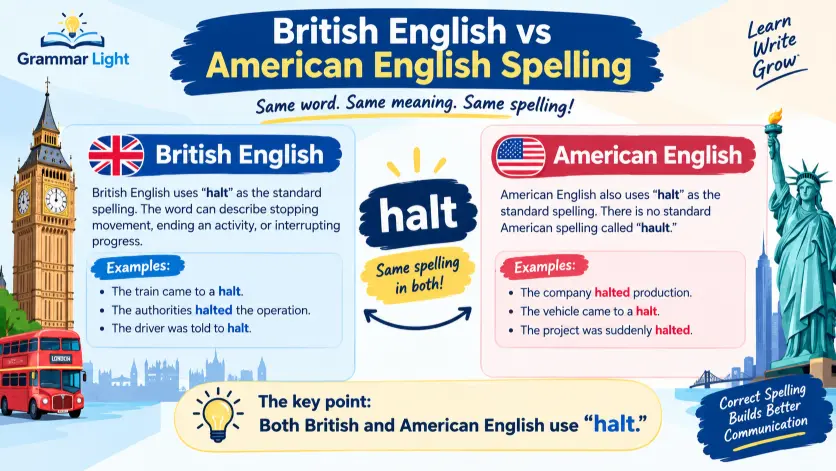
The spelling of halt does not change between British and American English, so the same form is used in both varieties.
Is Halt Spelled Differently in British English?
British English uses halt as the standard spelling. The word can describe stopping movement, ending an activity, or interrupting progress.
Examples include:
- The train came to a halt.
- The authorities halted the operation.
- The driver was told to halt.
Is Halt Spelled Differently in American English?
American English also uses halt. There is no standard American spelling called “hault.”
For example:
- The company halted production.
- The vehicle came to a halt.
- The project was suddenly halted.
British and American Spelling Comparison
| Form | British English | American English | Correct? |
| halt | Used | Used | ✅ Yes |
| hault | Not standard | Not standard | ❌ No |
| halted | Used | Used | ✅ Yes |
| halting | Used | Used | ✅ Yes |
The key point is simple: British and American English both use “halt.”
Which Spelling Should You Use?
Choosing the correct form is easy because standard English uses the same spelling across major English varieties.
For American English
Use halt in American schoolwork, business documents, websites, reports, and professional communication.
Example:
The company decided to halt the project.
For British English
Use halt in British academic and professional writing as well.
Example:
The authorities ordered the construction to halt.
For Global English
Halt is the safest choice for international readers because it is recognized across English speaking regions.
If your audience includes people from different countries, avoid hault and use the standard spelling halt.
Common Mistakes with Halt or Hault
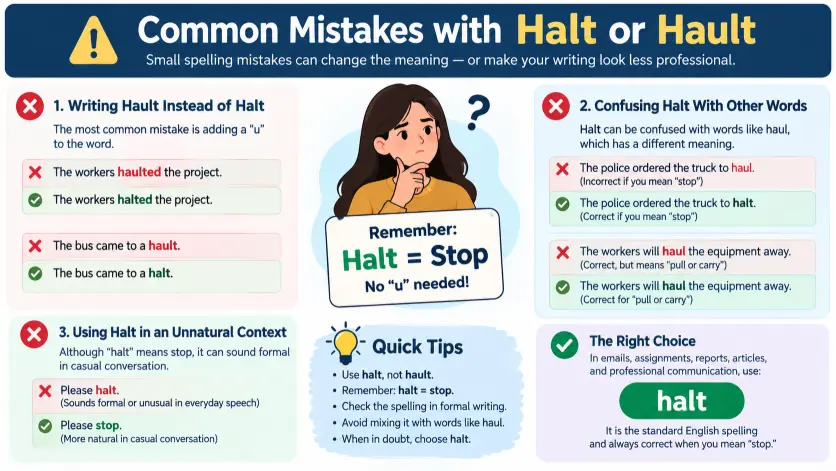
Many errors happen because writers rely on sound instead of checking the standard spelling.
Writing Hault Instead of Halt
The most common mistake is adding a u to the word.
❌ The workers haulted the project.
✅ The workers halted the project.
❌ The bus came to a hault.
✅ The bus came to a halt.
Confusing Halt With Other Words
“Halt” can sometimes be confused with words such as haul, which has a different meaning.
Halt means to stop.
Haul means to pull, carry, or transport something over a distance.
Examples:
- The police ordered the truck to halt.
- The workers will haul the equipment away.
Using Halt in an Unnatural Context
Although “halt” means stop, it can sound formal in casual conversation.
For example, “Please halt” is grammatically possible, but “Please stop” is usually more natural in everyday speech.
The best choice depends on the tone and context.
Halt or Hault in Everyday Examples
Seeing the correct spelling in different situations makes the distinction easier to remember.
In Emails
Professional emails may use halt when discussing a temporary stop to work or an activity.
Please halt all updates until the new instructions are released.
A simpler alternative for casual communication would be “stop.”
In News Writing
News reports frequently use “halt” when describing government decisions, business activity, transportation, or public events.
Officials ordered the construction work to halt after the inspection.
The word gives the sentence a formal and concise tone.
In Social Media
People may use “halt” in posts when they want a dramatic or formal tone.
The entire event came to a halt after the power went out.
In casual posts, “stop” is more common, but “halt” remains correct.
In Formal Writing
“Halt” works well in reports, academic writing, official notices, and business documents.
The organization temporarily halted operations while the issue was investigated.
This usage sounds professional and precise.
Quick Usage Table
| Situation | Example | Recommended Form |
| Please halt the process. | Halt | |
| News | Officials halted construction. | Halt |
| Social media | The celebration came to a halt. | Halt |
| Formal report | Operations were halted temporarily. | Halt |
| Casual conversation | Please stop here. | Stop |
The main spelling rule stays unchanged: use “halt,” never “hault,” when you mean “stop.”
Halt or Hault in Different Contexts
The meaning of halt stays connected to stopping, but its use can change depending on the situation.
In Transportation
“Halt” can describe a vehicle or train stopping.
For example:
- The train halted near the station.
- The driver brought the car to a halt.
- The bus came to a sudden halt.
In these sentences, the word focuses on stopping physical movement.
In Business
Companies often use “halt” when an operation or activity is stopped.
For example:
- The factory halted production.
- The company halted sales of the product.
- Officials ordered the plant to halt operations.
This use is common in business reports and news articles.
In Government and Public Affairs
Government agencies may use the word when announcing that an activity has been stopped.
For example:
- Officials halted construction.
- The authorities halted the program.
- The agency ordered work to halt.
This gives the statement a formal tone.
In Military Language
“Halt” has a long association with commands to stop moving.
For example:
The commander ordered the troops to halt.
The word can sound firm and authoritative in this context.
Halt vs Stop
Both words describe stopping, but they differ slightly in tone and common usage.
The main difference is that stop is more common in everyday English, while “halt” often sounds more formal or deliberate.
| Word | Meaning | Common Use | Tone |
| Halt | Stop or cause something to stop | Formal writing, news, commands | Formal |
| Stop | Cease movement or activity | Everyday conversation | Neutral |
| Pause | Stop temporarily | Conversations, work, activities | Neutral |
| End | Bring something to a finish | Events, activities, processes | Neutral/Formal |
Halt and Stop in Sentences
Compare these examples:
Please stop talking.
The supervisor ordered the discussion to halt.
Both sentences communicate the idea of stopping, but the second sounds more formal.
How to Use Halt Correctly
Using “halt” correctly depends on its grammatical role and the meaning you want to express.
Using Halt as a Verb
When “halt” works as a verb, it can mean to stop something or to stop moving.
Examples:
- The driver halted the car.
- The workers halted the process.
- The storm forced the team to halt construction.
The past tense is halted, not “haulted.”
Using Halt as a Noun
As a noun, “halt” refers to a stop or interruption.
Examples:
- The meeting came to a halt.
- The negotiations reached a halt.
- The machine suddenly came to a halt.
Common Expressions With Halt
Several expressions containing “halt” are frequently used in English.
Come to a halt means to stop.
The vehicle came to a halt.
Bring something to a halt means to cause something to stop.
The accident brought traffic to a halt.
Call a halt to something means to officially or deliberately stop an activity.
The manager called a halt to the project.
These expressions are especially useful in formal writing.
Halt in Different Sentence Structures
The position of “halt” can change depending on if it is functioning as a noun or verb.
Subject + Halt
The train halted suddenly.
Here, “halted” is the main verb.
Subject + Halt + Object
The manager halted the meeting.
In this structure, the manager causes the meeting to stop.
Come to a Halt
The negotiations came to a halt.
Here, “halt” functions as a noun.
Bring to a Halt
The accident brought traffic to a halt.
This structure means that the accident caused traffic to stop.
Remembering Halt, Not Hault
A simple memory rule can help you avoid the spelling mistake.
Think of halt = stop and remember that the standard word contains only the letters H A L T.
If you are writing the word in a sentence such as “The project came to a :::,” the correct choice is halt.
The spelling hault should be avoided when you mean “stop.”
Halt or Hault : Google Trends & Usage Data
Search interest in “halt or hault” mainly comes from people checking the correct spelling and meaning of a commonly heard word.
Which Form Is More Common?
Halt is the established English spelling and appears in dictionaries, books, news articles, websites, and professional documents. “Hault” may appear in searches because people sometimes type the word as they hear it.
Search behavior does not make “hault” a correct spelling. It simply shows that people are looking for clarification.
Usage by English Speaking Countries
The spelling halt is used in both American and British English. It is also understood across other English speaking regions, including Canada, Australia, and New Zealand.
The form does not normally change based on the country.
| Region | Standard Form | “Hault” as Standard Spelling |
| United States | halt | ❌ No |
| United Kingdom | halt | ❌ No |
| Canada | halt | ❌ No |
| Australia | halt | ❌ No |
| New Zealand | halt | ❌ No |
Search Context
People commonly search for this spelling when they encounter the word in writing or hear it in speech. Questions such as “What does a hault mean?” and “Is halt mean stop?” usually indicate a need for basic spelling or meaning clarification.
For accurate writing, the answer remains straightforward: use halt.
Halt or Hault Comparison Table
A side by side comparison makes the spelling difference easier to remember.
| Feature | Halt | Hault |
| Standard English word | ✅ Yes | ❌ No |
| Meaning “to stop” | ✅ Yes | ❌ No |
| Used as a noun | ✅ Yes | ❌ No |
| Used as a verb | ✅ Yes | ❌ No |
| Used in formal writing | ✅ Yes | ❌ No |
| Used in British English | ✅ Yes | ❌ No |
| Used in American English | ✅ Yes | ❌ No |
| Recommended spelling | Halt | Avoid |
The safest rule is simple: if you mean “stop,” write “halt,” not “hault.”
FAQs About Halt or Hault
These questions address the most common spelling and usage concerns surrounding the two forms.
What Does a Hault Mean?
“Hault” does not have the standard meaning of “stop” in modern English. In most cases, hault is simply a misspelling of halt.
Is Halt Mean Stop?
Yes, halt means stop. As a verb, it can mean to stop moving or to make something stop.
For example:
The officer ordered the vehicle to halt.
As a noun, it can refer to a stop or pause.
What Is the Difference Between “Halt” and “Hault”?
Halt is the correct standard spelling. Hault is generally an incorrect spelling when the intended meaning is “stop.”
For formal, academic, or professional writing, always choose halt.
What Does “Halt It” Mean?
“Halt it” means “stop it” or “make it stop.”
For example:
The supervisor told the workers to halt it.
However, “stop it” is usually more natural in casual conversation.
What Is Called Halt?
A halt is a stop or pause in movement, activity, or progress. It can refer to a physical stop or an interruption of an ongoing process.
For example:
The project came to a halt.
How to Use Halt in a Sentence?
You can use halt as either a verb or a noun.
As a verb:
The company halted production.
As a noun:
Production came to a halt.
Another common expression is:
The train came to a halt.
Is Hault Ever Correct?
For the meaning “stop,” hault is not the standard English spelling. Writers should use halt instead.
The word may appear as a typo, username, name, or other special term, but that does not make it an alternative spelling of “halt.”
Practical Examples of Halt in English
Real world examples make it easier to understand how halt works in different types of writing.
Examples for Students
Students can use “halt” in essays, assignments, and classroom exercises.
- The teacher asked the students to halt the discussion.
- Heavy rain caused the outdoor activity to come to a halt.
- The experiment was halted because of a technical problem.
Examples in Workplace Communication
In professional settings, “halt” can describe a temporary stop to a task or operation.
- Please halt the process until further instructions.
- Production was halted for safety checks.
- The team decided to halt development temporarily.
Examples in Formal Reports
The word is useful when a report needs precise and formal language.
- The investigation caused the project to come to a temporary halt.
- Operations were halted after the inspection.
- The organization brought the activity to a halt.
Examples in News Headlines
News writing often uses short, direct language.
- Government halts construction project.
- Factory halts production after equipment failure.
- Officials halt work at the site.
These examples show why “halt” is common in formal and informational writing.
Common Grammar Forms of Halt
Knowing the different forms of the word helps you use it accurately.
Present Form
The basic form is halt.
Officials may halt the operation.
Past Form
The past tense is halted.
Officials halted the operation yesterday.
Present Participle
The ing form is halting.
The company is halting production temporarily.
Noun Form
The noun is also halt.
The process came to a halt.
The spelling does not change to “hault” in any of these standard forms.
Words Related to Halt
Several words can express a similar idea, but each has its own tone or use.
Stop
Stop is the most common alternative.
The driver stopped the car.
Cease
Cease often sounds formal and means to stop an action or activity.
The company agreed to cease operations.
Pause
Pause usually suggests a temporary stop.
She paused the video.
Suspend
Suspend means to stop something temporarily, often by an official decision.
The school suspended the activity.
Terminate
Terminate usually means to bring something to an end.
The company terminated the contract.
These alternatives can sometimes replace “halt,” but the best choice depends on the context.
Halt or Hault: Quick Memory Tips
A simple spelling trick can help you remember the correct form.
Remember the Four Letters
Think of H A L T as a short word that means “stop.”
You do not need to add a u after the “a.”
Connect Halt With Stop
Whenever you think of halt, connect it directly with stop.
For example:
halt = stop
This association makes it easier to reject the incorrect form “hault.”
Check the Word in Formal Writing
If you are unsure while writing an email, assignment, report, or article, remember that halt is the standard spelling.
Using the correct form keeps your writing clear and professional.
Final Conclusion: Halt or Hault
The difference between halt and hault is simple once the correct spelling is clear.
Halt is the standard English word, and it means to stop, cause something to stop, or refer to a stop or interruption. It can function as both a verb and a noun. Common expressions include “come to a halt,” “bring something to a halt,” and “call a halt to something.”
“Hault” is generally a spelling error when the intended word is “halt.” British English and American English both use halt, so there is no regional spelling difference to remember.
For everyday conversation, “stop” may sound more natural. In formal writing, news reports, official statements, and professional documents, “halt” can provide a more formal tone.
The easiest rule is to remember halt = stop. If you mean that something has stopped or should stop, choose halt, not “hault.”
DISCOVER MORE!

I’m a grammar writer focused on making English rules, word usage, and sentence structure simple and easy to understand.








6 thoughts on “Why People Write Hault Instead of Halt (and How to Avoid It)”