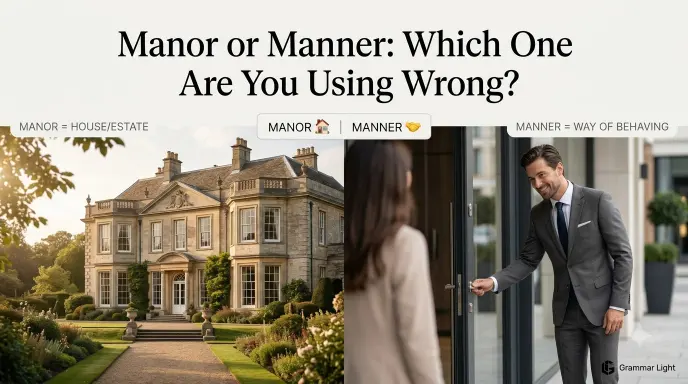
“Manor” and “manner” are both correct English words, but they have completely different meanings and uses. “Manor” usually refers to a large country house or an estate, while “manner” refers to the way something is done or the way someone behaves.
People often search for “manor or manner” because the two words look and sound somewhat similar, making them easy to confuse in writing. The difference becomes especially important in phrases such as “in a manner of speaking” and “manor house,” where using the wrong word changes the meaning entirely.
This guide explains the meanings, pronunciation, spelling, examples, common mistakes, and practical differences between manor and manner so you can choose the correct word confidently.
Manor or Manner Quick Answer
Use “manor” for a large country house, estate, or historical landed property. Use “manner” for the way something is done, a person’s behavior, or a particular style.
Examples:
- The family lives in an old manor.
- She spoke in a polite manner.
- The historic manor attracts many visitors.
- He handled the situation in a professional manner.
The simplest way to remember the difference is:
Manor = property or estate
Manner = way or behavior
What Does Manor Mean?
“Manor” is a noun that traditionally refers to a large country house together with the land or estate surrounding it.
The word is strongly associated with historical English estates and landownership. Today, it can also describe a large or impressive country residence.
Manor as a Property
A manor may include a large house, gardens, farmland, and other surrounding property.
For example:
The old manor stood on a hill overlooking the village.
Another example:
Tourists visited the historic manor during their trip.
In these sentences, “manor” refers to a place or property, not a way of doing something.
Manor House
The phrase “manor house” refers to the principal house associated with a manor or estate.
Example:
The manor house was built several centuries ago.
This is one of the most common expressions containing “manor.”
What Does Manner Mean?
“Manner” means the way something is done, the way someone behaves, or a particular style of doing something.
Unlike “manor,” it is usually connected with behavior, method, style, or conduct.
Manner as a Way of Doing Something
For example:
She completed the task in a careful manner.
Here, “manner” means way.
You could think of the sentence as:
She completed the task in a careful way.
The meaning remains essentially the same.
Manner as Behavior
“Manner” can also describe how someone behaves toward other people.
For example:
He has a friendly manner.
This means that his behavior or way of interacting with people is friendly.
Another example:
Her polite manner impressed the guests.
Here, “manner” refers to her behavior.
Manor vs Manner: Basic Difference
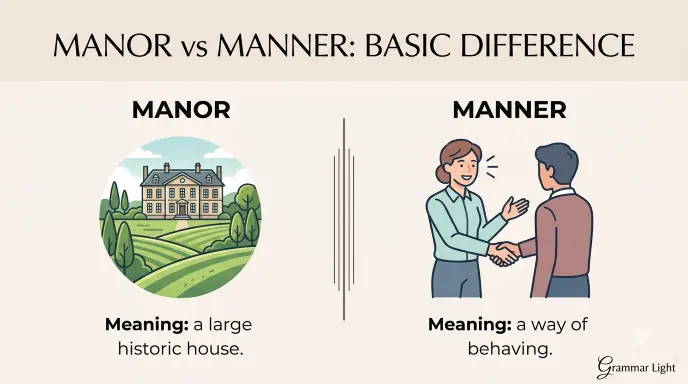
The easiest distinction is that manor is a place or estate, while manner is a way, style, or behavior.
| Word | Meaning | Example |
| Manor | Large country house or estate | They visited an old manor. |
| Manner | Way, method, style, or behavior | He spoke in a calm manner. |
The words may sound similar, but their meanings are unrelated in modern everyday English.
A Simple Memory Trick
Remember:
Manor → Mansion / property
Manner → Method / behavior
The words mansion and manor both relate to property, while method and manner can both describe a way of doing something.
Manor or Manner in a Sentence
Using the correct word depends entirely on what you mean.
If you are talking about a house, estate, or property, use manor.
The historic manor was surrounded by gardens.
If you are talking about a way, style, or behavior, use manner.
She answered the question in a respectful manner.
More Examples
Manor:
- The family purchased a beautiful manor.
- We explored the ancient manor.
- The manor house has impressive architecture.
Manner:
- He spoke in a confident manner.
- She completed the work in a professional manner.
- His calm manner helped everyone relax.
British English vs American English: Manor and Manner
“Manor” keeps the same spelling in both British and American English, while “manner” also keeps the same spelling; the difference is in their meaning and use, not regional spelling.
The two words can appear in both varieties of English without changing their spelling. However, their meanings remain completely different, so context is important.
Manor in British English
In British English, manor is commonly associated with a large country house, estate, or historic property.
Example:
The old manor has been preserved for generations.
The word can also appear in historical discussions about land and estates.
Manor in American English
American English also uses manor for a large or impressive residence, estate, or property.
Example:
The family purchased a historic manor in the countryside.
Although the historical background may differ, the basic meaning remains the same.
Manner in Both Varieties
Manner has essentially the same meaning in British and American English.
It can describe:
- the way something is done
- someone’s behavior
- a particular style
- a method of acting or speaking
For example:
He explained the situation in a calm manner.
This sentence works naturally in both varieties of English.
Manor House vs Manner of Speaking
“Manor house” refers to a property, while “manner of speaking” refers to someone’s way of expressing themselves.
These phrases are useful because they make the difference easy to remember.
Manor House
A manor house is a large country residence traditionally connected with an estate.
Example:
The historic manor house attracts visitors every year.
Here, “manor” describes a physical place.
Manner of Speaking
“Manner of speaking” means someone’s particular way of expressing something.
Example:
In his manner of speaking, he sounded very confident.
Here, “manner” refers to style or behavior.
The phrases may look similar when written quickly, but their meanings are entirely different.
In a Manner vs In a Manor
“In a manner” means in a particular way, while “in a manor” would literally mean inside or within a manor and is only appropriate when referring to a physical property.
For example:
She answered the question in a polite manner.
This means she answered it politely.
By contrast:
They stayed in a historic manor.
This means they stayed inside a large historic residence.
A common spelling mistake is writing “in a manor” when the intended phrase is “in a manner.”
Manner of or Manor of?
Use “manner of” when you mean a way or style, while “manor of” generally refers to a manor or estate associated with something.
Examples of manner of:
His manner of speaking was very formal.
I disliked her manner of treating the guests.
Examples involving manor:
The history of the manor is fascinating.
The estate was once known as the manor of the local lord.
The phrase “manner of” is much more common in everyday writing because it frequently introduces a way of doing or expressing something.
How to Remember Manor vs Manner
Remember “manor” as a place and “manner” as a way.
A simple memory trick is:
Manor = house or estate
Manner = way or behavior
You can also connect manner with method. Both words can describe how something is done.
For example:
He completed the task in a careful manner.
Think:
Manner = method = way
For manor, think:
Manor = mansion = property
This simple association can help prevent the two words from being confused.
Common Mistakes With Manor and Manner
The most common mistake is using “manor” when the sentence actually needs “manner,” or using “manner” when the sentence is describing a house or estate.
Because the words look and sound similar, writers sometimes select the wrong one without noticing. Checking the meaning of the sentence usually makes the correct choice clear.
Mistake 1: Using Manor for Behavior
Incorrect:
She spoke in a polite manor.
Correct:
She spoke in a polite manner.
The sentence describes how she spoke, so “manner” is required.
Mistake 2: Using Manner for a Property
Incorrect:
They visited an old manner in England.
Correct:
They visited an old manor in England.
The sentence describes a historic property, so “manor” is correct.
Mistake 3: Confusing “Manner” With “Manor House”
A manor house is a type of residence or estate.
Example:
The family restored the old manor house.
You should not replace “manor” with “manner” because the sentence refers to a physical property.
Manor and Manner Pronunciation
“Manor” and “manner” are pronounced almost identically in standard English, which is one reason they are easy to confuse.
In many varieties of English, both words are pronounced approximately like “MAN er.”
The spelling, however, does not tell you the meaning.
Manor Pronunciation
Manor is commonly pronounced:
MAN er
Example:
The historic manor was open to visitors.
Manner Pronunciation
Manner is also commonly pronounced:
MAN er
Example:
His friendly manner made everyone comfortable.
Since the pronunciation is so similar, learning the meaning and spelling is more useful than trying to distinguish the words by sound alone.
Manor vs Manner in Everyday English
“Manner” is much more common in everyday expressions, while “manor” is usually connected with property, estates, architecture, or history.
You are likely to encounter manner in phrases such as:
- in a polite manner
- in a professional manner
- manner of speaking
- manner of behavior
- in this manner
“Manor” commonly appears in phrases such as:
- manor house
- country manor
- historic manor
- manor estate
- old manor
Everyday Examples
Please respond in a respectful manner.
The historic manor is open to the public.
She has a cheerful manner.
They bought a large manor.
The context makes the intended meaning clear.
Is Manor a Synonym for Mansion?
Manor and mansion can overlap in meaning, but they are not exact synonyms.
A mansion generally means a large, impressive house. A manor traditionally refers to an estate or large country house, often with historical associations.
For example:
The wealthy family lived in a huge mansion.
A different sentence might be:
The historic manor included extensive surrounding land.
The words can describe similar looking properties in some contexts, but manor carries a more specific historical and estate related sense.
Is Manner the Same as Way?
“Manner” can often mean “way,” especially when describing how something is done or how someone behaves.
For example:
He completed the work in a careful manner.
This can be rewritten as:
He completed the work in a careful way.
Similarly:
She spoke in a friendly manner.
means:
She spoke in a friendly way.
However, “manner” can sound more formal than the everyday word way, especially in professional or formal writing.
FAQs
What is the difference between manner and manor?
Manner means a way, method, style, or type of behavior, while manor refers to a large country house, estate, or historic property.
What does “manor” mean?
“Manor” means a large country house or estate, traditionally associated with surrounding land and property.
Example:
The historic manor attracts visitors every year.
Is it timely manner or manor?
The correct expression is “in a timely manner.”
It means doing something within a suitable or expected amount of time.
Example:
Please complete the application in a timely manner.
“Timely manor” is incorrect in this context.
What does “manner” mean?
“Manner” means the way something is done or the way someone behaves.
Example:
She answered the question in a polite manner.
It can often be replaced by the word “way.”
How to use manor in a sentence?
Use “manor” when talking about a large house, estate, or historic property.
Examples:
The family lived in an ancient manor.
We visited a beautiful country manor.
The old manor house was surrounded by gardens.
Which is correct, “manner” or “manners”?
Both are correct, but they have different uses.
Manner is usually singular and refers to a way, style, or type of behavior.
She spoke in a calm manner.
Manners usually refers to socially accepted ways of behaving, especially politeness.
The children were taught good manners.
So, use manner for a way or style and manners for behavior and etiquette.
Practical Conclusion
“Manor” and “manner” are easy to confuse because they sound similar, but their meanings are completely different.
Use manor when talking about a large house, estate, or historic property. Use manner when referring to a way of doing something, a style, or someone’s behavior.
A simple reminder is:
Manor = property
Manner = way or behavior
Remembering this distinction will help you avoid common mistakes such as writing “timely manor” instead of the correct phrase “in a timely manner.”
LEARN MORE!

I’m a grammar writer focused on making English rules, word usage, and sentence structure simple and easy to understand.






7 thoughts on “Manor or Manner: Which One Are You Using Wrong?”