
Hopped or hoped are both correct English words, but they have different meanings. Hopped is the past tense of hop, meaning to jump on one or both feet or make a short jump. Hoped is the past tense of hope, meaning to want something to happen or believe that something good may happen.
These words often confuse English learners because they differ by only one letter, yet their pronunciation and meanings are different. For example, “She hopped over the puddle” describes a physical action, while “She hoped for good news” expresses a wish or expectation.
Understanding the difference between hopped or hoped helps you avoid spelling mistakes in school assignments, emails, stories, and everyday writing. The distinction also becomes easier when you learn how the final consonant changes in each word. The verb hop doubles its final p when forming hopped, while hope drops its final silent e before adding ed to form hoped.
This guide explains their meanings, spelling rules, pronunciation, and practical uses so you can confidently choose the correct word in any sentence.
Hopped or Hoped : Quick Answer
Hopped means jumped, while hoped means wished or expected something good to happen.
- Hopped: The rabbit hopped across the grass.
- Hoped: I hoped you would visit.
- Hopped: The child hopped on one foot.
- Hoped: We hoped for better weather.
Both words describe actions or states in the past, but they are used in different situations.
| Word | Meaning | Example |
| Hopped | Jumped or moved with a hop | The frog hopped into the pond. |
| Hoped | Wished or expected | She hoped to win the prize. |
A quick memory tip: hopped has a double “p” for the jumping action, while hoped has one “p” and comes from hope.
Definition and Meaning of Hoped and Hopped
Although these words look similar, they come from different verbs. Their meanings depend on the action or feeling being described.
What Does Hopped Mean?
Hopped is the simple past tense and past participle of hop. It describes jumping lightly or making a short movement, often on one foot or with a quick upward motion.
Examples:
- The frog hopped onto a rock.
- He hopped over the small fence.
- She hopped on one foot during the game.
- The bird hopped along the path.
The word can also be used informally to describe moving quickly from one place or activity to another. For example, “We hopped from one café to another” means we visited different cafés in succession.
What Does Hoped Mean?
Hoped is the simple past tense and past participle of hope. It expresses a wish, desire, or expectation about something that may happen.
Examples:
- I hoped to see you yesterday.
- They hoped for a positive result.
- She hoped that everything would be fine.
- We hoped to finish the project early.
Unlike hopped, hoped does not describe physical jumping. It expresses a person’s thoughts, wishes, or expectations.
Are Hopped and Hoped Interchangeable?
No. These words cannot normally replace each other because their meanings are different.
Incorrect: I hopped to get good news.
Correct: I hoped to get good news.
Incorrect: The rabbit hoped across the garden.
Correct: The rabbit hopped across the garden.
Use hopped for jumping or quick physical movement. Choose hoped when describing a wish or expectation.
The Origin of Hopped and Hoped
Both words developed from common English verbs, but their spelling follows different patterns.
Origin of Hopped
Hopped comes from the verb hop, which has long been used to describe a short jump or bouncing movement. In standard English spelling, a one syllable verb ending in a single consonant after a short vowel often doubles that consonant before adding ed.
Therefore:
- Hop → Hopped
- Stop → Stopped
- Plan → Planned
Doubling the final consonant helps preserve the short vowel pronunciation in the past tense form.
Origin of Hoped
Hoped comes from hope, a verb expressing desire or expectation. When a verb ends in a silent e, that final e is usually dropped before adding ed.
Therefore:
- Hope → Hoped
- Smile → Smiled
- Dance → Danced
The final e is removed before the ending is added, leaving the correct spelling hoped.
Hopped vs. Hoped: The Main Difference
The main difference is both meaning and spelling. Hopped describes a jump or short movement, whereas hoped describes a wish or expectation.
Compare these examples:
- The boy hopped over a puddle.
- The boy hoped the rain would stop.
In the first sentence, the boy performs a physical action. In the second, he wants a particular outcome.
The spelling rules also distinguish the words. Hop becomes hopped because the final consonant is doubled. Hope becomes hoped because the silent e is removed before adding ed.
Remembering both the meaning and the spelling pattern makes it easier to select the correct word when writing.
Hopped or Hoped in Everyday Examples
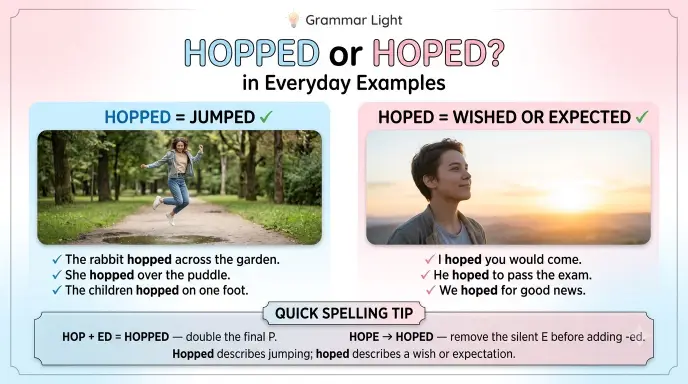
These words appear in different types of everyday communication.
Examples of Hopped
- The puppy hopped onto the sofa.
- She hopped across the stepping stones.
- He hopped into the car.
- The little bird hopped between branches.
- We hopped on the bus at the next stop.
Examples of Hoped
- I hoped you had a wonderful birthday.
- She hoped to pass her exam.
- They hoped for a peaceful evening.
- He hoped his friend would arrive soon.
- We hoped the shop would still be open.
The context usually makes the intended meaning clear. If the sentence describes jumping or movement, hopped is likely correct. If it describes a wish or expectation, hoped is the better choice.
Common Spelling Mistakes With Hoped and Hopped
Writers sometimes confuse these words because their base forms look alike. Learning the correct spelling patterns can prevent these errors.
Mistake 1: Writing “Hoped” for a Jump
Incorrect: The frog hoped into the water.
Correct: The frog hopped into the water.
The sentence describes a jumping action, so hopped is correct.
Mistake 2: Writing “Hopped” for a Wish
Incorrect: I hopped you would call me.
Correct: I hoped you would call me.
The sentence expresses an expectation, so hoped is correct.
Mistake 3: Forgetting the Double P
Incorrect: The child hoped over the puddle.
Correct: The child hopped over the puddle.
When forming the past tense of hop, double the p before adding ed.
Mistake 4: Adding an Extra P to Hope
Incorrect: I hoppped to see you.
Correct: I hoped to see you.
The past tense of hope is hoped, with one p. The silent e is removed before adding ed.
Hopped or Hoped: Which One Should You Use?
Choose the word according to what you want to communicate.
Use hopped when describing a jump, a bouncing movement, or an informal quick change from one place to another.
Use hoped when describing a wish, desire, or expectation about something.
For example:
- “The rabbit hopped away” describes movement.
- “I hoped the rabbit would return” describes an expectation.
- If you are unsure, identify the base verb first. If the verb is hop, its past tense is hopped. If the verb is hope, its past tense is hoped.
Hopped or Hoped in Different Situations
The correct choice between hopped and hoped depends on the situation being described. One word refers to movement, while the other expresses a wish or expectation.
In Stories and Narratives
Writers often use hopped to describe the movements of animals, children, or other characters.
Examples:
- The rabbit hopped through the garden.
- The little boy hopped across the stones.
- A bird hopped onto the windowsill.
Hoped is useful when a character wants something to happen.
Examples:
- She hoped the mysterious visitor would return.
- He hoped to find a hidden treasure.
- They hoped the journey would be safe.
In Everyday Conversations
Both words are common in spoken English, but they communicate different ideas.
Examples:
- “I hopped off the bus at the next stop.”
- “I hoped you would come to the party.”
- “We hopped between shops looking for a gift.”
- “I hoped the shop would have what I needed.”
The surrounding words help identify the intended meaning.
Hopped or Hoped: Pronunciation Differences
- Hopped and hoped have different vowel sounds, even though their spellings differ by only one letter.
- Hopped is pronounced with a short “o” sound, similar to the vowel in “hot” in many English accents.
Hoped has a long “o” sound, similar to the vowel in “hope” or “rope.”
The final ed in both words is pronounced as a /t/ sound, so both typically end with a sound similar to “t.”
Try saying these pairs aloud:
- Hopped :stopped
- Hoped : roped
- Hopped over the fence.
- Hoped for good news.
Practicing these words in complete sentences can help you hear the difference and remember the correct spelling.
Hopped or Hoped in Different Tenses
Understanding the base verbs makes it easier to use their forms correctly.
Forms of Hop
| Verb form | Example |
| Present | I hop over the line. |
| Past | I hopped over the line. |
| Present participle | I am hopping over the line. |
| Past participle | I have hopped over the line. |
The final p is doubled in hopped and hopping because of the spelling rule for short vowel verbs ending in a consonant.
Forms of Hope
| Verb form | Example |
| Present | I hope for good news. |
| Past | I hoped for good news. |
| Present participle | I am hoping for good news. |
| Past participle | I have hoped for the best. |
The silent e is dropped before adding ed or ing. That is why we write hoped and hoping, not “hopeed” or “hopeing.”
Practice: Choose Hopped or Hoped
Test your understanding with these sentences.
- The frog ______ into the pond.
- I ______ you enjoyed the trip.
- The child ______ on one foot.
- She ______ to receive good news.
- We ______ from one store to another.
Answers:
- Hopped
- Hoped
- Hopped
- Hoped
- Hopped
The first, third, and fifth sentences describe movement. The second and fourth express wishes or expectations.
FAQs About Hopped or Hoped
Q.1 What Is the Difference Between Hopped and Hoped?
Hopped is the past tense of hop, meaning to jump or make a short movement. Hoped is the past tense of hope, meaning to wish for or expect something.
Q.2 Is Hopped a Correct Word?
Yes. Hopped is the correct past tense form of hop.
Example: “The rabbit hopped over the log.”
Q.3 Is Hoped a Correct Word?
Yes. Hoped is the correct past tense form of hope.
Example: “I hoped you would visit.”
Q.4 Why Does Hopped Have Two Ps?
The verb hop has a short vowel followed by a single final consonant. In standard English spelling, the final consonant is doubled before adding ed, producing hopped.
Q.5 Why Does Hoped Have Only One P?
Hope already contains one p and ends in a silent e. The e is removed before adding ed, producing hoped.
Q.6 How Do You Pronounce Hopped and Hoped?
Hopped has a short vowel sound, while hoped has a long “o” sound. The final ed is usually pronounced /t/ in both words.
Q.7 Can Hopped Mean Moving Quickly Between Places?
Yes. Informally, hopped can describe moving quickly or making short visits between locations.
Example: “We hopped between cafés during our afternoon walk.”
Q.8 Which Word Should I Use in “I You Feel Better”?
Use hoped if you mean that you wished the person would feel better.
Correct: “I hoped you would feel better.”
You could also say, “I hope you feel better,” when expressing that wish in the present.
Final Thoughts
Hopped and hoped are both correct words, but they serve different purposes. Hopped describes jumping or quick movement, while hoped expresses a wish or expectation.
Remember the spelling rules: hop becomes hopped by doubling the p, while hope becomes hoped by removing the silent e before adding ed.
When writing, focus on the meaning of the sentence. If someone is jumping, choose hopped. If someone is wishing for a particular outcome, choose hoped. With regular practice, you can use both words confidently in everyday English.
CONTINUE READING!

I’m a grammar writer focused on making English rules, word usage, and sentence structure simple and easy to understand.