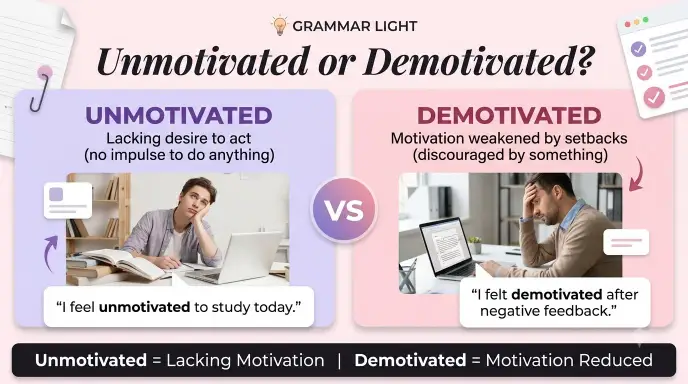
Unmotivated and demotivated both describe a lack of motivation, but they differ in the reason behind that feeling. Unmotivated generally means having little or no desire to do something, while demotivated usually means losing motivation because of discouragement, disappointment, stress, or other negative experiences.
People often search for unmotivated or demotivated because the words seem interchangeable in everyday English. Both can describe someone who struggles to study, complete work, achieve a goal, or maintain enthusiasm. However, the context can help you decide which word communicates your meaning more accurately.
For example, a student who never feels interested in studying might describe themselves as unmotivated. Another student who once enjoyed studying but lost enthusiasm after repeatedly receiving poor grades might feel demotivated.
Understanding this distinction can improve your vocabulary and make your writing more precise. It can also help you describe feelings in school, the workplace, relationships, and personal life without confusing a general lack of motivation with motivation that has been reduced by a particular experience.
This guide explains the meanings, differences, origins, everyday uses, and common mistakes associated with both words, with practical examples to help you choose the right expression.
Unmotivated or Demotivated : Quick Answer
Use unmotivated when someone lacks the desire or willingness to take action. Use demotivated when something has reduced or weakened their motivation.
Although both words can describe a person who does not feel motivated, the distinction is often about the cause or development of that feeling.
- Unmotivated: Lacking motivation, enthusiasm, or a strong reason to act.
- Demotivated: Having lost some motivation, often because of discouragement or an unpleasant experience.
Quick Examples
- Unmotivated: “I feel unmotivated to exercise today.” The speaker does not feel like exercising.
- Demotivated: “I felt demotivated after my manager criticized my work.” The criticism weakened the speaker’s motivation.
- Unmotivated: “He seems unmotivated to apply for new jobs.” He shows little desire to apply.
- Demotivated: “She became demotivated after several unsuccessful interviews.” Repeated setbacks reduced her enthusiasm.
Remember that these meanings overlap. Someone can be demotivated and therefore appear unmotivated. The surrounding context helps communicate the intended meaning.
Definition and Meaning of Unmotivated or Demotivated
What Does Unmotivated Mean?
Unmotivated is an adjective describing someone who lacks motivation, enthusiasm, or the desire to do something.
The word does not necessarily explain why a person feels this way. The cause might be boredom, tiredness, uncertainty, a lack of interest, or difficulty identifying a meaningful goal.
For example:
“I am unmotivated to clean my room today.”
This sentence means the speaker does not currently feel the desire or enthusiasm to clean. It does not tell us if something caused that feeling.
Other examples include:
- “The unmotivated student rarely participates in class.”
- “I felt unmotivated to start my new project.”
- “He seemed unmotivated during the training session.”
In each example, unmotivated describes a lack of motivation without necessarily identifying its cause.
What Does Demotivated Mean?
Demotivated is an adjective describing someone whose motivation has decreased or been weakened.
The word often suggests that something has contributed to the change. This could be repeated failure, criticism, a lack of recognition, disappointment, or an environment that makes effort feel unrewarding.
For example:
“Employees became demotivated after their hard work went unrecognized.”
The sentence suggests that the employees’ motivation weakened because their efforts were not acknowledged.
More examples include:
- “She felt demotivated after failing the examination.”
- “Constant criticism left him demotivated.”
- “The team became demotivated when the project was repeatedly delayed.”
The emphasis is on reduced enthusiasm or willingness, often following a discouraging experience.
What Is the Main Difference Between Unmotivated and Demotivated?
The main difference is the emphasis each word places on motivation.
Unmotivated describes a lack of motivation, while demotivated emphasizes motivation that has decreased or been undermined.
| Feature | Unmotivated | Demotivated |
| Basic meaning | Lacking motivation | Having reduced motivation |
| Main emphasis | Current lack of desire | A decline in enthusiasm |
| Cause implied? | Not necessarily | Often, but not always |
| Common context | Boredom, low interest, uncertainty | Criticism, setbacks, disappointment |
| Example | “I feel unmotivated to study.” | “I feel demotivated after failing.” |
These are useful distinctions rather than absolute rules. English speakers sometimes use the words interchangeably, especially in casual conversation.
Can Someone Be Both Unmotivated and Demotivated?
Yes. A person can be both unmotivated and demotivated, depending on the circumstances.
For example, someone who experiences repeated rejection while searching for a job may gradually lose enthusiasm. They might then describe themselves as demotivated because of the rejections and unmotivated to submit further applications.
The first word can emphasize the current state, while the second highlights the decline that led to it.
The best word depends on what you want to emphasize: the lack of motivation itself or the experience that weakened it.
The Origin of Unmotivated and Demotivated
Understanding how these words are formed can make their meanings easier to remember.
The Origin of Unmotivated
The word unmotivated combines the prefix un , the word motivate, and the suffix ed.
- Un : A prefix commonly used to express negation or the absence of something.
- Motivate: To provide a reason, encouragement, or desire to act.
- ed: A suffix that helps form the adjective motivated.
When un is added to motivated, the result is unmotivated, meaning not motivated or lacking motivation.
For example, an unmotivated employee may have little enthusiasm for a task, but the word alone does not tell us why.
The Origin of Demotivated
The word demotivated combines the prefix de , the word motivate, and the suffix ed.
The prefix de can indicate reversal, removal, or reduction. In demotivated, it conveys the idea of motivation being reduced or undermined.
For example, a worker who loses enthusiasm after repeated disappointment may feel demotivated.
The prefix provides a helpful clue: unmotivated emphasizes the absence of motivation, while demotivated often emphasizes a reduction in motivation.
Why Do the Words Sound Similar?
Both words share the root motivate and the ending ed. Their similar structure explains why they are often confused.
However, their prefixes contribute different shades of meaning.
- Un points toward a lack of motivation.
- De suggests a reduction or weakening of motivation.
This distinction is useful for understanding both words, although actual usage can overlap.
British English vs. American English
Unlike words such as colour and color, unmotivated and demotivated do not have different standard spellings in British and American English.
Both forms are used in the United Kingdom, the United States, and other English speaking regions. The difference lies mainly in meaning and context, not regional spelling rules.
| Context | British English | American English |
| Lacking motivation | Unmotivated | Unmotivated |
| Motivation reduced by setbacks | Demotivated | Demotivated |
| Discouraged by criticism | Demotivated | Demotivated |
| Showing little interest | Unmotivated | Unmotivated |
For example, a British writer might say, “The students felt demotivated after the disappointing results.” An American writer could use exactly the same sentence.
There may be regional preferences in particular settings, but neither word is restricted to one variety of English.
Which Word Should You Use?
Choose unmotivated when you want to describe a general lack of motivation without emphasizing its cause.
Choose demotivated when you want to highlight a decline in motivation, particularly after a discouraging event.
For an international audience, either word is appropriate when used in the right context. Focus on the intended meaning rather than trying to select a British or American spelling.
Common Mistakes With Unmotivated or Demotivated
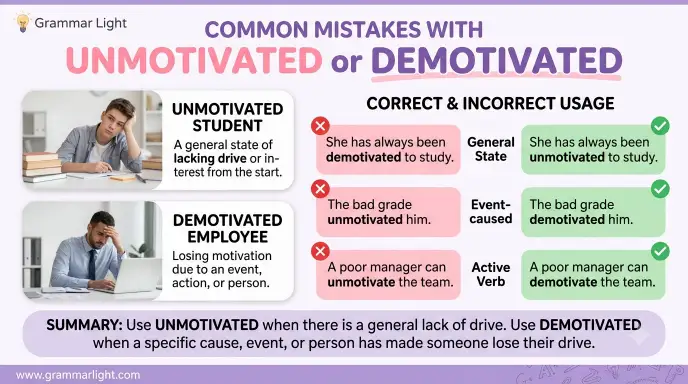
Mistake 1: Treating the Words as Completely Identical
Although the meanings overlap, the words can communicate different ideas.
Incorrect assumption: “Unmotivated and demotivated always mean exactly the same thing.”
Better understanding: Unmotivated describes a lack of motivation, while demotivated often suggests that motivation has weakened.
Mistake 2: Using Demotivated Without Considering Context
The word demotivated is especially useful when motivation has declined. However, the sentence should make sense in context.
Example: “After weeks of rejection, he felt demotivated.”
This works because the repeated rejection provides a reason for the decline in motivation.
Mistake 3: Assuming Unmotivated Means Lazy
Being unmotivated does not automatically mean someone is lazy.
A person might lack motivation because of uncertainty, exhaustion, stress, a lack of support, or a task that seems meaningless. The adjective describes motivation, not a person’s entire character.
Mistake 4: Assuming Demotivated Always Requires an External Cause
Demotivation is often associated with criticism or setbacks, but the word does not require a specific external event to be mentioned.
For example, “I have felt demotivated lately” is grammatically correct even if the speaker does not explain why.
Mistake 5: Using the Wrong Word in Professional Writing
In workplace communication, the distinction can help describe a problem more precisely.
- “The employee seems unmotivated to take on additional responsibilities.” This emphasizes a current lack of willingness.
- “The employee became demotivated after repeated changes to the project.” This emphasizes a decline in enthusiasm.
Choosing the more precise word can make your message clearer without making assumptions about someone’s personality.
Unmotivated or Demotivated in Everyday Examples
Both words appear in education, work, personal goals, and everyday conversations. The following examples show how context affects the choice.
In Education
Unmotivated: “I feel unmotivated to revise for my examination.”
The student lacks enthusiasm for studying.
Demotivated: “I became demotivated after receiving a poor grade despite studying hard.”
The disappointing result weakened the student’s motivation.
In the Workplace
Unmotivated: “The employee seems unmotivated to begin the new assignment.”
The sentence describes a lack of enthusiasm for the task.
Demotivated: “The team felt demotivated after management ignored their suggestions.”
The team’s motivation declined following a discouraging experience.
In Personal Life
Unmotivated: “I have been unmotivated to exercise this week.”
The speaker is describing a current lack of desire to exercise.
Demotivated: “I felt demotivated after missing my fitness goals several times.”
The repeated setbacks weakened the speaker’s enthusiasm.
In Emails
Unmotivated: “I have been feeling unmotivated about the project and would appreciate some guidance on how to move forward.”
This communicates a lack of enthusiasm and asks for support.
Demotivated: “Recent setbacks have left the team feeling demotivated, so I would like to discuss ways to rebuild morale.”
This highlights a decline in motivation and suggests a constructive next step.
In Everyday Conversation
Unmotivated: “I do not know why, but I feel unmotivated today.”
The speaker describes a general feeling without identifying a cause.
Demotivated: “I was excited about the competition, but losing the first round left me demotivated.”
The speaker explains how an experience affected their motivation.
These examples show that unmotivated focuses on the lack of motivation, while demotivated often draws attention to motivation that has decreased. Both are correct when they accurately express the intended meaning.
Unmotivated vs. Demotivated: Which Word Is More Appropriate?
Choosing between unmotivated and demotivated depends on the situation you want to describe. Both words are correct, but one may communicate your meaning more clearly than the other.
Use Unmotivated for a General Lack of Motivation
Choose unmotivated when someone has little desire, interest, or enthusiasm for an activity. You do not need to explain why the person feels that way.
Examples:
- “I feel unmotivated to complete my assignments.”
- “He seems unmotivated to pursue his career goals.”
- “The students were unmotivated during the afternoon lesson.”
In these sentences, the focus is on the person’s current state rather than a particular event that caused it.
Use Demotivated for Reduced Motivation
Choose demotivated when you want to emphasize that someone’s motivation has weakened. This often happens after disappointment, repeated setbacks, criticism, or a lack of encouragement.
Examples:
- “She became demotivated after failing the interview.”
- “The employees felt demotivated when their efforts went unnoticed.”
- “He was demotivated by the constant changes in the project.”
Here, the word highlights a decline in enthusiasm or willingness to continue.
Can You Replace One Word With the Other?
Sometimes, yes. In casual conversation, both words can describe someone who does not feel motivated.
For example:
“I feel unmotivated to study.”
“I feel demotivated about studying.”
Both sentences are understandable, but the second may suggest that the speaker’s motivation has weakened. The first simply describes a lack of motivation.
Writing tip: When the reason for the loss of motivation matters, demotivated may be more precise. When you are describing a general state, unmotivated is often the clearer choice.
Unmotivated or Demotivated: Examples in Different Situations
The context can help you choose the most suitable word. Here are additional examples from common situations.
At School or University
A student might feel unmotivated when a subject seems uninteresting or difficult. Another student might become demotivated after receiving disappointing results despite making a serious effort.
- Unmotivated: “Daniel felt unmotivated to attend his extra classes.”
- Demotivated: “Daniel became demotivated after repeatedly failing his mathematics tests.”
The first example describes a lack of enthusiasm. The second highlights a decline in motivation associated with repeated disappointment.
At Work
Motivation can change because of workload, management decisions, recognition, or workplace conditions.
- Unmotivated: “The new employee appeared unmotivated to learn the company’s procedures.”
- Demotivated: “The staff became demotivated after several months without feedback.”
The choice of adjective helps communicate if you are describing a general lack of motivation or a decline that developed over time.
During Exercise and Fitness
Personal goals can also illustrate the difference.
- Unmotivated: “I feel unmotivated to go to the gym this morning.”
- Demotivated: “I became demotivated after seeing little progress despite following my workout plan.”
The first sentence describes how the speaker feels today. The second connects the loss of motivation to a disappointing experience.
While Learning a New Skill
Learning a language, playing an instrument, or developing a professional skill requires consistent effort.
- Unmotivated: “She felt unmotivated to practise the piano.”
- Demotivated: “She became demotivated when she struggled to improve after weeks of practice.”
Both sentences describe difficulty maintaining enthusiasm, but the second emphasizes the effect of slow progress.
Synonyms of Unmotivated and Demotivated
Although the two words overlap, their synonyms can express slightly different shades of meaning. Choosing an appropriate alternative can make your writing more natural and specific.
Synonyms for Unmotivated
| Synonym | Meaning | Example |
| Apathetic | Showing little interest or concern | He seemed apathetic about the proposal. |
| Unenthusiastic | Lacking excitement or eagerness | She was unenthusiastic about the meeting. |
| Disinterested | Not interested in something | They appeared disinterested in the activity. |
| Inactive | Not taking action or participating | He remained inactive during the discussion. |
| Reluctant | Unwilling or hesitant to act | She was reluctant to accept the offer. |
These words are not exact replacements in every sentence. For example, reluctant emphasizes unwillingness, whereas unmotivated focuses on a lack of motivation.
Synonyms for Demotivated
| Synonym | Meaning | Example |
| Discouraged | Having lost confidence or enthusiasm | He felt discouraged after the rejection. |
| Disheartened | Having lost hope or confidence | She was disheartened by the results. |
| Dispirited | Feeling less cheerful or hopeful | The team felt dispirited after the defeat. |
| Disillusioned | Disappointed after discovering reality differs from expectations | He became disillusioned with the process. |
| Uninspired | Lacking fresh ideas or enthusiasm | She felt uninspired by the assignment. |
Important distinction: Discouraged and disheartened can be particularly useful when a negative experience has reduced someone’s motivation. However, the best synonym depends on the precise meaning and tone you want to convey.
Frequently Asked Questions About Unmotivated or Demotivated
Q.1 Is unmotivated or demotivated correct?
Both words are correct. Unmotivated describes a lack of motivation, while demotivated often describes motivation that has weakened. Choose the word that best matches your intended meaning and context.
Q.2 What is the main difference between unmotivated and demotivated?
The main difference is the emphasis. Unmotivated focuses on having little or no motivation, whereas demotivated often suggests that motivation has decreased because of discouragement, disappointment, or another experience.
Q.3 Is demotivated a real English word?
Yes. Demotivated is a recognized English word used to describe someone whose motivation has decreased or been undermined. It is commonly used in discussions about education, employment, personal goals, and performance.
Q.4 Does unmotivated mean lazy?
No. Being unmotivated does not automatically mean someone is lazy. A person may lack motivation because of fatigue, uncertainty, a lack of interest, stress, or other circumstances. The word describes their motivation rather than defining their character.
Q.5 Can I say that I feel demotivated?
Yes. “I feel demotivated” is grammatically correct and natural. It communicates that your motivation has weakened or that you are struggling to maintain enthusiasm. For example, “I feel demotivated after several unsuccessful attempts.”
Q.6 What is the opposite of unmotivated?
Possible opposites include motivated, enthusiastic, driven, and eager. The most appropriate choice depends on the sentence. For example, “She is motivated to succeed” directly contrasts with “She is unmotivated to continue.”
Q.7 What is the opposite of demotivated?
The most direct opposite is motivated. Depending on the context, encouraged, inspired, and reinvigorated may also express the opposite idea. For example, “Positive feedback left the team feeling motivated again.”
Q.8 Which word is better for a workplace?
Both words are appropriate in professional communication. Use unmotivated to describe a general lack of enthusiasm and demotivated when highlighting a decline in motivation. When discussing an employee, describe observable behavior and relevant circumstances rather than making unsupported assumptions.
Q.9 Are unmotivated and demotivated interchangeable?
They can be interchangeable in some informal contexts, but they are not always identical in meaning. Unmotivated describes the state of lacking motivation, while demotivated often emphasizes that motivation has diminished.
Q.10 Is demotivated British or American English?
Demotivated is used in both British and American English. The spelling is the same in both varieties. Unmotivated is also standard in both, so the choice depends on meaning rather than regional spelling.
Final Thoughts
Understanding the difference between unmotivated and demotivated helps you describe motivation more accurately. Although both words can refer to a lack of enthusiasm, they often emphasize different aspects of the experience.
Use unmotivated when someone lacks the desire or willingness to act. Use demotivated when their motivation has decreased or been weakened.
For example, a student who has little interest in studying may feel unmotivated. A student who loses enthusiasm after repeated disappointing results may feel demotivated.
The distinction is not absolute, and everyday English sometimes uses the terms interchangeably. Still, considering the context will help you select the clearest word for emails, school assignments, workplace discussions, and everyday conversations.
With practice, you can use both words naturally and communicate your intended meaning with greater precision.
SEE MORE!

I’m a grammar writer focused on making English rules, word usage, and sentence structure simple and easy to understand.