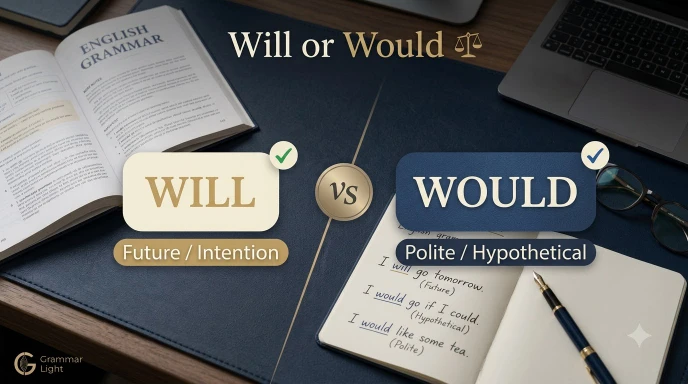
Will and would are both correct English words, but they are used in different situations. Will commonly expresses future actions, decisions, promises, or willingness, while would is often used for hypothetical situations, polite requests, preferences, and reported speech. Because the two words are closely related, English learners often confuse them when choosing the right one in a sentence. Understanding their differences makes everyday communication much clearer.
People often search for “will or would” because both words can appear before a verb and sometimes seem interchangeable. However, replacing one with the other can change the meaning, tone, or time of a sentence.
For example, “I will help you” shows a clear intention or willingness, while “I would help you” can suggest a condition or hypothetical situation.
This guide explains will vs. would in simple English. It covers their meanings, grammatical roles, common uses, differences, and everyday examples. By the end, you will know when to use each word naturally in conversations, writing, requests, offers, and conditional sentences.
Will or Would : Quick Answer
Will is mainly used to talk about the future, decisions, promises, willingness, and predictions.
Would is commonly used for hypothetical situations, polite requests, preferences, reported speech, and actions that depend on a condition.
Examples With Will
- I will call you tomorrow.
- She will help us.
- They will arrive soon.
- I will finish the work tonight.
These sentences describe future actions, intentions, or predictions.
Examples With Would
- I would help you if I had more time.
- Would you like some coffee?
- She said she would call me.
- I would rather stay home.
The meaning changes depending on the context.
Definition and Meaning of Would or Will
What Does Will Mean?
Will is a modal auxiliary verb used to express future actions, decisions, promises, willingness, and predictions.
For example:
I will visit you tomorrow.
The sentence indicates an action expected to happen in the future.
Will can also show a decision made at the moment of speaking:
The phone is ringing. I will answer it.
Here, the speaker decides to answer the phone immediately.
What Does Would Mean?
Would is also a modal auxiliary verb. It has several uses, including hypothetical situations, polite requests, preferences, reported speech, and repeated actions in the past.
For example:
I would travel more if I had enough money.
The sentence describes a hypothetical situation rather than a definite future action.
Another example is:
Would you help me with this?
Here, would makes the request more polite.
Are Will and Would Related?
Yes. Would is historically related to will, and in traditional grammar, would is often described as the past form of will. However, modern English uses would for several purposes that are not simply about past time.
For example:
She said, “I will come.”
Reported speech:
She said that she would come.
The word changes from will to would because the statement is being reported from a past point of view.
When to Use Will
Will is useful in several common situations.
Future Actions
Use will when talking about something expected to happen in the future.
Examples:
I will see you tomorrow.
He will start his new job next week.
We will visit London next summer.
Promises
Will can express a promise or commitment.
Examples:
- I will never forget your kindness.
- I will help you with the project.
- I will be there on time.
These sentences show a strong intention to do something.
Quick Decisions
Use will when you make a decision while speaking.
Example:
I am hungry. I will make a sandwich.
The decision is made at that moment.
Predictions
Will can also be used to make predictions about the future.
Examples:
It will rain tonight.
She will probably win the competition.
Technology will continue to change our lives.
When to Use Would
Would has a wider range of uses and often creates a more hypothetical or polite tone.
Hypothetical Situations
Use would when describing something that could happen under a particular condition.
Example:
I would buy that car if I had enough money.
The speaker is not saying they will definitely buy it. The action depends on a condition.
Polite Requests
Would can make a request sound more polite.
Examples:
- Would you open the window?
- Would you help me with this box?
- Would you please wait here?
These requests are generally softer than direct commands.
Preferences
Would is commonly used with would rather to express a preference.
Examples:
I would rather stay home.
She would rather drink tea.
They would rather travel by train.
The structure would rather means that someone prefers one option over another.
Will vs. Would: The Main Difference
The simplest way to understand the difference is to look at certainty, conditions, time, and politeness.
| Will | Would |
| Often refers to the future | Often refers to hypothetical situations |
| Can express firm intentions | Can express conditional intentions |
| Used for promises | Used for polite requests |
| Used for predictions | Used for preferences |
| Can show willingness | Can show imagined results |
| Often sounds more direct | Often sounds softer or more indirect |
Compare these examples:
I will help you.
This sounds like a clear promise or intention.
I would help you if I could.
This expresses willingness, but the situation depends on a condition.
The difference is small in form but important in meaning.
Will or Would in Conditional Sentences
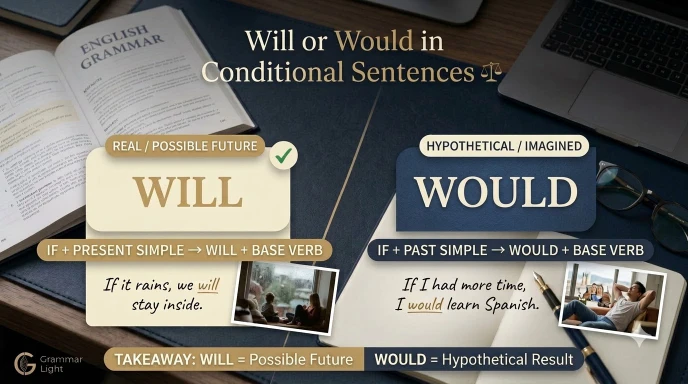
Conditional sentences are one of the most common places where learners encounter would.
First Conditional
The first conditional commonly uses will for a possible future result.
Example:
If it rains, we will stay home.
The speaker considers the condition realistically possible.
Second Conditional
The second conditional commonly uses would for hypothetical or unlikely situations.
Example:
If I won the lottery, I would buy a house.
The situation is imagined rather than presented as a definite future event.
Compare:
If I have enough money, I will buy the laptop.
This suggests a realistic future possibility.
If I had enough money, I would buy the laptop.
This presents a hypothetical situation.
Common Mistakes With Will and Would
One common mistake is using would whenever a sentence refers to the future.
Incorrect:
I would visit you tomorrow.
This can sound incomplete or unnatural if there is no context explaining a condition or another reason for using would.
Clearer:
I will visit you tomorrow.
Another mistake is using will in a hypothetical conditional result.
Less appropriate:
If I were rich, I will travel around the world.
Better:
If I were rich, I would travel around the world.
The second sentence correctly connects the hypothetical condition with would.
Will or Would in Everyday Conversation
Both words appear frequently in everyday English.
Making Offers
I will carry that bag for you.
This is a direct offer.
Making Polite Requests
Would you carry this bag for me?
This is a polite request.
Talking About Plans
I will call you after work.
This communicates a future intention.
Talking About Preferences
I would rather call you later.
This expresses a preference.
The surrounding context usually tells you which word fits best.
Will or Would: Which One Should You Use?
Choose will when you are talking about a future action, promise, prediction, decision, or clear intention.
Choose would when you are describing a hypothetical situation, making a polite request, expressing a preference, or reporting something from a past perspective.
A useful shortcut is:
Will = future or definite intention
Would = hypothetical, polite, preferred, or reported
Bilkul. Aap ke diye hue 6 FAQ questions ko Q.1 numbering ke saath add karke Part 2 dobara de rahi hoon. Baqi structure bhi natural rakha hai aur har answer ke baad small divider hai.
Will vs. Would in Reported Speech
One important difference between will and would appears in reported speech. When someone reports what another person said in the past, will often changes to would.
Direct Speech
Sarah said, “I will call you tomorrow.”
Reported Speech
Sarah said that she would call me the next day.
The original statement uses will because Sarah is speaking about the future from her point of view. When the statement is reported from a past perspective, would is commonly used.
Another example:
He said, “I will help you.”
Reported:
He said that he would help me.
This pattern is common in everyday English, formal writing, and storytelling.
Will or Would for Polite Language
Both words can express willingness, but would often sounds softer and more polite.
Compare:
Will you help me?
Would you help me?
Both sentences are correct. The second one generally sounds more courteous.
Will for Direct Requests
- Will can be used for direct requests.
- Will you close the door?
- Will you wait for me?
- Will you send me the file?
Would for Softer Requests
- Would is commonly used when you want to make a request sound more polite.
- Would you close the door?
- Would you wait for me?
- Would you send me the file?
The choice depends on the situation and the tone you want.
Will & Would for Offers and Invitations
- Will is often used for direct offers or promises.
- I will help you with your homework.
- I will carry your bags.
- I will make some tea.
- Would is especially common in polite invitations.
- Would you like some tea?
- Would you like to join us?
- Would you like to sit here?
The expression would you like is one of the most common polite structures in English.
Will and Would With If
The words will and would can both appear in conditional sentences, but they usually express different ideas.
Will for Real Future Possibilities
Use will when the condition describes a realistic future possibility.
- If you study hard, you will pass the exam.
- If she arrives early, we will start the meeting.
- If it rains, we will stay inside.
Would for Hypothetical Situations
Use would when the result is connected to an imagined or unlikely situation.
- If I had more time, I would learn Spanish.
- If he lived closer, he would visit us more often.
- If they knew the truth, they would understand.
The main difference is that will commonly describes a possible future result, while would often describes an imagined result.
Will or Would for Preferences
Would rather is commonly used to express a preference.
Examples:
I would rather stay home tonight.
She would rather drink coffee.
We would rather walk than take a taxi.
The basic structure is:
would rather + base verb
For example:
I would rather wait.
Not:
I would rather to wait.
After would rather, the main verb normally remains in its base form.
Will or Would for Repeated Past Actions
Would can sometimes describe actions that happened repeatedly in the past.
For example:
When we were children, we would play outside every evening.
This means playing outside was a repeated past activity.
Another example:
Every summer, my grandfather would take us fishing.
Here, would does not describe a hypothetical situation. It describes a repeated past habit.
Context is important because would has several different uses.
Will or Would in “Would Like”
One of the most common expressions with would is would like.
I would like a cup of coffee.
I would like to ask a question.
We would like to thank everyone for coming.
Would like is a polite way to express a present desire, request, or preference.
Compare:
I would like to visit Paris.
This expresses a desire.
I will visit Paris next year.
This expresses a future plan or intention.
The two sentences are not interchangeable.
How to Remember Will and Would
A simple way to remember the difference is to connect each word with its most common uses.
Remember Will
Think:
Future + Promise + Decision + Prediction
Examples:
- I will call you.
- I will help you.
- I will finish it tomorrow.
Remember Would
Think:
Hypothetical + Polite + Preference + Reported Speech
Examples:
I would help if I could.
Would you help me?
I would rather stay home.
She said she would come.
This shortcut can make the difference easier to remember.
FAQs About Will or Would
Q.1 When to use would or will?
Use will for future actions, predictions, promises, decisions, and willingness.
Use would for hypothetical situations, polite requests, preferences, reported speech, and some repeated past actions.
For example:
I will call you tomorrow.
I would call you if I had your number.
The first sentence describes a future intention. The second describes a hypothetical situation.
Q.2 Is it “I would love to” or “I will love to”?
“I would love to” is the natural expression when you want to say that you would be very happy or pleased to do something.
Example:
- I would love to help you.
- “I will love to” is generally not used for this meaning.
Q.3 Is it better to use would or will?
Neither word is always better. The correct choice depends on the meaning.
Use will for a definite future intention:
I will call you tonight.
Use would for a hypothetical situation:
I would call you if I had your number.
Use would for polite expressions:
Would you like some coffee?
The context determines which word is appropriate.
Q.4 Do we say “I will” or “I would”?
Both are correct, but they express different meanings.
I will help you.
This shows a clear intention or willingness.
I would help you if I could.
This shows willingness under a condition.
Another common use is:
I would love to help you.
Here, would makes the expression polite and natural.
Q.5 How do you use would?
Would has several common uses. It can describe hypothetical situations, polite requests, preferences, reported speech, and repeated past actions.
Examples:
I would travel more if I had more money.
Would you open the window?
I would rather stay home.
She said she would call.
When we were young, we would play outside.
The exact meaning depends on the sentence.
Q.6 What does “will” mean?
Will is a modal verb commonly used to talk about the future. It can also express promises, decisions, predictions, willingness, and offers.
Examples:
I will see you tomorrow.
I will help you.
She will probably arrive soon.
I will never forget this.
The meaning depends on the context, but its strongest everyday association is with future actions and intentions.
Q.7 Is “would” always the past of “will”?
No. Would can function as the past form of will in reported speech, but it has many other uses.
For example:
He said he would come.
Here, would relates to the past reporting context.
But:
Would you like some tea?
Here, would is being used to make a polite offer, not to describe past time.
Q.8 Which is correct: “I will go” or “I would go”?
Both can be correct.
I will go tomorrow.
This expresses a future plan or intention.
I would go if I had enough money.
This expresses a hypothetical situation.
The condition changes the meaning.
Final Thoughts
Will and would are both correct English words, but they serve different purposes. Will is commonly connected with future actions, promises, predictions, decisions, and willingness. Would is often used for hypothetical situations, polite requests, preferences, reported speech, and repeated past actions.
A useful rule is to think of will as more direct and future focused, while would is often more hypothetical, polite, or conditional. However, context always matters.
Once you understand these common patterns, choosing between will and would becomes much easier in both conversation and writing.
YOU MAY LIKE!

A writer with a strong interest in English grammar, spelling, and word usage. The focus is on researching commonly confused words and explaining the differences in a simple and easy to understand way.


1 thought on “Will or Would: Meaning, Difference, and Usage”