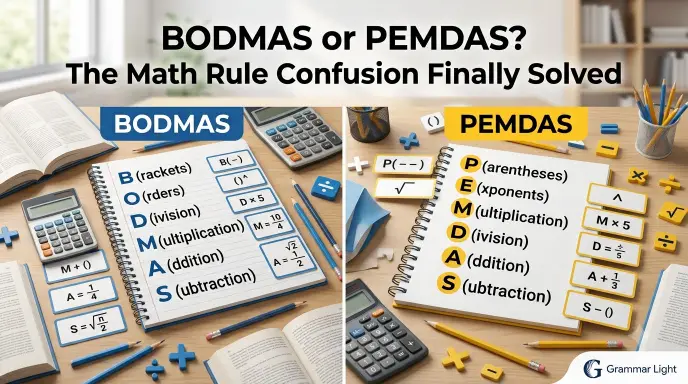
BODMAS and PEMDAS are two common ways to remember the correct order of mathematical operations.
Students often search for “BODMAS or PEMDAS” because different schools, textbooks, and countries may use different terms for the same basic rule. Seeing BODMAS in one place and PEMDAS in another can make the topic seem more complicated than it is.
BODMAS stands for Brackets, Orders, Division, Multiplication, Addition, and Subtraction. PEMDAS stands for Parentheses, Exponents, Multiplication, Division, Addition, and Subtraction.
The important point is that multiplication and division have the same priority. You normally solve them from left to right. Addition and subtraction also share the same priority.
For example:
6 + 4 × 2 = 14
First, multiply 4 × 2 to get 8. Then add 6 to get 14.
Understanding this rule helps students solve expressions correctly and avoid common mistakes caused by treating BODMAS or PEMDAS as a strict six-step sequence.
*BODMAS or PEMDAS : Quick Answer
BODMAS and PEMDAS describe essentially the same order of operations, but they use different words in their acronyms.
BODMAS means:
Brackets → Orders → Division → Multiplication → Addition → Subtraction
PEMDAS means:
Parentheses → Exponents → Multiplication → Division → Addition → Subtraction
The basic rule is:
Grouping symbols → Exponents/Orders → Multiplication and Division → Addition and Subtraction
Remember that multiplication and division are handled from left to right, rather than always doing multiplication before division.
Simple Example
8 + 2 × 3
First:
2 × 3 = 6
Then:
8 + 6 = 14
So, the correct answer is 14.
What Does BODMAS Mean?
BODMAS is a mnemonic that helps students remember the order in which mathematical operations are normally performed.
B : Brackets
Brackets group part of an expression that should be solved first.
Example:
5 × (2 + 3)
First:
2 + 3 = 5
Then:
5 × 5 = 25
O : Orders
Orders generally refer to powers, exponents, roots, and related operations.
Example:
2³ + 4
First:
2³ = 8
Then:
8 + 4 = 12
D : Division
Division is performed before addition and subtraction.
Example:
18 ÷ 3 + 2
First:
18 ÷ 3 = 6
Then:
6 + 2 = 8
M : Multiplication
Multiplication also comes before addition and subtraction.
Example:
7 + 3 × 2
First:
3 × 2 = 6
Then:
7 + 6 = 13
A : Addition
Addition is performed after multiplication and division.
S : Subtraction
Subtraction has the same priority as addition.
For expressions containing both addition and subtraction, work from left to right.
What Does PEMDAS Mean?
PEMDAS is another mnemonic used to remember the order of mathematical operations.
P : Parentheses
Parentheses group operations that should be completed together.
Example:
4 × (3 + 2)
First:
3 + 2 = 5
Then:
4 × 5 = 20
E : Exponents
Exponents represent powers.
Example:
3² + 5
First:
3² = 9
Then:
9 + 5 = 14
M : Multiplication
Multiplication has priority over addition and subtraction.
D : Division
Division has the same priority as multiplication.
This means PEMDAS does not require every multiplication operation to be completed before every division operation.
A : Addition
Addition is handled after multiplication and division.
S : Subtraction
Subtraction has the same priority as addition.
BODMAS vs PEMDAS: Basic Difference
The main difference between BODMAS and PEMDAS is the terminology used to describe grouping symbols and powers.
| BODMAS | PEMDAS |
| Brackets | Parentheses |
| Orders | Exponents |
| Division | Multiplication |
| Multiplication | Division |
| Addition | Addition |
| Subtraction | Subtraction |
“Brackets” and “parentheses” refer to grouping symbols. “Orders” and “exponents” relate to powers and similar operations.
The different letter order can sometimes cause confusion, but multiplication and division have equal priority, just as addition and subtraction have equal priority.
Is BODMAS the Same as PEMDAS?
Yes, BODMAS and PEMDAS are different memory aids for essentially the same order-of-operations principle.
Consider:
12 + 6 ÷ 3
First divide:
6 ÷ 3 = 2
Then add:
12 + 2 = 14
The result is 14 using either system.
The key is to understand the mathematical relationships between operations instead of treating each letter as a separate step that must always be completed before the next letter.
Why Do Multiplication and Division Have the Same Priority?
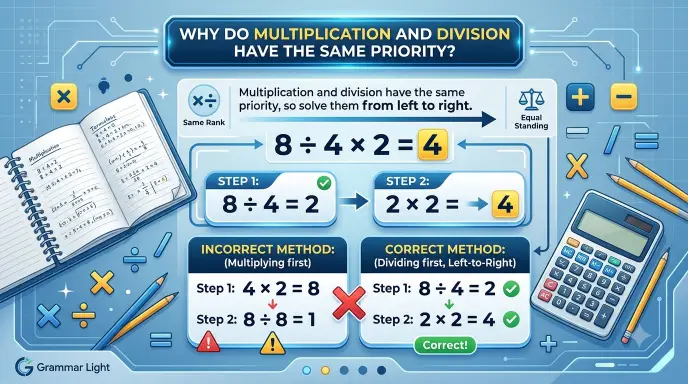
Multiplication and division belong to the same level of the order of operations.
Consider:
24 ÷ 6 × 2
Work from left to right:
24 ÷ 6 = 4
4 × 2 = 8
The answer is 8.
You should not automatically multiply first simply because M appears before D in PEMDAS.
Addition and subtraction follow the same principle.
Example:
15 − 5 + 3
Work from left to right:
15 − 5 = 10
10 + 3 = 13
The answer is 13.
The Easy BODMAS and PEMDAS Rule
The easiest way to remember the rule is to group operations by priority instead of treating BODMAS or PEMDAS as six completely separate steps.
- Brackets or parentheses
- Orders or exponents
- Multiplication and division from left to right
- Addition and subtraction from left to right
This approach makes mathematical expressions easier to understand and helps prevent the most common mistakes.
How to Use BODMAS and PEMDAS Step by Step
The easiest way to solve a BODMAS or PEMDAS expression is to identify the highest-priority operation first and then work through the remaining operations carefully.
Step 1: Solve Brackets or Parentheses
Look for anything inside brackets or parentheses.
Example:
6 × (4 + 2)
First:
4 + 2 = 6
Then:
6 × 6 = 36
Step 2: Solve Orders or Exponents
Next, calculate powers or exponents.
Example:
3² + 5
First:
3² = 9
Then:
9 + 5 = 14
Step 3: Solve Multiplication and Division
Multiplication and division have the same priority.
Work from left to right.
Example:
20 ÷ 5 × 3
First:
20 ÷ 5 = 4
Then:
4 × 3 = 12
Step 4: Solve Addition and Subtraction
Addition and subtraction also have the same priority.
Work from left to right.
Example:
18 − 6 + 4
First:
18 − 6 = 12
Then:
12 + 4 = 16
BODMAS Examples With Answers
These examples show how BODMAS works with different combinations of operations.
Example 1: Multiplication Before Addition
7 + 5 × 2
First:
5 × 2 = 10
Then:
7 + 10 = 17
Example 2: Division Before Subtraction
20 − 12 ÷ 4
First:
12 ÷ 4 = 3
Then:
20 − 3 = 17
Example 3: Brackets First
4 × (6 − 2)
First:
6 − 2 = 4
Then:
4 × 4 = 16
Example 4: Exponents
2³ + 6 × 2
First:
2³ = 8
Then:
6 × 2 = 12
Finally:
8 + 12 = 20
PEMDAS Examples With Answers
PEMDAS follows the same basic process, using parentheses and exponents as its terminology.
Example 1
9 + 3 × 4
First:
3 × 4 = 12
Then:
9 + 12 = 21
Example 2
(9 + 3) × 4
First:
9 + 3 = 12
Then:
12 × 4 = 48
Example 3
5² − 4 × 3
First:
5² = 25
Then:
4 × 3 = 12
Finally:
25 − 12 = 13
BODMAS and PEMDAS With Fractions
Fractions do not change the basic order of operations, so brackets, exponents, multiplication, division, addition, and subtraction are still handled by priority.
Consider:
1/2 + 3 × 2
First:
3 × 2 = 6
Then:
1/2 + 6 = 6½
Example With Parentheses
2 × (1/2 + 3)
First solve the parentheses:
1/2 + 3 = 7/2
Then:
2 × 7/2 = 7
BODMAS and PEMDAS With Negative Numbers
Negative numbers follow the same order of operations, but parentheses can change the result significantly.
Consider:
−4 + 3 × 2
First:
3 × 2 = 6
Then:
−4 + 6 = 2
Now compare it with:
(−4 + 3) × 2
First:
−4 + 3 = −1
Then:
−1 × 2 = −2
The parentheses change the answer from 2 to −2.
Common BODMAS and PEMDAS Mistakes
Most mistakes happen when people misunderstand equal-priority operations or skip brackets and exponents.
Mistake 1: Multiplying Before Division Every Time
Consider:
16 ÷ 4 × 2
The correct method is left to right:
16 ÷ 4 = 4
4 × 2 = 8
Multiplication does not automatically come before division.
Mistake 2: Adding Before Subtracting Every Time
Consider:
15 − 5 + 2
Work from left to right:
15 − 5 = 10
10 + 2 = 12
Mistake 3: Ignoring Parentheses
Consider:
8 × (2 + 3)
Solve the parentheses first:
2 + 3 = 5
Then:
8 × 5 = 40
Mistake 4: Solving Everything From Left to Right
Not every expression should be calculated from the first number to the last.
Example:
4 + 5 × 2
Incorrect:
4 + 5 = 9
9 × 2 = 18 ❌
Correct:
5 × 2 = 10
4 + 10 = 14 ✅
*BODMAS vs PEMDAS in Different Countries
BODMAS and PEMDAS are used in different educational settings, but the underlying mathematical principle remains the same.
BODMAS is commonly seen in the UK and in many countries that follow British-style mathematics education.
PEMDAS is especially common in the United States.
Other variations also exist, such as BEDMAS, where the “E” represents exponents.
The wording may change, but the goal is the same: help students remember the correct order for solving mathematical expressions.
BODMAS or PEMDAS: Which One Should You Use?
Use the version taught by your school, teacher, textbook, or curriculum, but focus on understanding the actual order of operations.
If your textbook uses BODMAS, continue using BODMAS.
If your American mathematics class uses PEMDAS, use PEMDAS.
The important thing is not the acronym itself. The important rules are:
- Grouping symbols are handled first.
- Exponents or orders come next.
- Multiplication and division are solved from left to right.
- Addition and subtraction are solved from left to right.
This approach works even if you encounter a different acronym later.
BODMAS and PEMDAS Comparison Table
The following table shows how the two acronyms describe the same general mathematical process.
| Mathematical Level | BODMAS | PEMDAS |
| Grouping | Brackets | Parentheses |
| Powers | Orders | Exponents |
| Multiplication & Division | Left to right | Left to right |
| Addition & Subtraction | Left to right | Left to right |
This is why knowing the priority levels is more useful than simply memorizing the letters.
Why Does PEMDAS Say Multiplication Before Division?
The wording of PEMDAS can make multiplication appear more important than division, but that is not the mathematical rule.
In PEMDAS, M and D have equal priority.
For example:
48 ÷ 6 × 2
Start from the left:
48 ÷ 6 = 8
Then:
8 × 2 = 16
Doing multiplication first would produce a different result, which is why the left-to-right rule matters.
Why Does BODMAS Say Division Before Multiplication?
BODMAS can create the opposite confusion because D appears before M, but division is not automatically performed before multiplication.
Consider:
48 × 2 ÷ 6
Work from left to right:
48 × 2 = 96
96 ÷ 6 = 16
You do not divide first simply because D appears before M in the word BODMAS.
The letters are a memory aid, not a strict sequence for equal-priority operations.
What Happens When There Are Multiple Operations?
When an expression contains several operations, apply the priority rules repeatedly until only the final answer remains.
Consider:
10 + 6 ÷ 2 × 3 − 4
First handle division and multiplication from left to right:
6 ÷ 2 = 3
Then:
3 × 3 = 9
Now the expression becomes:
10 + 9 − 4
Work from left to right:
10 + 9 = 19
19 − 4 = 15
So the answer is 15.
How to Avoid BODMAS and PEMDAS Mistakes
The best way to avoid mistakes is to write each calculation step clearly instead of trying to solve the entire expression mentally.
1. Look for Brackets
Check for parentheses or brackets before doing anything else.
2. Look for Powers
Identify exponents, squares, cubes, and similar operations.
3. Move Left to Right
For multiplication and division, start from the left and continue toward the right.
4. Check Addition and Subtraction
Handle addition and subtraction from left to right.
5. Review the Expression
After getting an answer, quickly check that no higher-priority operation was skipped.
This simple process is especially useful for students working through long expressions or exam questions.
BODMAS or PEMDAS in Real-Life Math
BODMAS and PEMDAS are useful whenever a calculation contains more than one mathematical operation.
You may use the order of operations in shopping, budgeting, measurements, schoolwork, business calculations, and everyday problem-solving.
Shopping Example
Suppose three items cost $5 each, and you also pay a $4 delivery fee.
The expression is:
3 × 5 + 4
First:
3 × 5 = 15
Then:
15 + 4 = 19
The total is $19.
Measurement Example
Suppose a rectangle has a length of 8 meters and a width of 3 meters.
Its area is:
8 × 3 = 24 square meters
The calculation is simple, but more complicated formulas may require several operations.
BODMAS or PEMDAS: Common Confusions
Most confusion comes from misunderstanding the priority of operations rather than from the acronyms themselves.
Does PEMDAS Mean Multiply Before Divide?
No.
Multiplication and division have equal priority. Work from left to right.
Does BODMAS Mean Divide Before Multiply?
No.
Division and multiplication are also equal in BODMAS. The left-to-right rule applies.
Does Addition Come Before Subtraction?
No.
Addition and subtraction have equal priority, so solve them from left to right.
Are BODMAS and PEMDAS Different Rules?
No.
They are different mnemonic systems that describe the same general order of operations.
BODMAS and PEMDAS Practice Questions
Practice problems can help you understand the rule instead of simply memorizing the acronym.
Question 1
5 + 3 × 4
Answer:
3 × 4 = 12
5 + 12 = 17
Question 2
(5 + 3) × 4
Answer:
5 + 3 = 8
8 × 4 = 32
Question 3
20 ÷ 5 + 6
Answer:
20 ÷ 5 = 4
4 + 6 = 10
Question 4
18 − 6 ÷ 3
Answer:
6 ÷ 3 = 2
18 − 2 = 16
Question 5
2³ + 4 × 2
Answer:
2³ = 8
4 × 2 = 8
8 + 8 = 16
BODMAS or PEMDAS: A Simple Memory Guide
Remember the priority levels rather than treating the letters as a rigid sequence.
You can use this short guide:
Brackets / Parentheses
↓
Orders / Exponents
↓
Multiplication and Division : left to right
↓
Addition and Subtraction : left to right
This method works for both BODMAS and PEMDAS.
Frequently Asked Questions About BODMAS or PEMDAS
These are the most common questions students ask about BODMAS, PEMDAS, and the correct order of mathematical operations.
Is BODMAS the same as PEMDAS?
Yes. Both are mnemonics used to remember the order of mathematical operations. The terminology differs, but the underlying rules are essentially the same.
Which is correct, BODMAS or PEMDAS?
Both are correct as memory aids. BODMAS is commonly used in many countries, while PEMDAS is especially common in the United States.
Does multiplication come before division in PEMDAS?
No. Multiplication and division have equal priority. They should normally be calculated from left to right.
Does division come before multiplication in BODMAS?
No. Division and multiplication also have equal priority in BODMAS. The expression should be solved from left to right at that level.
What does BODMAS stand for?
BODMAS stands for Brackets, Orders, Division, Multiplication, Addition, and Subtraction.
What does PEMDAS stand for?
PEMDAS stands for Parentheses, Exponents, Multiplication, Division, Addition, and Subtraction.
Why do BODMAS and PEMDAS look different?
They use different words and acronym arrangements to describe the same general order of operations. Brackets and parentheses refer to grouping symbols, while orders and exponents relate to powers and similar operations.
Practical Conclusion
BODMAS and PEMDAS are two common ways of remembering the order of mathematical operations, and both lead to the same results when applied correctly.
BODMAS uses Brackets and Orders, while PEMDAS uses Parentheses and Exponents.
The most important rule is to remember that multiplication and division share the same priority. Addition and subtraction also share the same priority.
When you see an expression, first handle brackets or parentheses, then exponents or orders. After that, work through multiplication and division from left to right. Finish with addition and subtraction from left to right.
Once you understand these priority levels, you do not need to worry about which acronym appears in a textbook. Understanding the rule is more important than memorizing the letters.
READ MORE!

I’m a grammar writer focused on making English rules, word usage, and sentence structure simple and easy to understand.