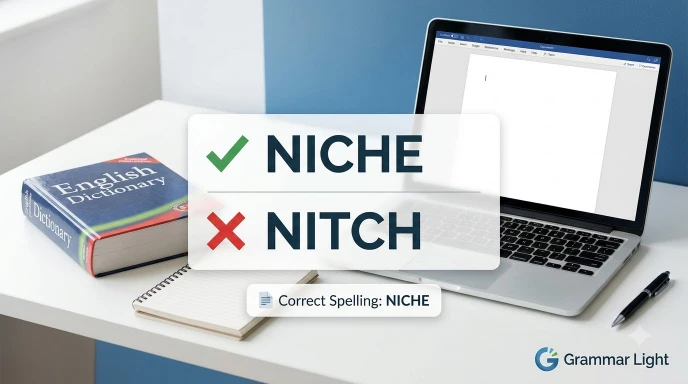
“Niche” is the correct spelling when you mean a specialized area, role, market, or suitable position. “Nitch” is generally a misspelling of “niche,” although it may appear as an informal or mistaken spelling.
The word niche is commonly used in business, marketing, science, ecology, and everyday English. For example, you might say, “She found a niche in the online education market.” The word can also describe a suitable place or role for a person or thing.
People often search for “nitch or niche” because the two spellings sound similar when spoken. The pronunciation can make the spelling difficult to remember, especially for English learners and people who encounter the word mainly in conversation.
The confusion becomes easier to solve once you remember that the standard English spelling is niche. In most contexts, writing nitch will be considered incorrect.
Examples:
- Correct: The company found a profitable niche.
- Incorrect: The company found a profitable nitch.
- Correct: This product fills a specific niche.
- Incorrect: This product fills a specific nitch.
The key point is simple: Use “niche” in standard English writing.
Definition and Meaning of Niche
The word niche has several related meanings, depending on the context. At its core, it refers to a specialized position, place, role, or area that suits a particular person, thing, or group.
In business, a niche is a small and specific part of a larger market. A company may focus on a particular group of customers instead of trying to serve everyone.
For example:
The company specializes in a niche market for handmade educational toys.
Here, niche describes a specific part of the wider toy market.
In everyday language, niche can describe a suitable position or area where someone or something fits particularly well.
For example:
She found her niche as a creative writing teacher.
This means she discovered an area that suited her skills and interests.
Niche in Business
In business and marketing, a niche market is a specialized section of a larger market. It usually serves people with particular needs, interests, or preferences.
Examples include:
- Organic skincare for sensitive skin
- Clothing for petite athletes
- Educational toys for toddlers
- Travel services for solo older people
Each example represents a more specific market within a broader industry.
Niche in Ecology
Niche also has an important scientific meaning. In ecology, an organism’s niche refers to its role and position within an ecosystem.
For example, two animals may live in the same general environment but have different ecological niches because they eat different foods or perform different roles.
Niche as a Suitable Position
The word can also describe a position where someone or something naturally fits.
For example:
Writing children’s books became his niche.
The meaning is that children’s books became his particular area of strength or specialization.
The Origin of Niche
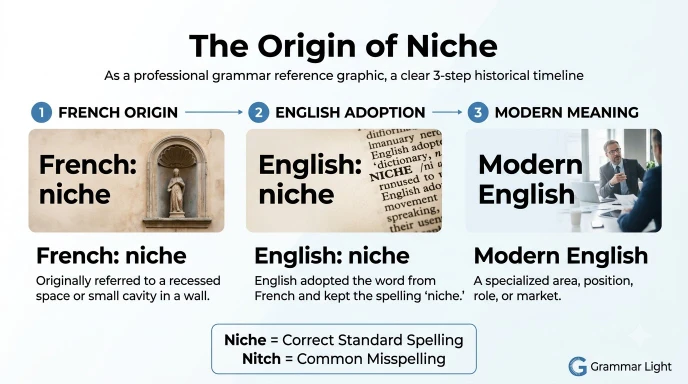
The spelling niche comes from French. The French word niche originally referred to a recessed space or small cavity, particularly one designed to hold a statue.
The word ultimately developed from an Italian term associated with a niche or recess.
English adopted niche and gradually expanded its meaning. Instead of referring only to a physical recess, the word began to describe a specialized position or place.
Over time, its use became especially common in biology, business, marketing, and general descriptions of specialization.
The spelling niche has remained the standard English form. The alternative nitch may appear because English speakers sometimes spell words according to how they sound. Since niche can be pronounced in different ways, learners may connect its pronunciation with an unexpected spelling.
That explains why “nitch or niche” is a common spelling question.
The important distinction is that pronunciation does not change the standard spelling. In formal English, academic writing, professional communication, and published content, niche is the accepted spelling.
British English vs American English Spelling
Unlike some English words that have different British and American spellings, niche is normally spelled the same way in both varieties of English.
| English Variety | Correct Spelling | Example |
| American English | niche | She found a profitable niche. |
| British English | niche | She found a profitable niche. |
| Canadian English | niche | The business serves a small niche. |
| Australian English | niche | The company targets a specific niche. |
| International English | niche | This product serves a unique niche. |
The main difference you may notice is pronunciation, not spelling.
Some speakers pronounce niche like “neesh,” while others use a pronunciation closer to “nitch.” Even when the second pronunciation is used, the standard written form remains niche.
Therefore, changing the spelling to nitch simply because of pronunciation is not appropriate in standard writing.
Which Spelling Should You Use?
Use niche whenever you are writing in standard English.
This applies to:
- School assignments
- Business documents
- Emails
- Blog posts
- Academic writing
- Marketing materials
- Websites
- Professional reports
- Social media posts
If you are writing for an American audience, use niche.
If your audience is British, Australian, Canadian, or international, use niche as well.
There is no standard British versus American spelling choice here. The word does not normally change based on the variety of English.
If you are unsure because you have heard the word pronounced like “nitch,” remember that pronunciation and spelling are not always identical in English.
For example:
Correct: This website targets a specific niche.
Incorrect: This website targets a specific nitch.
Using niche consistently will help your writing look accurate and professional.
Common Mistakes With Niche
One of the most common mistakes is writing “nitch” instead of “niche.” Although nitch may appear in searches or informal writing, it is not the standard spelling when you mean a specialized area, market, role, or position.
Mistake 1: Writing “Nitch”
❌ The company has found a profitable nitch.
✅ The company has found a profitable niche.
The correct spelling is niche.
Mistake 2: Changing the Spelling Because of Pronunciation
Some people hear niche pronounced like “nitch” and assume the spelling should match the sound. English contains many words whose pronunciation does not directly reveal their spelling.
For formal writing, always use niche, regardless of which accepted pronunciation you hear.
Mistake 3: Using “Niche” for Any Large Market
A niche usually refers to a specific or specialized area, not an entire broad industry.
❌ The entire clothing industry is my niche.
✅ Sustainable clothing for petite women is my niche.
The second example identifies a more specific group and need.
Mistake 4: Confusing Niche With Niche Market
A niche can describe a specialized area by itself. A niche market specifically refers to a specialized section of a larger market.
For example:
Her niche is handmade educational products.
She sells products in the children’s educational niche market.
Both are correct, but their structures are slightly different.
Niche vs. Nitch: What Is the Difference?
The simplest distinction is spelling.
| Word | Standard Use | Meaning |
| Niche | Yes | A specialized area, position, role, or market |
| Nitch | No, for this meaning | Usually a misspelling of niche |
If you are discussing a specialized market, a person’s particular area of expertise, or an organism’s ecological role, niche is the spelling you should use.
For example:
- Correct: She found her niche in graphic design.
- Correct: The brand serves a small niche market.
- Correct: Every species has an ecological niche.
- Incorrect: She found her nitch in graphic design.
The spelling nitch can occur in other contexts as a proper name, typo, or nonstandard usage, but it should not replace niche in standard English.
How Do You Pronounce Niche?
The pronunciation of niche can cause some of the spelling confusion.
Two common pronunciations are:
- /niːʃ/ : similar to “neesh”
- /nɪtʃ/ : similar to “nitch”
Because one pronunciation sounds almost exactly like the spelling nitch, some writers assume that nitch must be an alternative spelling.
However, niche remains the standard written form.
For example:
The company has created a niche for itself in the technology industry.
If you pronounce the word as “neesh” or “nitch,” the written form is still niche.
Niche in Everyday Examples
The word niche appears frequently in everyday writing and conversation.
In Business
The company found a profitable niche in the local food market.
In Marketing
This campaign targets a very specific niche.
In an Email
We believe this product could fill an important niche in the market.
In Education
She found her niche as a science teacher.
In Conversation
I think photography is really his niche.
In Blogging
Choosing a clear niche can help a website attract a focused audience.
In Science
The species occupies a unique ecological niche.
These examples show that niche can describe a market, profession, interest, specialization, or ecological role.
Niche in Different Contexts
The meaning of niche changes slightly depending on where it is used.
Business Niche
A business niche is a specialized area of a larger industry.
The company focuses on a niche involving eco friendly home products.
Personal Niche
A person can have a niche based on their skills or interests.
She found her niche in children’s literature.
Online Niche
Online creators and websites often focus on a particular subject or audience.
The website has built a niche around beginner friendly gardening advice.
Ecological Niche
In biology, an ecological niche describes the role a species plays within its environment.
Bees occupy an important niche in many ecosystems.
Physical Niche
The original sense of niche can refer to a recessed space in a wall, often used to display something.
The statue was placed in a small niche.
FAQs About Nitch or Niche
Q.1 What Is the Meaning of Nitch?
“Nitch” is generally a misspelling of “niche” when referring to a specialized area, role, market, or position. In standard English, use niche instead.
For example: She found her niche in graphic design.
Q.2 What Is Your Niche Meaning?
“Your niche” means the specific area, skill, interest, or field that suits you best or where you have a particular specialization.
For example: Her niche is creating educational content for children.
Q.3 Are Niche and Nitch the Same?
No, niche and nitch are not normally treated as the same spelling. Niche is the standard word for a specialized area or position, while nitch is usually a spelling mistake caused by pronunciation.
Q.4 What Does Its Niche Mean?
“Its niche” means the particular role, position, or area that something occupies or is best suited for.
For example: The bird has an important niche in the ecosystem.
Q.5 What Is Niche in Gen Z Slang?
In Gen Z and online language, niche can describe something very specific, uncommon, or targeted to a small group of people.
For example, a highly specific internet joke or unusual interest may be described as a niche topic.
Q.6 What Is Another Word for Nitch?
If you mean niche, possible alternatives include specialty, role, position, field, area, or specialization, depending on the context.
For example:
She found her niche in photography.
can become:
She found her specialty in photography.
Final Thoughts
Niche is the correct spelling when referring to a specialized area, market, role, position, or ecological function. Nitch is generally a misspelling in these contexts.
The confusion mainly comes from pronunciation. Some people pronounce niche like “nitch,” but the spelling does not change.
A simple rule can help you remember it:
Niche = correct standard spelling.
Nitch = usually incorrect when you mean niche.
If you are writing for a British, American, Canadian, Australian, or international audience, niche is the spelling to choose.
LEARN MORE!

I’m a grammar writer focused on making English rules, word usage, and sentence structure simple and easy to understand.








1 thought on “Nitch or Niche: Which One Should You Use in English?”