“Descendants” is the correct spelling; “descendents” is a common misspelling. The word descendants refers to people, animals, or living things that come from a particular ancestor or earlier generation.
The confusion happens because the word is related to descend, and many people naturally expect the spelling to be descendents. However, standard English uses descendants, with ants at the end rather than ents.
Understanding the correct spelling is especially useful when writing about family history, genealogy, ancestry, historical figures, or inherited traits. The distinction is simple once you connect the word with its related forms, such as descendant and descend.
Descendents or Descendants : Quick Answer
Descendants is the correct spelling.
Descendents is generally considered a spelling mistake when you mean people or living things who come from an earlier ancestor.
Examples:
- The king’s descendants still live in the region.
- She traced her family line through several generations of descendants.
- The descendants of the original settlers returned to the village.
The correct singular form is descendant.
- One person = descendant
- More than one = descendants
A simple way to remember the spelling is:
Descend → descendant → descendants
What Does Descendants Mean?
Descendants are people or living things that come from a particular ancestor or earlier generation.
In family relationships, a person’s children, grandchildren, great grandchildren, and later generations can all be their descendants.
For example, if one person has children, those children are their descendants. Their grandchildren are also descendants, as are later generations.
Descendants in Family History
The word is especially common in genealogy and family history writing.
For example:
The descendants of the family settled in several different countries.
This means later generations of that family now live in those countries.
Descendants Beyond Humans
The word does not have to refer only to people.
It can also describe animals, plants, or other living things that come from earlier organisms.
For example:
Modern horses are descendants of earlier horse species.
Here, descendants describes biological lineage rather than a human family.
Why Is Descendants the Correct Spelling?
The standard spelling is descendant, which comes from the Latin descendere, meaning “to descend” or “come down.”
The English noun developed with the ending ant, giving us:
descendant
When making it plural, simply add s:
descendant → descendants
The spelling descendents is easy to create because English contains many words ending in ent. However, this particular noun is spelled with ant.
That makes the correct pattern:
descendant → descendants
not:
descendent → descendents
Descendant vs Descendants
The difference between descendant and descendants is simply singular versus plural.
Descendant
Use descendant when referring to one person, animal, or living thing in a later generation.
Example:
She is a direct descendant of the famous author.
Only one person is being described.
Descendants
Use descendants when referring to two or more.
Example:
The author’s descendants preserved many of his personal letters.
Here, the word refers to multiple people.
Is “Descendents” Ever Correct?
In standard modern English, descendants is the spelling you should use when referring to later generations or offspring.
Descendents is generally treated as a misspelling of descendants.
For formal writing, academic work, family history research, and professional communication, use descendants.
For example:
❌ The descendants of the ruler gathered for the ceremony.
The spelling in this sentence is incorrect.
✅ The descendants of the ruler gathered for the ceremony.
The second version uses the standard spelling.
Descendants vs Descendents: The Main Difference
“Descendants” is the standard and correct spelling when referring to later generations of a family, species, or lineage. “Descendents” is a common misspelling that occurs because the word is related to descend.
Descendant as a Noun
A descendant is a person, animal, or living thing that comes from an earlier ancestor or generation.
For example:
She is a descendant of the original settlers.
This means she comes from that earlier group through a family line.
The plural form is:
descendant → descendants
Descendant vs Ancestor
The two words describe opposite directions in a family line.
An ancestor is someone from an earlier generation.
A descendant is someone from a later generation.
For example:
Your great grandparents are your ancestors.
Your grandchildren can be your descendants.
This relationship can be represented simply as:
Ancestor → parent → child → descendant
The exact relationship depends on the generation being discussed, but the basic distinction remains the same.
Descendants in Genealogy
The word descendants is especially common in genealogy, family trees, historical research, and ancestry records.
A family tree may trace one person backward toward their ancestors or forward toward their descendants.
For example:
The genealogist researched the descendants of the family patriarch.
Here, descendants refers to later generations connected to that ancestor.
You may also see phrases such as:
- direct descendants
- living descendants
- lineal descendants
- descendants of an ancestor
- descendants of a royal family
- descendants of early settlers
Direct Descendants Meaning
A direct descendant is someone who comes directly from a particular ancestor through a line of descent.
For example, a person’s child, grandchild, or great grandchild can be described as a direct descendant.
The term is useful when distinguishing a person’s direct family line from other relatives.
For example:
She is a direct descendant of the historical figure.
This sentence indicates a direct line of descent rather than simply being related through a more distant or collateral family connection.
Descendants in Biology
Descendants can also refer to later organisms or species that come from earlier organisms.
For example:
Modern species can share common ancestors with other species.
In biological writing, descendant can describe organisms that develop from earlier generations or populations.
The word therefore has a broader meaning than simply “children or grandchildren.”
It can describe lineage and origin across generations.
Common Mistakes With Descendants
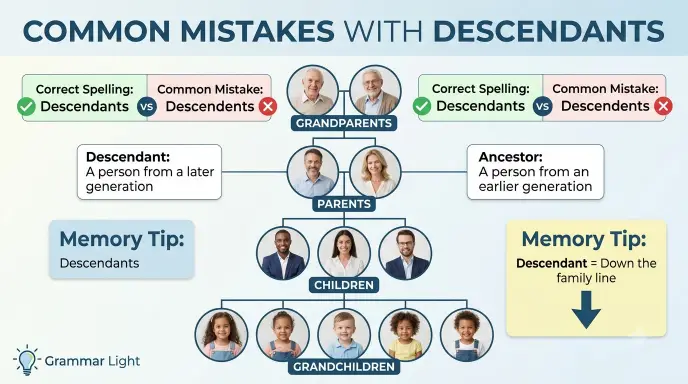
One of the most common mistakes is adding ent instead of ant.
Incorrect:
descendents
Correct:
descendants
Another mistake is confusing descendants with ancestors.
Remember:
Ancestors = earlier generations
Descendants = later generations
Keeping these two directions separate makes the meaning much easier to understand.
How to Remember the Correct Spelling
A useful memory trick is to remember the singular form first:
descendant
Then add s:
descendants
You can also connect the spelling with the ending:
descend + ant = descendant
descendant + s = descendants
Avoid creating the spelling descendent simply because it resembles other English words ending in ent.
Descendants in Historical and Legal Contexts
“Descendants” is also commonly used when discussing historical families, inheritance, property, and legal relationships.
Historical Families
Historical records often use descendants to describe people who came from a notable person or family.
For example:
The descendants of the king continued to live in the region.
The word focuses on the later generations connected to that historical figure.
Other common examples include:
- descendants of a famous writer
- descendants of a royal family
- descendants of early settlers
- descendants of an ancient civilization
- descendants of historical figures
Descendants and Family Relationships
The word descendants does not refer only to immediate children.
A descendant can be a child, grandchild, great grandchild, or a later generation in the same direct line.
For example:
A → B → C → D
If A is the original ancestor, then B, C, and D can all be descendants of A.
This makes descendant useful when discussing an entire family line rather than one specific generation.
Descendants vs Relatives
Descendant and relative do not mean exactly the same thing.
A descendant comes from a particular ancestor through a direct line.
A relative is a broader term for someone connected to another person through family.
For example, a person’s sibling is a relative, but that sibling is not normally their descendant.
This distinction is especially important in genealogy and historical writing.
Descendants vs Descendents in Sentences
The spelling difference becomes easy to see when used in complete sentences.
Correct Examples
- The author has many descendants living around the world.
- Researchers studied the descendants of the ancient population.
- The property was passed down to his descendants.
- The museum invited the descendants of the original settlers.
- She discovered that she was one of the writer’s descendants.
Incorrect Examples
- The author has many descendents living around the world.
- Researchers studied the descendents of the ancient population.
- The property was passed down to his descendents.
In standard modern English, descendants is the spelling to use.
Why Is “Descendents” So Commonly Misspelled?
The spelling descendents is understandable because English contains many words ending in ent.
The mistake is also encouraged by the base verb descend.
Someone may naturally think:
descend → descendent → descendents
However, the standard noun is:
descend → descendant → descendants
The ending ant is the important spelling detail to remember.
Descendant or Descendants?
The choice depends on the number of people or living things being discussed.
Singular
Use descendant for one person or thing.
He is a descendant of the founder.
Plural
Use descendants for more than one.
His descendants still live in the area.
A simple pattern is:
One = descendant
More than one = descendants
Quick Spelling Check
If you are unsure about descendants vs descendents, remember this:
| Word | Correct? | Meaning |
| descendant | ✅ | A later generation from an ancestor |
| descendants | ✅ | More than one descendant |
| descendent | ❌ | Common misspelling |
| descendents | ❌ | Common misspelling |
The standard spelling contains ant, not ent.
Frequently Asked Questions About Descendants and Descendents
What Is the Difference Between “Descendents” and “Descendants”?
Descendants is the correct standard spelling. Descendents is a common misspelling.
Example: She is one of his descendants.
What Is the Difference Between Decedent and Descendant?
A decedent is a person who has died, while a descendant is someone who comes from an earlier ancestor.
Example: The lawyer handled the estate of the decedent.
Example: She is a descendant of the founder.
What Is the Difference Between Ascendants and Descendants?
Ascendants are earlier generations in a family, while descendants are later generations.
Ascendants = generations above
Descendants = generations below
What Is Descendants Meaning?
Descendants means people, animals, or living things that come from an earlier generation or ancestor.
Example: The descendants of the settlers still live in the area.
What Is a Descendant in a Family?
A descendant is a person who comes from another person through a direct family line.
Children, grandchildren, and great grandchildren can all be descendants of an ancestor.
What Is the Plural of Descendent?
The standard noun is descendant, and its plural is descendants.
Singular: descendant
Plural: descendants
“Descendents” is generally a misspelling.
Final Thoughts
Descendants is the correct spelling when referring to people, animals, or living things that come from an earlier generation or ancestor. Descendents is a common spelling mistake.
Remember the simple distinction:
Descendant = later generation
Ancestor = earlier generation
Also, do not confuse descendant with decedent, which refers to a person who has died. Using the correct spelling and understanding these differences makes the word much easier to use confidently.
FIND MORE ARTICLE!

I’m a grammar writer focused on making English rules, word usage, and sentence structure simple and easy to understand.





1 thought on “Descendants or Descendents: What’s the Right Way to Spell It?”