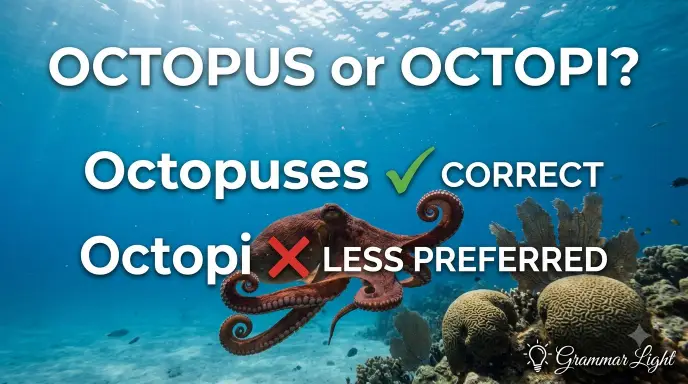
The standard plural of octopus is “octopuses,” while “octopi” is a traditional plural that comes from treating the word as if it had a Latin ending. Both forms appear in English, but they do not have exactly the same status or usage.
The confusion happens because many English speakers learn that words ending in us form their plurals with i. That pattern works for some Latin words, such as cactus → cacti, but octopus does not require the same treatment. The word entered English from Greek, not Latin, which is why the plural octopuses is widely accepted and often preferred in modern English.
Octopus or Octopi : Quick Answer
“Octopuses” is the standard English plural, while “octopi” is an established but traditionally formed alternative.
Singular Form
The singular form is:
Octopus
Example:
“I saw an octopus at the aquarium.”
Plural Form
The most straightforward English plural is:
Octopuses
Example:
“The aquarium has several octopuses.”
What About Octopi?
Octopi is also used in English, but its formation is based on the assumption that octopus is a Latin noun ending in us.
Because octopus comes from Greek, that assumption is not linguistically accurate.
What Does Octopus Mean?
An octopus is a marine animal with eight arms and a soft body.
Basic Meaning
An octopus is a type of cephalopod that lives in oceans and other marine environments.
The word is commonly used when talking about the animal as an individual.
For example:
“The octopus changed its color.”
Physical Features
An octopus is known for:
- Eight arms
- A soft body
- No internal skeleton
- Suckers on its arms
- A rounded head
- Strong swimming and crawling abilities
These characteristics make octopuses easy to distinguish from many other marine animals.
What Is the Plural of Octopus?
The plural of octopus is most commonly “octopuses.”
Octopuses
The form octopuses follows a normal English plural pattern by adding es.
For example:
One octopus
Two octopuses
Several octopuses
This form is widely understood and fits ordinary English plural formation.
Octopi
Octopi is another plural form that appears in English writing and speech.
For example:
“The researchers observed several octopi.”
Although familiar to many English speakers, it is based on a Latin style pluralization that does not accurately reflect the original language of octopus.
Why Do People Say Octopi?
People often say octopi because English contains several familiar words ending in us that traditionally form plurals in i.
The Latin Plural Pattern
Some English words with Latin origins have plurals ending in i.
For example:
- Cactus → cacti
- Fungus → fungi
- Radius → radii
Because of these examples, people may naturally assume:
Octopus → octopi
However, the same rule does not automatically apply to every English word ending in us.
The Problem With the Assumption
Octopus has Greek roots rather than being a Latin word.
The ending can therefore be misleading. People often recognize the familiar us → i pattern and apply it to octopus even though the word’s origin is different.
Octopus vs. Octopi: The Main Difference
The main difference is plural formation and linguistic history, not the animals themselves.
Octopus
Octopus is the singular noun.
Example:
“That octopus has eight arms.”
Octopuses
Octopuses is the standard English plural.
Example:
“Several octopuses live in the reef.”
Octopi
Octopi is a traditional alternative plural that developed from a Latin style interpretation of the word.
Example:
“The divers saw several octopi.”
The three forms can be summarized as:
| Form | Use |
| Octopus | Singular |
| Octopuses | Standard English plural |
| Octopi | Traditional alternative plural |
Is Octopi Grammatically Correct?
“Octopi” is widely used, but “octopuses” is the more straightforward standard English plural.
Why Octopuses Is Preferred
The form octopuses follows ordinary English plural formation and avoids incorrectly treating the word as a Latin noun.
For modern general writing, this makes octopuses a clear choice.
Is Octopi Wrong?
It is better to describe octopi as a traditional or alternative form rather than simply calling it meaningless or unusable.
You may encounter it in:
- Casual writing
- Older texts
- Informal conversations
- Popular articles
- Educational discussions
The important point is that octopuses is the regular English plural.
The Origin of the Word Octopus
Octopus comes from Greek roots associated with the idea of eight feet.
Greek Connection
The word is related to Greek elements meaning eight and foot.
This reflects the animal’s characteristic body structure, with eight arms.
Why Origin Matters
Understanding the origin explains why octopi can be misleading.
If a word is assumed to be Latin simply because it ends in us, it may receive a Latin style plural even when its actual history comes from another language.
That is what makes octopus → octopi an interesting example of how word origins can influence English pluralization.
Octopuses in Everyday Sentences
Using octopuses in ordinary sentences is simple.
Singular Examples
“The octopus is hiding under a rock.”
“An octopus can move through narrow spaces.”
Plural Examples
“The divers observed several octopuses.”
“Octopuses are fascinating marine animals.”
“The aquarium has three octopuses.”
These examples show how the plural octopuses works naturally in modern English.
Octopuses or Octopi: Which Form Should You Use?
Octopuses is the standard English plural and is the clearest choice for general, academic, and professional writing. Octopi is also used, but it comes from applying a Latin style plural pattern to a word with Greek origins.
Octopuses in Modern English
The regular English plural is formed as:
Octopus → Octopuses
For example:
“The aquarium has several octopuses.”
Octopi as an Alternative
Octopi remains familiar to many English speakers and can be found in dictionaries and published writing. However, its formation is based on a Latin style assumption that does not match the Greek origin of octopus.
Common Mistakes With Octopus Plurals
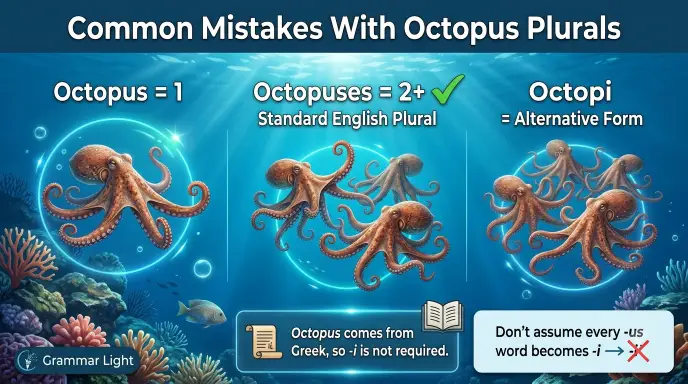
Mistake 1: Thinking Octopi Is the Only Correct Plural
Some people believe that octopi is the only correct plural because of words such as cactus → cacti. English does not apply the same plural rule to every word ending in us.
Mistake 2: Assuming Octopuses Is Wrong
Octopuses is completely acceptable English. It follows the ordinary English plural pattern and is widely used.
Mistake 3: Confusing Origin With Modern Usage
Word origins can explain why a form developed, but modern English usage can follow a different pattern. The Greek origin of octopus helps explain why octopuses is a natural English plural.
Octopus or Octopi in Everyday Sentences
Singular Example
“The octopus was hiding beneath a rock.”
Plural Example
“Several octopuses were observed near the reef.”
Alternative Plural Example
“The documentary featured several octopi.”
All three sentences can be understood, but octopuses is the straightforward standard plural for modern English writing.
Frequently Asked Questions About Octopus or Octopi
Which Is Correct, Octopuses or Octopi?
Octopuses is the standard English plural of octopus. Octopi is an established alternative form that is still used, but it comes from a Latin style pluralization rather than the word’s Greek origin.
What Is a Collective of Octopuses Called?
There is no widely established special collective noun for octopuses comparable to terms such as a “flock” for birds. When several are being discussed together, expressions such as a group of octopuses are clear and natural.
Does an Octopus Have 3 or 9 Hearts?
An octopus has three hearts. Two hearts pump blood toward the gills, while the third pumps oxygenated blood to the rest of the body.
How Do You Say Octopi?
Octopi is commonly pronounced with four syllables, with the main stress on the first syllable. The pronunciation is similar to the way many English speakers naturally say the plural in conversation.
Why Don’t We Say Octopi Anymore?
People still do say “octopi,” so it has not disappeared from English. However, octopuses is widely preferred in modern standard English because it follows a regular English plural pattern and does not incorrectly treat octopus as a Latin noun.
Why Don’t We Eat Octopuses?
People do eat octopus in many parts of the world, so it is not accurate to say that octopuses are generally not eaten. Octopus is used as food in various cuisines, including Mediterranean and East Asian cuisines. If it is eaten depends on cultural traditions, availability, dietary choices, and local practices.
Octopus or Octopi: Quick Comparison
| Form | Meaning | Usage |
| Octopus | One animal | Singular |
| Octopuses | More than one animal | Standard English plural |
| Octopi | More than one animal | Alternative traditional form |
Final Thoughts
Octopuses is the clearest and most widely accepted plural form of octopus in modern English. Although octopi is still used and understood, it comes from a Latin style plural pattern that does not accurately reflect the Greek origin of the word.
For everyday writing, academic work, articles, and professional communication, octopuses is the simple choice. Remember the basic pattern: one octopus, two octopuses. This keeps your writing natural, clear, and consistent.
Explore the Meaning!

I’m a grammar writer focused on making English rules, word usage, and sentence structure simple and easy to understand.






1 thought on “Octopus or Octopi? The Correct Plural Explained”