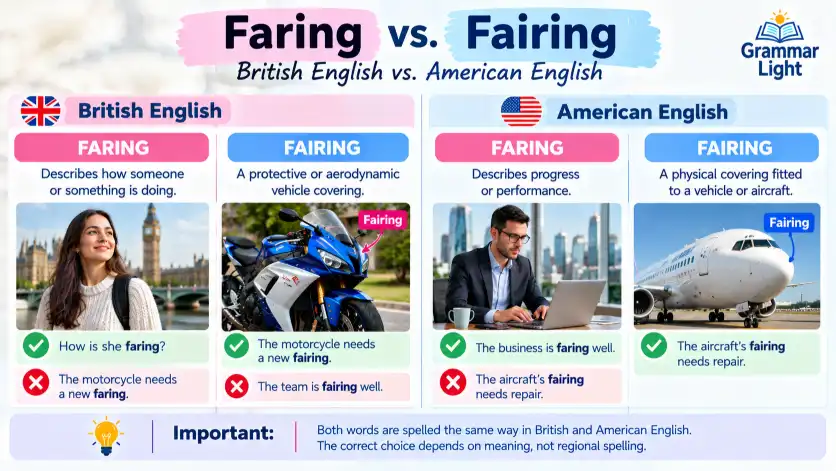
Choosing between faring and fairing can be confusing because these words sound alike but have different meanings. Faring describes how someone or something is doing, progressing, or getting along, while fairing usually refers to a protective or aerodynamic covering on a vehicle, aircraft, motorcycle, or boat. Although the words share the same pronunciation in common English usage, their spelling depends on the context.
People often search for faring or fairing when writing about someone’s progress, describing vehicle parts, or checking which spelling fits a sentence. The confusion is understandable because both words are correctly spelled English words, but they cannot usually replace each other. Using the wrong one may change the meaning of a sentence or make a description inaccurate.
This guide explains the difference between faring and fairing, their definitions, origins, common uses, and practical examples. It also covers common spelling mistakes and helps you decide which word to use in everyday writing. Whether you are a student, an English learner, a writer, or someone interested in vehicles, you will learn how to distinguish these terms confidently.
Fairing or Faring: Quick Answer
Faring is the present participle of fare, meaning to get along, perform, or experience a particular situation. Fairing is a noun that usually describes a covering designed to reduce air resistance or protect parts of a vehicle.
Here is the simplest way to remember the difference:
- Faring: Describes progress, performance, or how someone is doing.
- Fairing: Names a physical covering or structure, especially on a motorcycle, aircraft, or other vehicle.
Examples at a Glance
- How are you faring after the difficult exam? : asks how someone is doing.
- The motorcycle needs a new fairing. : refers to a vehicle component.
- The business is faring better this year. : describes business performance.
- The aircraft’s fairing reduces aerodynamic drag. : refers to an aerodynamic structure.
Quick rule: If you mean how someone or something is doing, use faring. If you mean a protective or aerodynamic vehicle covering, use fairing.
Definition and Meaning of Faring
Faring comes from the verb fare. It describes how a person, organization, activity, or situation is progressing or being experienced. The word commonly appears in questions about health, success, performance, and general circumstances.
For example, someone might ask, “How are you faring?” when they want to know how another person is managing a difficult experience. Similarly, a manager might discuss how a company is faring during a challenging financial period.
The word does not necessarily suggest success or failure. Its meaning depends on the words surrounding it.
How Faring Is Used
Faring is commonly used in three situations:
1. Describing personal circumstances
Use faring when asking how someone is coping with a situation.
Example: How is your brother faring in his new job?
2. Discussing progress or performance
The word can describe the performance of a business, team, project, or plan.
Example: The small business is faring well despite increased costs.
3. Comparing outcomes
Faring can also help compare how different people or things are performing.
Example: Students who practiced regularly were faring better on the final test.
In each example, faring describes a condition or outcome rather than a physical object.
Is Faring a Verb?
Yes. Faring is the -ing form of the verb fare. Depending on the sentence, it can function as a present participle or a gerund.
Consider these examples:
- The team is faring well this season. : present participle in a continuous verb phrase.
- Faring poorly in the first round did not discourage her. : gerund phrase functioning as the subject.
The base verb fare is somewhat formal in modern English, but the expression how are you faring? remains useful in conversations and writing.
Definition and Meaning of Fairing
Fairing is a noun most commonly used for a shaped covering that improves airflow around a vehicle or component. It can also protect exposed parts, reduce drag, and create a smoother exterior.
Fairings are common in engineering and transportation. Motorcycles, aircraft, rockets, boats, and some bicycles may use fairings for practical or aerodynamic purposes.
For example, a motorcycle fairing may cover parts of the engine or front section while helping direct airflow around the rider. On an aircraft, a fairing may cover a joint or connection between components to reduce air resistance.
Common Uses of Fairing
1. Motorcycle fairings
Motorcycle fairings are exterior panels fitted around parts of a motorcycle. Depending on the design, they may improve aerodynamics, offer some protection from wind, and give the bike a distinctive appearance.
Example: The mechanic replaced the cracked fairing on the motorcycle.
2. Aircraft fairings
Aircraft fairings cover joints, gaps, or structural connections. Their streamlined shape helps reduce aerodynamic drag.
Example: The engineers inspected the aircraft’s wing fairing before departure.
3. Rocket and aerospace fairings
In aerospace engineering, a fairing may protect a payload during launch. A payload fairing typically shields equipment from aerodynamic forces and environmental conditions until it can be exposed safely.
Example: The rocket’s payload fairing protected the satellite during the early stages of launch.
4. Boat and other vehicle components
The term can also describe shaped coverings or structures used on boats and other vehicles to improve their exterior profile or protect particular components.
Remember: A fairing is generally a physical object. Unlike faring, it does not describe how well a person or business is doing.
The Origin of Faring and Fairing
Although faring and fairing are pronounced alike in many varieties of English, they developed from different words and acquired distinct meanings.
The Origin of Faring
Faring comes from the verb fare, an old English word associated with traveling, proceeding, or getting along. Over time, the verb developed broader uses relating to someone’s condition or the outcome of an experience.
Expressions such as fare well and fare poorly reflect this meaning. In modern English, the word frequently appears in questions about progress, such as How are you faring?
Its meaning is not limited to physical travel. Someone can fare well in an examination, a business can fare poorly during an economic downturn, and a person can fare better after making a change.
The Origin of Fairing
Fairing is connected to fair, particularly the verb meaning to shape or streamline a surface. In engineering, fairing involves making a structure smoother or more streamlined, especially to improve its aerodynamic or hydrodynamic properties.
The noun fairing developed as a name for the covering or shaped structure that creates this smoother profile.
Although both words contain the letters -aring, their different origins explain why they have different meanings today.
Faring vs. Fairing: Key Differences
The easiest way to distinguish these terms is to identify what the sentence describes. One concerns progress or circumstances; the other generally names a component or covering.
| Feature | Faring | Fairing |
| Main meaning | Doing, progressing, or coping | A shaped covering or structure |
| Part of speech | Verb form; sometimes a gerund | Usually a noun |
| Root word | Fare | Fair |
| Common context | Health, work, business, performance | Motorcycles, aircraft, rockets, boats |
| Example | She is faring well. | The fairing is damaged. |
| Refers to a physical object? | Usually no | Usually yes |
The key distinction is meaning, not pronunciation. Hearing the word alone may not tell you which spelling is intended, so consider the context.
A Simple Memory Trick
Think of faring as being connected to fare well or fare poorly. Both expressions describe how someone or something is doing.
Think of fairing as a component that helps make a vehicle smoother or more streamlined.
- How is the project faring? : progress.
- How is the motorcycle fairing attached? : a vehicle component.
This distinction works in most everyday and technical situations.
Faring or Fairing in Everyday Examples
Understanding definitions is helpful, but seeing faring and fairing in real sentences makes it easier to choose the correct spelling. The surrounding words usually reveal whether the sentence describes someone’s progress or refers to a physical component.
Examples of Faring in Sentences
Use faring when discussing how a person, group, business, or situation is progressing.
- How are you faring after your recent surgery?
- The students are faring better in mathematics this semester.
- Our company is faring well despite the economic challenges.
- She was faring poorly until she received additional support.
- The team is faring better than it did last season.
- How is your new business faring in the competitive market?
- The project is faring well because everyone is working together.
- He wondered how his former classmates were faring.
- Small retailers are faring differently in the current economy.
- The patient is faring well under the doctor’s supervision.
In each sentence, faring describes a condition, experience, or level of progress. No physical covering is involved.
Examples of Fairing in Sentences
Use fairing when referring to a covering or streamlined structure, particularly in transportation and engineering.
- The motorcycle’s fairing was damaged in the accident.
- The mechanic ordered a replacement fairing for the sports bike.
- Engineers inspected the aircraft’s fairing before takeoff.
- The rocket’s payload fairing protected the satellite during launch.
- A cracked fairing can affect the appearance of a motorcycle.
- The technician removed the front fairing to access internal components.
- The aircraft’s new fairing helped create a smoother exterior profile.
- The boat’s fairing was designed to improve its streamlined shape.
- The rider chose a lightweight fairing for the racing motorcycle.
- The repair shop painted the replacement fairing to match the vehicle.
Here, fairing names a physical structure or component. The word does not describe performance in the way faring does.
Common Mistakes When Using Faring and Fairing
Because the two words sound alike, writers sometimes use one spelling in place of the other. The best way to avoid this mistake is to identify the intended meaning before choosing the word.
Mistake 1: Using Fairing to Describe Progress
Incorrect: How is your new business fairing?
Correct: How is your new business faring?
Why: The sentence asks about the business’s performance, so the correct word is faring, derived from fare.
Mistake 2: Using Faring for a Vehicle Part
Incorrect: The motorcycle needs a new faring.
Correct: The motorcycle needs a new fairing.
Why: A motorcycle’s exterior covering is called a fairing. The word refers to a physical component, not the motorcycle’s progress.
Mistake 3: Assuming the Words Are Interchangeable
Incorrect: The aircraft’s faring reduces air resistance.
Correct: The aircraft’s fairing reduces air resistance.
Why: The sentence identifies an engineering component. Using faring would change the intended meaning and make the sentence incorrect in this context.
Mistake 4: Choosing the Spelling Based Only on Sound
Incorrect: The team is fairing well this season.
Correct: The team is faring well this season.
Why: Pronunciation alone cannot reliably distinguish these words. Their meanings and grammatical roles determine the correct spelling.
Mistake 5: Confusing Faring With Fare
Incorrect: The company is fare well this year.
Correct: The company is faring well this year.
Why: After is, the sentence requires the -ing form to create the present continuous construction. The base verb fare would need a different grammatical structure.
Practical tip: Before writing either word, ask yourself one question: Am I describing how something is doing, or am I naming a physical part? That simple check prevents most spelling errors.
How to Choose the Correct Word
Choosing between faring and fairing becomes straightforward when you follow a few simple steps.
Step 1: Identify the Intended Meaning
If you are describing someone’s condition, performance, or progress, choose faring.
Example: The students are faring well in their new school.
If you are naming a covering or structure, choose fairing.
Example: The motorcycle’s fairing needs repair.
Step 2: Examine the Sentence Structure
The grammar around the word can provide a useful clue.
- Faring: Often appears after forms of be, such as is faring, are faring, or was faring.
- Fairing: Commonly follows a possessive or descriptive word, such as the fairing, motorcycle fairing, or aircraft fairing.
These are useful patterns, not absolute rules. The intended meaning remains the most reliable guide.
Step 3: Replace the Word With a Simpler Expression
Try replacing the word with a phrase that expresses its meaning.
For faring, use doing, progressing, or getting along.
Example: How is she faring? becomes How is she doing?
For fairing, use covering, panel, or aerodynamic structure, depending on the context.
Example: The motorcycle fairing is broken becomes The motorcycle’s exterior panel is broken.
If the replacement fits naturally, you have probably selected the correct spelling.
Faring vs Fairing in British and American English
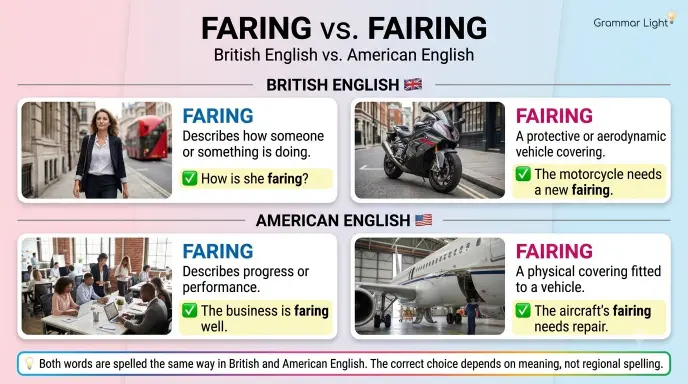
Faring and fairing are spelled the same way in standard British and American English. Neither word has a different standard spelling across these two varieties.
| Usage | American English | British English |
| Describing progress | Faring | Faring |
| Naming a vehicle covering | Fairing | Fairing |
| Asking about someone’s condition | How are you faring? | How are you faring? |
| Describing a motorcycle component | Motorcycle fairing | Motorcycle fairing |
Unlike some spelling differences, such as color and colour, the choice between these two words does not depend on the country where you are writing.
Use the spelling that matches the meaning in both American and British English. This rule also applies to standard international English.
Why Fairing and Faring Matter in Technical and Everyday Writing
Using the right spelling improves clarity because these words belong to different contexts.
In Everyday Communication
People often use faring to ask about someone’s experiences or progress. The expression can sound polite, thoughtful, or slightly formal.
Examples include:
- How are you faring at your new job?
- I hope you are faring well after the move.
- The family is faring better now.
In these sentences, the word helps communicate concern or describe changing circumstances.
In Automotive and Engineering Writing
The word fairing appears in product descriptions, repair instructions, technical manuals, and discussions of vehicle design.
Examples include:
- Inspect the front fairing for cracks.
- Replace the damaged side fairing before reinstalling the panel.
- The aircraft fairing covers the structural joint.
In technical writing, spelling fairing correctly is particularly important because it identifies a specific physical component. Using faring instead may confuse readers or reduce the accuracy of a description.
Frequently Asked Questions
Q.1 What is the difference between faring and fairing?
Faring describes how someone or something is doing or progressing. Fairing usually refers to a shaped covering or structure used on a vehicle, aircraft, or other piece of equipment. For example, a business may be faring well, while a motorcycle may need a new fairing.
Q.2 Is faring a real word?
Yes. Faring is the correct -ing form of the verb fare. It appears in expressions such as How are you faring? and The company is faring well. The word describes progress, circumstances, or performance.
Q.3 Is fairing a real word?
Yes. Fairing is a correctly spelled English word, commonly used as a noun for a streamlined covering or structure. Motorcycle and aircraft fairings are familiar examples. The term also appears in aerospace engineering, including the phrase payload fairing.
Q.4 How do you spell faring when asking how someone is doing?
Use faring when asking about a person’s condition or circumstances. The correct sentence is How are you faring? The word comes from fare, meaning to get along or experience a particular outcome.
Q.5 Is it motorcycle faring or motorcycle fairing?
The correct term is motorcycle fairing. It refers to an exterior panel or covering fitted to a motorcycle. Depending on its design, this component may improve aerodynamics, provide some protection from wind, or enhance the motorcycle’s appearance.
Q.6 Does fairing mean doing well?
No. Fairing does not normally mean doing well. The word for describing progress is faring, as in The team is faring well this season. Fairing generally names a physical covering or structure.
Q.7 Are faring and fairing pronounced the same way?
Yes. In common English pronunciation, faring and fairing are homophones: they sound the same but have different spellings and meanings. Their sentence context helps readers determine which word is intended.
Q.8 Can faring be used for a business or team?
Yes. Faring can describe the performance of a business, sports team, project, or organization. For example, The company is faring better this year describes improved performance. The word is useful when discussing outcomes rather than physical objects.
Q.9 What is an example of fairing in aviation?
An aircraft fairing is a shaped structure that covers a joint, gap, or connection between components. Its design may help reduce aerodynamic drag and create a smoother exterior. A payload fairing on a rocket protects its payload during launch.
Q.10 How can I remember the difference between faring and fairing?
Remember the expressions fare well and vehicle fairing. The first relates to how someone or something is doing, so use faring. The second names a physical component, so use fairing. Checking the meaning before spelling the word is the most reliable strategy.
Final Thoughts
Faring and fairing are both correct words, but they serve different purposes. Use faring when describing how someone or something is doing, coping, or progressing. Choose fairing when referring to a physical covering, especially one used on motorcycles, aircraft, rockets, or other vehicles.
The difference is simple once you focus on meaning instead of sound. When the sentence concerns progress, think of fare well. When it concerns a vehicle component, use fairing. This small distinction will help you write more accurately and avoid a common spelling mistake.
LEARN MORE!

I’m a grammar writer focused on making English rules, word usage, and sentence structure simple and easy to understand.