
“Reining” and “reigning” are both correct English words, but they have different meanings and uses. Reining is connected with controlling or limiting something, while reigning refers to ruling or currently holding a title or position.
These words are easy to confuse because they sound very similar. The extra g in reigning changes its meaning and connects it to the word reign, meaning rule or authority. Reining, on the other hand, comes from rein, associated with controlling a horse and, more broadly, controlling or restricting something.
Reining or Reigning :Quick Answer
Use “reining” when you mean controlling, restraining, or limiting something; use “reigning” when you mean ruling or currently holding a title.
Examples:
- The company is reining in its expenses.
- She is the reigning world champion.
- The rider was reining the horse back.
- The reigning monarch attended the ceremony.
A simple way to remember the difference is:
Rein = control
Reign = rule
What Does Reining Mean?
Reining is the present participle of the verb rein. It generally means controlling, restraining, or limiting something.
The original meaning comes from reins, the straps used by a rider to guide and control a horse. Over time, rein also developed a figurative meaning related to controlling people, actions, spending, emotions, or situations.
For example:
- The rider was reining the horse in.
- The manager is reining in unnecessary expenses.
- The government introduced measures for reining in excessive spending.
The expression “reining in” is particularly common in everyday and professional English.
What Does Reigning Mean?
Reigning is the present participle of reign. It means ruling or currently holding a position of authority or a particular title.
The word is traditionally associated with kings, queens, and other rulers.
For example:
- The reigning king addressed the crowd.
- The reigning queen visited the city.
- The country welcomed its reigning monarch.
However, reigning is also frequently used outside politics and royalty. In sports, competitions, and entertainment, it can describe someone who currently holds a championship or title.
For example:
She is the reigning national champion.
This means she currently holds that championship title.
Reining vs Reigning: The Main Difference
The easiest way to distinguish these words is to look at their root words.
| Word | Comes From | Meaning | Example |
| Reining | Rein | Controlling or limiting | Reining in spending |
| Reigning | Reign | Ruling or holding a title | Reigning champion |
Reining = control.
Reigning = rule or current title.
Although the words look and sound similar, they should not be substituted for each other.
For example:
- The company is reining in its costs.
The company is controlling or reducing its costs. - The company is reigning in its costs.
This is incorrect because reigning does not mean controlling expenses.
Reining in Meaning
“Reining in” means controlling, restricting, or reducing something that has become excessive.
The expression can be used with spending, behavior, growth, emotions, or other things that need to be brought under control.
Examples include:
- The business is reining in its operating costs.
- Parents may try to rein in excessive screen time.
- The manager is reining in unnecessary spending.
- New regulations aim at reining in excessive fees.
The important point is that the expression is spelled reining in, not reigning in.
Reigning Champion Meaning
A “reigning champion” is someone who currently holds a championship title.
For example:
The reigning champion will defend the title next month.
This means the person currently has the championship and is entering another competition.
The same expression can describe teams:
The reigning champions returned for another season.
Here, reigning indicates their current status as title holders. It does not mean they are ruling over other teams in a literal political sense.
A Simple Trick to Remember the Difference
Connect each word to its root:
REIN → REINING → CONTROL
Think about the reins of a horse. Reins help a rider control and guide the horse.
REIGN → REIGNING → RULE
Think about a king or queen who reigns over a kingdom.
This gives you an easy memory connection:
Reining = controlling
Reigning = ruling or holding a title
Reining vs Reigning in a Sentence
The easiest way to understand these words is to see how they function in real sentences. Reining usually describes an action of control, while reigning describes ruling or holding a current title.
Examples of Reining
Use reining when something is being controlled, restrained, or brought back under control.
- The company is reining in its expenses.
- The rider was reining the horse back.
- The manager is reining in unnecessary spending.
- She is reining in her emotions.
- New policies are aimed at reining in excessive costs.
In most modern usage, “reining in” is much more common than using reining by itself.
Examples of Reigning
Use reigning when someone is currently ruling or holds a title.
- She is the reigning tennis champion.
- The reigning monarch attended the ceremony.
- He defeated the reigning champion.
- The team remains the reigning national champion.
- The reigning king announced the new policy.
Here, reigning connects to the idea of rule, authority, or current status.
Reining or Reigning: Common Confusion
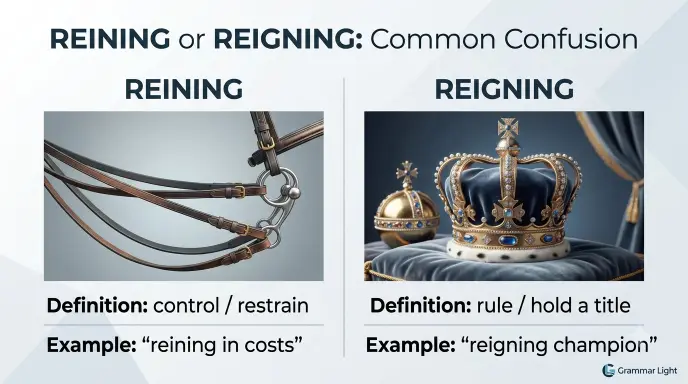
The confusion usually happens because both words sound almost identical.
Reining comes from rein, while reigning comes from reign.
A rein is associated with controlling a horse, whereas a reign refers to a period of rule.
This difference explains why these sentences require different spellings:
The coach is reining in the team’s spending.
The coach is controlling the spending.
The team is the reigning champion.
The team currently holds the championship.
Changing one word to the other would change the meaning.
Reining In vs Reigning In
“Reining in” is the correct expression when you mean controlling or limiting something.
This is one of the most important spelling distinctions to remember.
Correct:
The company is reining in its expenses.
Incorrect:
The company is reigning in its expenses.
The reason is simple: the phrase comes from rein, not reign.
The same distinction applies to many situations involving control:
- reining in spending
- reining in costs
- reining in behavior
- reining in growth
- reining in emotions
Whenever the meaning is control or restraint, think rein → reining.
Reigning Champion vs Reining Champion
The correct phrase is “reigning champion.”
A reigning champion is someone who currently holds a championship title.
For example:
The reigning champion will compete again this weekend.
The word reigning is correct because the athlete currently holds the title.
“Reining champion” would suggest the idea of controlling a champion, which is not the intended meaning.
The same pattern appears with other titles:
- reigning champion
- reigning world champion
- reigning national champion
- reigning league champion
These expressions all refer to a current title holder.
Reining and Reigning Pronunciation
Both words are commonly pronounced alike in standard English, which makes their spelling especially easy to confuse.
The difference is therefore mainly visible in writing and meaning, rather than in ordinary speech.
When you hear the word without seeing it written, context usually tells you which meaning is intended.
For example, if someone says a business is controlling its expenses, the intended word is reining. If someone says an athlete currently holds a championship, the intended word is reigning.
How to Choose the Correct Word
Ask yourself one simple question:
Am I talking about control or rule?
If the answer is control, use reining.
The manager is reining in unnecessary expenses.
If the answer is rule, authority, or a current title, use reigning.
She is the reigning champion.
This quick test can prevent most spelling mistakes involving these two words.
Reining or Reigning: Word Origins
Reining and reigning come from two different root words, which explains why their meanings are different even though their spellings and pronunciations are similar.
The Origin of Reining
Reining comes from the verb rein, which is connected to the reins used to control and guide a horse.
The idea of controlling a horse gradually developed into a broader figurative meaning. English speakers began using rein for controlling other things as well.
That is why we now commonly say:
- reining in spending
- reining in costs
- reining in behavior
- reining in growth
The basic idea remains control or restraint.
The Origin of Reigning
Reigning comes from reign, a word associated with ruling or exercising authority.
It is commonly used when discussing monarchs, rulers, and people who currently hold titles.
The same idea extends to competitions and sports.
For example:
- a reigning monarch
- a reigning king
- a reigning queen
- a reigning champion
The central meaning is rule, authority, or current title holder status.
Reining vs Reigning: Grammar and Word Forms
Both words are forms created by adding ing, but they come from different verbs.
| Base Verb | ing Form | Meaning |
| rein | reining | controlling or restraining |
| reign | reigning | ruling or holding a title |
The spelling becomes easier to remember once you identify the base verb.
For example:
rein → reining
The final e of rein is dropped before ing.
Similarly:
reign → reigning
The spelling retains the g associated with reign.
When to Use Reining
Use reining when the sentence describes an effort to control, restrict, or guide something.
Common contexts include business, finance, personal behavior, sports involving horses, and general situations involving restraint.
Reining in Spending
The business is reining in its spending.
This means the business is trying to reduce or control how much it spends.
Reining in Behavior
The teacher had difficulty reining in the noisy students.
Here, reining in means bringing the students’ behavior under control.
Reining a Horse
The rider was reining the horse toward the gate.
In this literal use, the word relates directly to the reins used by the rider.
When to Use Reigning
Use reigning when someone is ruling or currently holds a particular title.
Reigning Monarch
The reigning monarch attended the official ceremony.
The word refers to the person who currently occupies the position of monarch.
Reigning Champion
The reigning champion entered the competition again.
The athlete currently holds the championship title.
Reigning Leader
In some contexts, reigning can describe someone who currently holds a dominant or recognized position.
The key idea remains current authority or status, rather than control in the rein sense.
Reining or Reigning: Quick Memory Rule
A short memory rule can make the distinction much easier:
Reining → Rein → Control
Reigning → Reign → Rule
If you can replace the idea with control, think reining.
If you can replace it with rule or current title, think reigning.
Common Spelling Mistakes
The most frequent mistake is writing “reigning in” when the intended phrase is “reining in.”
For example:
❌ The company is reigning in costs.
✅ The company is reining in costs.
Another common mistake is using reining in a championship context.
❌ She is the reining champion.
✅ She is the reigning champion.
Remember that the first sentence needs the idea of control, while the second needs the idea of holding a title.
Reining or Reigning: Detailed Usage Guide
The correct spelling depends on the meaning you want to express: control calls for “reining,” while rule or current title status calls for “reigning.”
Reining in Everyday English
Reining is most often encountered in the phrase “reining in.”
This phrase works naturally when something needs to be controlled, reduced, or restricted.
Examples:
- The company is reining in its expenses.
- The manager is reining in unnecessary costs.
- She is reining in her spending.
- The government introduced measures for reining in inflation.
The object can be something physical or abstract. Spending, behavior, growth, emotions, and costs can all be described as being reined in.
Reigning in Sports
Reigning is extremely common in sports writing.
A person or team that currently holds a championship is described as the reigning champion.
Examples:
- The reigning champion returned to defend the title.
- The team defeated the reigning league champions.
- She entered the tournament as the reigning world champion.
The word describes current status, not the act of controlling something.
Reining or Reigning in Professional Writing
Writers often encounter both words in news reports, business articles, sports coverage, and formal documents.
Reining usually appears when discussing efforts to control something.
Examples:
- The company is reining in operating costs.
- Officials are reining in unnecessary spending.
- The organization is reining in its expansion plans.
Reigning commonly appears when describing a current title holder or authority figure.
Examples:
- The reigning champion will return next season.
- The reigning monarch addressed the public.
- The reigning title holder accepted the award.
Reining vs Reigning: Sentence Comparison
Putting the words side by side makes their difference easier to recognize.
| Reining | Reigning |
| The company is reining in costs. | She is the reigning champion. |
| He is reining in his spending. | The reigning monarch attended. |
| The rider is reining the horse. | The reigning title holder competed again. |
| Officials are reining in excessive growth. | The reigning champion defended the title. |
The first column focuses on control or restraint.
The second focuses on rule or current status.
Can Reining and Reigning Be Interchanged?
No. “Reining” and “reigning” should not normally be used interchangeably.
Although they are pronounced similarly, they come from different verbs and carry different meanings.
For example:
The company is reining in its expenses.
This means the company is controlling its expenses.
Changing reining to reigning would make the sentence incorrect because reigning does not mean controlling expenses.
Likewise:
She is the reigning champion.
Changing reigning to reining would remove the intended meaning of current championship status.
Reining or Reigning: Which Is Correct?
Both are correct words. The correct choice depends entirely on the context.
Use reining for:
- controlling
- restricting
- reducing
- guiding a horse
- bringing something under control
Use reigning for:
- ruling
- monarchs
- current champions
- current title holders
- people currently occupying a position of authority
A useful shortcut is:
Control → Reining
Rule or title → Reigning
How to Avoid the Mistake
The easiest way to avoid confusion is to identify the word’s root before writing it.
If you mean rein, think about a horse’s reins and control:
rein → reining
If you mean reign, think about a king, queen, or champion holding a position:
reign → reigning
Before using the word, ask yourself what the sentence is actually describing. If something is being controlled, choose reining. If someone currently rules or holds a title, choose reigning.
Frequently Asked Questions About Reining and Reigning
These common questions focus on the meanings, spelling, and everyday use of reining and reigning
What Does Reining Mean?
Reining means controlling, restraining, limiting, or guiding something. It comes from the verb rein, which is associated with controlling a horse.
It is especially common in the expression “reining in,” meaning to bring something under control.
Example:
The company is reining in its expenses.
What Does “Reigning” Mean?
Reigning means ruling or currently holding a position, title, or championship.
It comes from the verb reign, which refers to ruling or exercising authority.
Example:
She is the reigning world champion.
Here, reigning means that she currently holds the championship title.
Which Is Correct: “Reining” or “Reigning Champion”?
The correct phrase is “reigning champion.”
It describes a person or team that currently holds a championship title.
Example:
The reigning champion returned to defend the title.
“Reining champion” is incorrect when you mean the current title holder.
What Does “Reining in Someone” Mean?
“Reining in someone” means controlling, restraining, or limiting someone’s behavior or actions.
For example:
The manager had to rein in the employee’s aggressive behavior.
It can also refer to controlling a person’s spending, emotions, enthusiasm, or other actions.
The expression comes from the idea of using reins to control a horse.
Is It Reining or Reigning?
Both words are correct, but they have different meanings.
Use reining when you mean controlling, restricting, or guiding something.
Use reigning when you mean ruling or currently holding a title.
For example:
- Reining in costs = controlling costs
- Reigning champion = current champion
A quick memory rule is:
Rein = control → reining
Reign = rule → reigning
What Is Another Word for “Reining In”?
Depending on the context, alternatives to “reining in” include:
- controlling
- restraining
- limiting
- reducing
- curbing
- restricting
- containing
- checking
For example:
The company is reining in expenses.
can also be expressed as:
The company is reducing expenses.
or:
The company is curbing expenses.
The best alternative depends on the exact meaning and tone of the sentence.
Final Thoughts
Reining and reigning may sound alike, but their meanings are different. Reining relates to controlling, restricting, or guiding something, especially in the phrase “reining in.” Reigning relates to ruling or currently holding a title, as in “reigning champion.”
The easiest way to remember them is simple: rein means control, while reign means rule. Once you connect each spelling with its meaning, choosing the correct word becomes much easier.
Keep Exploring!

I’m a grammar writer focused on making English rules, word usage, and sentence structure simple and easy to understand.








3 thoughts on “Reining or Reigning? Correct Spelling & Usage Explained”