What Is Doodle or Die?
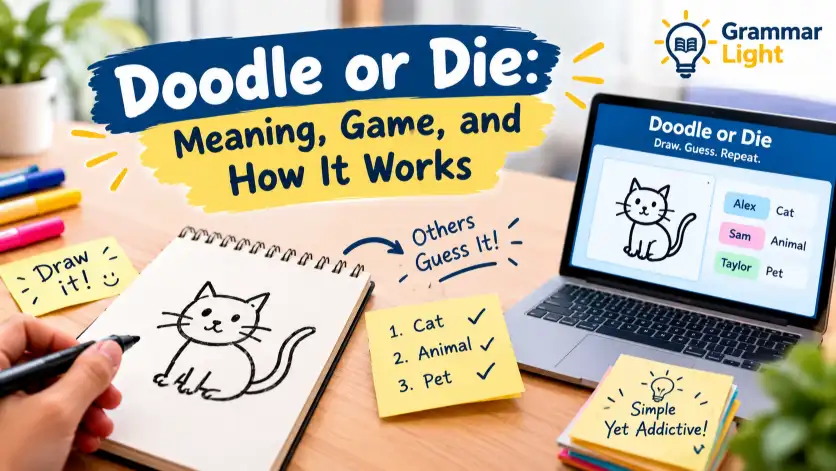
Doodle or Die is a drawing and guessing game in which players create pictures based on given words or ideas, while other players try to guess what the drawing represents. The concept is built around quick sketches, creative interpretation, and funny misunderstandings.
The main idea is simple: one person draws, another person guesses, and the result can become increasingly unpredictable depending on how clearly the original idea is communicated.
What Does the Name Mean?
The word “doodle” means a simple, casual, or spontaneous drawing that is usually created without focusing on artistic perfection.
The word “die” gives the name a dramatic and playful twist. In the context of the game, it is part of the title rather than an instruction to literally do anything dangerous.
Together, the name creates a memorable phrase associated with drawing, guessing, and entertainment.
How Does the Game Work?
The basic process of Doodle or Die starts when a player receives a word, phrase, or concept.
Instead of writing the answer, the player tries to represent it through a picture. Other participants examine the Doodle or Die drawing and attempt to identify the intended answer.
The challenge in Doodle or Die comes from communicating an idea without directly using the word itself.
For example, if the assigned word is “umbrella,” the player might draw a person standing underneath an umbrella. Other players can then use these visual clues to figure out the answer in Doodle or Die.
Why Is It Called a Drawing and Guessing Game?
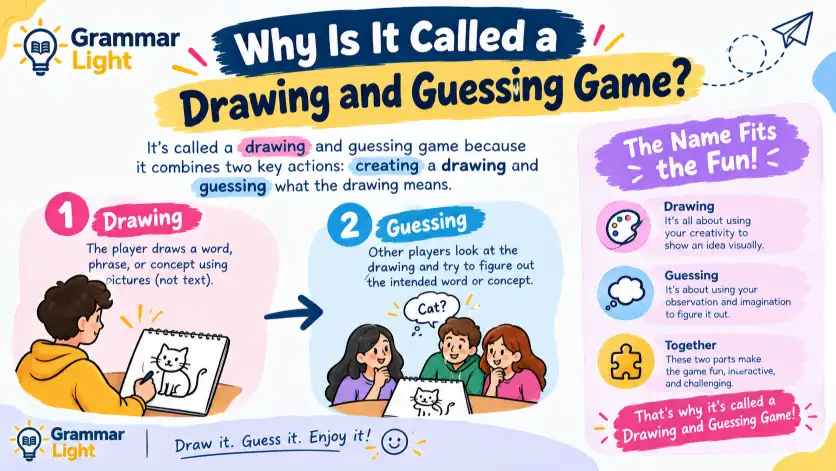
The activity in Doodle or Die combines two main skills: visual communication and interpretation.
The person drawing in Doodle or Die has to decide which parts of an idea are easiest to show visually. The person guessing in Doodle or Die has to interpret those visual clues and connect them to a possible answer.
This creates a simple but engaging interaction between players, making Doodle or Die an entertaining experience.
Is Artistic Talent Necessary?
No. Players do not need professional drawing skills to participate.
The purpose is usually to communicate an idea rather than produce a beautiful illustration. A few recognizable shapes can sometimes communicate an answer better than a highly detailed picture.
In fact, imperfect drawings can make the experience more amusing because other players may interpret them in unexpected ways.
What Can You Draw?
The possibilities depend on the rules and the prompts being used.
Common categories can include:
- Animals
- Food
- Objects
- Places
- Activities
- People
- Emotions
- Everyday situations
- Movies or fictional concepts
- Abstract ideas
Easy subjects can be represented directly, while more complicated ideas may require several visual clues.
Why Do People Enjoy This Type of Game?
The entertainment comes from seeing how different people interpret the same idea.
A player may have a very clear image in mind but produce a sketch that looks completely different to everyone else. The resulting guesses can create funny and unexpected moments.
The game also encourages creativity because players have to find visual ways to communicate ideas quickly.
Can Beginners Play It?
Yes. The basic concept is easy enough for beginners to understand.
New players can start with familiar objects and simple words. Once they become comfortable with the format, more difficult prompts can be introduced.
Because there is no requirement for advanced artistic ability, people can participate regardless of their drawing experience.
What Makes a Good Drawing?
A useful game drawing should provide enough clues for other players to make a reasonable guess.
Start with the main subject and then add details that make its identity clearer. For an action, showing a person performing the action can be more effective than drawing a complicated background.
Too many unnecessary details may make the picture harder to understand.
How Does Guessing Make It More Challenging?
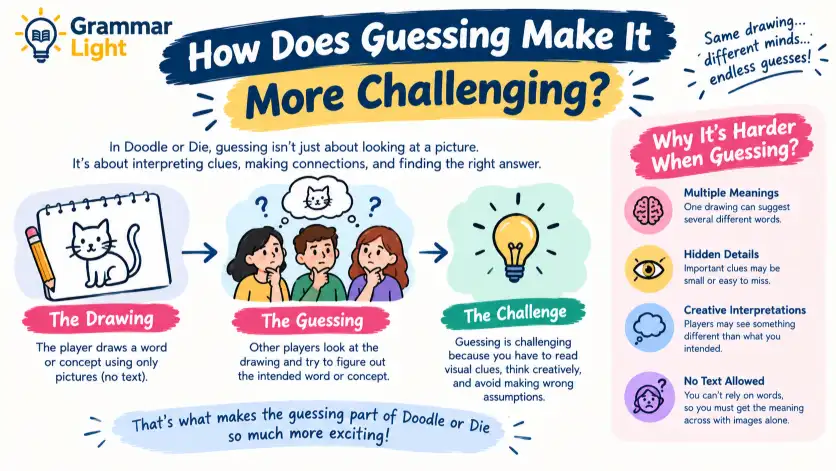
A drawing can have several possible interpretations.
For example, a few curved lines might represent a wave, a cloud, smoke, or even a road depending on the surrounding details.
Players therefore need to consider the complete picture instead of focusing on one small part.
This uncertainty is one of the reasons the format can remain entertaining from one round to another.
What Happens When Nobody Guesses Correctly?
A difficult prompt may sometimes result in several incorrect guesses.
That does not necessarily make the round unsuccessful. The incorrect answers can become part of the entertainment, especially when they are very different from the original idea.
Depending on the rules being used, the player may reveal the answer after a certain amount of time or after several unsuccessful guesses.
How Can the Game Be Made More Fun?
Different rules can change the experience.
Players can use time limits, points, difficult prompts, themed rounds, or team based guessing. Younger players can receive simpler words, while experienced players can be given abstract or unusual concepts.
A balanced set of prompts usually keeps the game challenging without making every round frustrating.
Simple Example of a Round
Imagine that the selected word is “rainbow.”
The drawing player might create a curved set of lines with several colors and place it above clouds.
The other players then study the picture and suggest possible answers.
If someone correctly identifies the rainbow, the round is complete. If not, additional clues or a time limit may determine what happens next.
Doodle or Die vs. Traditional Drawing Games
The basic drawing and guessing format is similar to other popular sketching games, but different versions can have their own rules, themes, scoring systems, and platforms.
The common element is visual communication.
Players do not simply draw for artistic purposes. They draw with the specific goal of making another person understand an idea.
Key Points to Remember
Doodle or Die is essentially a drawing and guessing concept centered on creativity, quick thinking, and visual clues.
The player creating the picture does not need to be an expert artist.
The person guessing must interpret the sketch and connect it with the possible prompt.
Simple drawings can be effective, while complicated ideas may require several visual clues.
The humor often comes from the difference between what the artist intended and what other players think they see.
How to Improve Your Drawing Strategy
A successful round is not necessarily about making the most detailed picture. The goal is to create visual clues that other players can recognize without giving the answer away too easily.
Start with the most important part of the prompt. Once the main shape is visible, add one or two details that make the subject easier to identify.
This approach keeps the drawing understandable while still leaving room for guessing.
Choosing the Right Visual Clues
Different words require different types of clues.
A physical object can often be drawn directly, while an action may be easier to show through a person or character performing it.
For an abstract idea, symbols and familiar situations can be more useful than trying to draw the concept literally.
Choosing the right clue can make a difficult prompt much easier to communicate.
Using Time Limits Effectively
A time limit can make each round faster and more exciting.
When players have only a short period to draw, they are encouraged to focus on the most important details instead of spending too much time on decoration.
Short rounds can also give everyone more opportunities to participate.
The exact time can be adjusted according to the age and experience of the players.
Easy Prompts for New Players
Beginners usually find familiar subjects easier to draw.
Good starting categories include animals, household objects, foods, vehicles, and common activities.
For example, a bicycle, apple, cat, house, or airplane can usually be represented with simple shapes.
Starting with recognizable subjects allows new players to understand the format before moving to more challenging ideas.
Challenging Ideas for Experienced Players
Once players become comfortable with the basic rules, more complicated prompts can make the activity interesting.
Abstract concepts, emotions, phrases, and situations may require several connected clues.
A player might need to combine symbols, characters, and actions to communicate a single idea.
These prompts test creativity because there may not be one obvious way to represent them.
How to Make Guessing More Interesting
Guessing becomes more engaging when players have enough information to form different possibilities.
If a drawing is immediately obvious, the round may end very quickly. If it provides no useful clues, players may become frustrated.
A good prompt and a reasonable drawing create a middle ground where the answer is challenging but still possible to discover.
Playing With Teams
Team play can add another layer of interaction.
Players can be divided into small groups, with one person drawing while teammates attempt to identify the prompt.
A scoring system can award points for correct answers within the time limit.
Team formats can work particularly well when a larger group wants everyone to participate.
Creating a Simple Scoring System
A basic scoring system does not need to be complicated.
For example, a team or player could receive points for identifying an answer before the timer ends.
Extra points could be used for especially difficult prompts if the group wants to increase the challenge.
The important part is to explain the scoring rules before the game begins so everyone understands how points are earned.
Common Drawing Mistakes
One common mistake in Doodle or Die is adding too many details before establishing the main subject.
Another problem occurs when a Doodle or Die drawing becomes too abstract for the other players to interpret.
Using text can also reduce the challenge if the rules are supposed to rely primarily on pictures.
Keeping the main idea visible and avoiding unnecessary complexity can make each Doodle or Die round easier to follow.
How to Guess More Accurately
Guessing is not just about looking at the individual shapes.
Consider the entire drawing and ask what the different elements might have in common.
If there is a person, an object, and an action in the same picture, these elements may work together to communicate the intended answer.
Players can also pay attention to the category or theme of the round if one has been provided.
The Role of Creativity
Creativity is important because some ideas cannot be represented in one obvious image.
Players may need to think about associations, symbols, visual metaphors, or sequences of actions.
There can be several possible approaches to the same prompt.
This freedom allows different players to develop completely different drawing styles while attempting to communicate the same concept.
Family Friendly Ways to Play
For younger players, prompts can focus on familiar subjects and everyday experiences.
Parents or teachers can prepare lists of simple words before the activity begins.
Rules can also be adjusted by removing difficult concepts and allowing extra drawing time.
This makes the game easier to understand while keeping the central drawing and guessing experience intact.
Classroom Activity Ideas
The format can also be adapted for educational activities.
Teachers can use vocabulary words, science concepts, historical subjects, or other lesson related terms as prompts.
Students then have to represent the selected concept visually.
This can provide an alternative way to review information while encouraging students to think about how ideas can be communicated without lengthy explanations.
Digital and Offline Versions
A drawing challenge can take place with paper and pencils or through a digital drawing surface.
An offline version requires very little preparation. Players simply need drawing materials, prompts, and a way to keep track of turns.
Digital versions can make it easier for people in different locations to participate together.
The basic principle remains the same regardless of the medium: one person communicates visually while others interpret the drawing.
Why Quick Thinking Matters
Players often have only a limited amount of time to decide what to draw.
This encourages them to prioritize important information.
Instead of trying to create a perfect illustration, the player has to decide which visual elements will communicate the idea most efficiently.
That combination of speed and creativity is an important part of the challenge.
Keeping the Game Balanced
A good game should include a mixture of easy, medium, and difficult prompts.
If every word is extremely simple, rounds may become predictable. If every prompt is difficult, players may struggle to make meaningful guesses.
Mixing different levels allows players to experience quick successes while still encountering challenging rounds.
Final Thoughts on Playing
The strongest drawing games focus on communication rather than artistic perfection.
Clear clues, suitable prompts, reasonable time limits, and simple rules can make the activity enjoyable for different types of players.
if it is played with friends, family, classmates, or a larger group, the format can be adapted to match the audience.
The unexpected guesses and creative interpretations are often what turn an ordinary drawing round into an entertaining experience.
Best Ways to Approach Difficult Prompts
Some prompts are easy to represent with a single object, while others require a more creative approach.
When a word is difficult to draw directly, think about related actions, objects, symbols, or situations. Breaking one complicated idea into smaller visual clues can make the answer easier for others to discover.
The goal is not to illustrate every possible meaning. Focus on the interpretation that best matches the selected prompt.
Turning Abstract Words Into Pictures
Abstract words can be challenging because they do not always have a physical appearance.
Ideas such as happiness, confusion, friendship, speed, or fear may need to be represented through expressions, actions, symbols, or familiar situations.
For example, an emotion could be shown through a character’s facial expression or body language rather than through a literal picture.
Using Context to Help Players Guess
The surrounding elements of a drawing can provide important information.
A single object may have several possible meanings, but adding a person, location, or action can narrow down the possibilities.
For instance, drawing a cup alone could represent several things. Adding a person drinking from it gives the other players a stronger clue.
When a Drawing Becomes Too Complicated
Adding more details does not always make a picture clearer.
Too many objects can create several possible interpretations and make the guessing process confusing.
A strong drawing usually has a clear main subject with only the supporting details needed to communicate the idea.
Using Categories to Organize Rounds
Categories can make it easier to prepare prompts before a game begins.
A round might focus entirely on animals, foods, occupations, transportation, movies, or everyday activities.
Themed rounds can also help players understand what type of answer they should expect.
Building a Good Prompt List
A balanced prompt list should contain different levels of difficulty.
Simple words can help players get comfortable with the rules. Medium level prompts can provide a greater challenge, while difficult ideas can test experienced participants.
A varied list keeps the activity feeling fresh from one round to the next.
Handling Multiple Possible Answers
Sometimes a drawing may reasonably suggest more than one answer.
For example, a picture of a person running could represent running, exercise, racing, or sports.
The prompt determines the intended answer, but the drawing can still create alternative interpretations.
What Makes a Prompt Too Easy?
A prompt may be too easy when its visual representation is immediately obvious.
If players can identify the answer within seconds every time, there may be little challenge involved.
Easy prompts are still useful for beginners, while experienced players may prefer concepts that require several clues.
What Makes a Prompt Too Difficult?
A prompt can become frustrating when there is no practical way to represent it visually.
Highly specific phrases, obscure references, or concepts with no recognizable visual connection may be difficult to communicate.
A good challenge should require creativity without making the answer impossible to convey.
Improving Communication Between Players
Players should understand the rules before the first round begins.
Clarify if letters, numbers, gestures, or written clues are allowed. Also explain how much time each person has and how answers are submitted.
Clear instructions reduce confusion and allow everyone to focus on the game.
Keeping Score Without Complicating Things
Scoring can be as simple as awarding one point for every correct answer.
For a more competitive format, additional points can be awarded when an especially difficult prompt is solved quickly.
For casual groups, complicated scoring systems are usually unnecessary.
How to Make Group Games More Inclusive
Different players may have different drawing abilities and confidence levels.
Giving everyone a chance to draw can prevent the same person from dominating every round.
Teams can also help less confident participants because players can contribute ideas together.
Funny Drawings and Unexpected Interpretations
One of the most memorable parts of a drawing game is often an answer that is completely different from the intended prompt.
A poorly understood sketch may lead players toward an unexpected interpretation.
These moments can create laughter and become memorable parts of the game.
How to Create a Friendly Competitive Atmosphere
Competition can make the game more exciting, but the rules should remain enjoyable for everyone.
Players can compete for points while still treating incorrect answers as part of the fun.
Avoiding criticism of someone’s drawing ability can also help participants feel comfortable experimenting.
Useful Materials for Offline Play
A traditional version requires only a few basic supplies.
You can use:
- Paper
- Pencils
- Pens
- Erasers
- A timer
- Prepared prompt cards
- A scoreboard
A whiteboard can also work well for larger groups.
Ways to Adapt the Rules
The basic format can be changed according to the group.
You can remove the time limit for young children, increase the difficulty for experienced players, or introduce themed rounds for special occasions.
Some groups may prefer individual competition, while others may enjoy working in teams.
Frequently Asked Questions
Which Is the Hardest Google Doodle Game?
There is no single officially recognized hardest Google Doodle game. Difficulty depends on the player’s experience, game mechanics, speed requirements, and personal skills.
Some interactive Doodles are simple and casual, while others involve puzzles, timing, strategy, or increasingly difficult challenges.
What Does “Doodle” Mean?
A doodle is a simple drawing or sketch that someone makes casually, often without planning a detailed artwork.
The term can also refer to Google’s interactive artwork and games created for special occasions, events, people, or historical moments.
How Much Is Mr. Doodle’s Net Worth?
Mr. Doodle is the artistic name of Sam Cox, a British artist known for his distinctive black and white doodle style.
There is no reliably verified public figure that can establish his exact current net worth. Online estimates may differ substantially, so they should not be treated as confirmed financial information.
Is Doodle Really Free?
The answer depends on which doodle or game is being discussed.
Google Doodles that appear on Google’s homepage are generally available to users without a separate purchase. Other games or services using the word “doodle” may have their own pricing or access rules.
What Is the #1 Hardest Game in the World?
There is no universally accepted number one hardest game in the world.
Difficulty can depend on factors such as reaction speed, strategic thinking, complexity, learning curve, and the player’s experience.
A game that is extremely challenging for one person may feel manageable to another.
Is Lucky a Girl Google Doodle?
If you are referring to Lucky, the character featured in Google’s interactive Champion Island Games Doodle, Lucky is a cat and the main playable character in the game.
The Doodle follows Lucky as she takes part in different sports and challenges across Champion Island.
The History Behind Google Doodles
Google Doodles are special changes made to the Google logo to celebrate notable events, people, achievements, holidays, and cultural moments.
Some Doodles are simply visual designs, while others become interactive experiences that users can play directly from the Google homepage.
This has helped turn the familiar logo into a creative way of introducing users to interesting stories and events.
How Interactive Doodles Became Popular
Interactive Doodles allow users to do more than simply look at an altered logo.
They may involve puzzles, sports, music, exploration, memory challenges, or other forms of interaction.
Because users can participate instead of only viewing the artwork, some interactive releases have become especially memorable.
Why Google Creates Playable Doodles
A playable Doodle can make an important event or cultural subject more engaging.
Instead of presenting information in a traditional format, Google can use animation, sound, characters, and simple game mechanics to encourage users to explore the topic.
This approach can make historical or cultural subjects easier to discover.
Famous Interactive Experiences
Over the years, Google has released interactive Doodles covering a wide range of themes.
Some have featured sports competitions, musical instruments, puzzles, coding activities, and fictional adventures.
Champion Island is one example that received considerable attention because it combined several sports challenges with an adventure style story.
What Is Champion Island?
Champion Island is an interactive Google Doodle featuring a cat named Lucky.
Players guide Lucky through different areas while participating in sports related challenges.
The experience combines exploration, characters, mini games, and a larger adventure structure rather than presenting only one short activity.
Why Players Remember Certain Doodles
Memorable interactive experiences often have more than one interesting element.
A recognizable character, enjoyable mechanics, attractive artwork, and a clear objective can encourage users to spend more time exploring.
Nostalgia can also influence how people remember older interactive releases.
Are Google Doodles Available After Their Original Date?
Some interactive Doodles can remain accessible through Google’s Doodle archive after their original homepage appearance.
The archive provides a way to explore previous artwork and interactive projects.
Availability can vary depending on the particular Doodle and its features.
How Difficult Are Interactive Doodles?
Difficulty varies significantly.
A simple activity may be designed for casual participation, while another may require timing, memory, problem solving, or strategic decisions.
For that reason, there is no universal difficulty level that applies to every interactive release.
Why People Search for the Hardest Doodle
Players who enjoy challenges may compare different interactive experiences and try to identify which ones require the most skill.
However, difficulty is partly subjective.
A puzzle may be difficult for someone who prefers action based challenges, while a fast paced game may be harder for someone who prefers slower problem solving activities.
Tips for Playing Challenging Doodles
Read the instructions before starting if they are provided.
Pay attention to patterns, timing, and repeated mechanics.
If the game involves several stages, learning the basic controls first can make later sections easier.
Taking a short break after repeated unsuccessful attempts can also help players approach the challenge with a fresh perspective.
Understanding the Difference Between Doodles and Games
Not every Google Doodle is a game.
Some are static illustrations, while others include animations or interactive elements.
A playable Doodle can function like a small browser game, but its original purpose is usually connected to a person, event, celebration, or cultural subject.
Can Doodles Be Educational?
Yes. Interactive projects can introduce users to subjects such as history, science, music, sports, culture, and technology.
For example, an activity may encourage users to learn about a historical figure while interacting with a visual experience based on that person’s work.
This combination can make learning more engaging.
The Artistic Side of Doodles
The artwork is an important part of the experience.
Artists and designers can use characters, colors, animation, typography, and visual storytelling to transform the familiar Google logo into something connected to the featured subject.
In interactive releases, the visual design also needs to support the gameplay.
Why Simple Mechanics Can Work Well
A complicated game system is not always necessary.
Simple controls can allow users to understand the experience quickly, which is especially useful when people discover a Doodle unexpectedly on the Google homepage.
The focus can then remain on the theme, story, or challenge rather than on learning complicated controls.
Doodle or Die: Final Overview
Doodle or Die can refer to a drawing and guessing concept, while Google Doodles represent a broader collection of creative Google homepage experiences.
Interactive Google Doodles have included games, puzzles, sports activities, musical experiences, and educational projects.
Their difficulty can vary widely, and there is no officially established single hardest Doodle for every player.
For anyone interested in challenging experiences, exploring different interactive releases can be a fun way to discover which mechanics match their skills.
Final Takeaways
Drawing games rely on visual communication, creativity, and interpretation.
Google Doodles can range from simple artwork to fully interactive experiences.
Champion Island is one notable example featuring Lucky and multiple sports challenges.
The difficulty of an interactive Doodle depends on its mechanics and the person playing it.
There is no universal answer to which game is the hardest because different players may struggle with different types of challenges.
Both drawing activities and interactive Doodles show how simple visual ideas can become engaging forms of entertainment.
FIND OUT MORE!

I’m a grammar writer focused on making English rules, word usage, and sentence structure simple and easy to understand.


2 thoughts on “Doodle or Die: Meaning, Game, and How It Works”