
“Venetian” and “Palazzo” are both words strongly associated with Italian architecture, design, and the city of Venice. However, they do not mean the same thing.
Venetian is an adjective that generally means something connected with Venice, its people, culture, history, or distinctive artistic style.
Palazzo is an Italian word that traditionally means a large or important building, especially a palace or grand urban residence.
Understanding this basic distinction makes it easier to recognize why the two terms may appear together in architecture, interior design, hotels, and place names.
What Is Venetian Style?
Venetian style refers to design elements associated with Venice and its artistic traditions.
It can include decorative architecture, rich materials, elaborate details, ornamental patterns, dramatic interiors, and influences that developed through Venice’s long history as an important European city.
The term can be used broadly, so its exact meaning depends on the context.
For example, Venetian inspired interior design may use luxurious textures, decorative surfaces, elegant furniture, and classical details.
What Is a Palazzo?
A palazzo is traditionally a substantial Italian building, often associated with an aristocratic family or an important institution.
The word comes from the Italian term for palace and is related to the Latin word palatium.
Historically, Italian cities developed many grand residences that were designed not only as homes but also as places where wealthy families could conduct business and receive visitors.
Some palazzi became important landmarks because of their architecture, history, and connection to prominent families.
Where Does the Word Palazzo Come From?
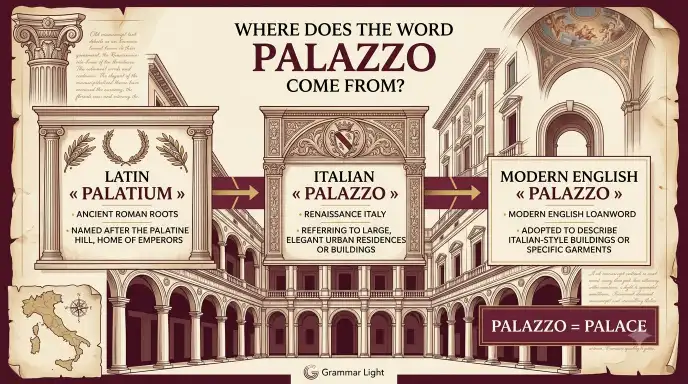
The word “palazzo” has its roots in Italian.
Its historical connection to the idea of a palace reflects the importance of large urban residences in Italian architecture.
The plural form is palazzi, which is useful to know when reading about Italian buildings or architecture.
Although people sometimes use “palazzo” simply to mean a palace, the architectural meaning can be more specific depending on the historical setting.
How Are Venetian and Palazzo Different?
The biggest difference is grammatical and conceptual.
Venetian describes a connection to Venice or something associated with its style and culture.
Palazzo identifies a type of building or grand residence.
Therefore, one word functions mainly as a description, while the other refers to a physical structure.
A Venetian palazzo, for example, would mean a palazzo located in Venice or one associated with Venetian architectural traditions.
Why Are the Terms Sometimes Used Together?
Venice is known for its historic palazzi, which line important waterways and streets throughout the city.
As a result, “Venetian” and “palazzo” naturally appear together when people discuss the city’s architecture.
A Venetian palazzo may feature elaborate facades, large windows, decorative interiors, and architectural details influenced by the city’s unique history.
The combination therefore describes both place or style and building type.
Venetian Architecture and Its Character
Venetian architecture developed under the influence of the city’s geography and extensive international connections.
Buildings often had to respond to Venice’s waterways, narrow streets, limited ground space, and distinctive urban environment.
The city’s trading history also brought different artistic influences into Venetian design.
As a result, Venetian buildings can display a mixture of European and eastern Mediterranean influences.
Features Often Seen in Venetian Palazzi
Historic Venetian palazzi can have several recognizable architectural characteristics.
These may include:
- Large windows
- Decorative facades
- Arched openings
- Elaborate stonework
- Water facing entrances
- Multiple floors
- Grand reception spaces
- Decorative interior details
Not every building contains all of these features, but they help explain the visual character commonly associated with historic Venetian residences.
Why Water Matters to Venetian Palaces
Venice was built around a network of canals, and waterways played an important role in transportation and commerce.
For some historic palazzi, the canal facing entrance was particularly significant.
Visitors could arrive by boat rather than through a conventional street entrance.
This relationship between architecture and water is one of the features that makes Venetian buildings visually distinctive.
Palazzo vs. Palace
Although “palazzo” is often translated as “palace,” the two words are not always interchangeable in everyday usage.
A palazzo can refer to a grand historic urban building that served as a residence, administrative center, or important institutional space.
The English word “palace” may suggest a royal residence, but many Italian palazzi were connected to powerful or wealthy families rather than monarchs.
Context is therefore important when translating the term.
Are All Palazzi Royal Buildings?
No.
A palazzo does not necessarily mean that a king or queen lived there.
Many historic Italian palazzi were associated with aristocratic families, wealthy merchants, government institutions, or other influential organizations.
Their size and decoration reflected the social and economic importance of the people or institutions connected with them.
Venetian Style in Modern Design
The influence of Venetian architecture is not limited to historic buildings.
Modern designers may borrow Venetian inspired elements for homes, hotels, restaurants, furniture, and decorative projects.
These designs may reinterpret classical features rather than copy an entire historic building.
For this reason, the phrase “Venetian style” can describe both historical architecture and modern decorative inspiration.
Quick Difference at a Glance
| Term | Basic Meaning | Main Use |
| Venetian | Connected with Venice | Style, culture, people, architecture |
| Palazzo | A grand Italian building or residence | Architecture |
| Venetian Palazzo | A grand building associated with Venice | Historic architecture |
Key Point to Remember
The simplest way to understand the difference is this: Venetian describes a connection to Venice, while palazzo refers to a grand Italian building or residence.
When the two terms appear together, they usually describe a grand building connected with Venice or its architectural traditions.
Architectural Details That Set Them Apart
Venetian usually describes a style, design, or architectural character connected with Venice, while Palazzo refers to a palace or large, grand building in Italian architecture. A Venetian building may have features such as ornate windows, decorative façades, balconies, and water facing entrances. A Palazzo can be identified more by its building type and historical purpose than by one specific decorative style.
How Venetian Interiors Are Recognized
Venetian inspired interiors often include rich textures, decorative details, elegant furniture, patterned surfaces, and traditional Italian influences. These elements can create a luxurious appearance while reflecting the artistic character associated with Venice.
The Role of Color in Venetian Design
Color is an important part of Venetian inspired design. Deep shades, warm metallic accents, decorative finishes, and artistic patterns are often used to create a dramatic and elegant atmosphere. Modern interpretations may use simpler colors while keeping the traditional Venetian influence.
How Palazzi Were Designed for Daily Life
Historic palazzi were generally designed as large residences or important buildings. Their layouts could include reception rooms, private living spaces, courtyards, staircases, and service areas. The size and arrangement often reflected the wealth and social position of the people who lived there.
Famous Venetian Palaces and Buildings
Venice is known for historic buildings that demonstrate the relationship between architecture, water, art, and social history. Many of these structures line canals and feature elaborate façades that have become closely associated with the city’s identity.
Palazzo Ducale and Its Importance
The Palazzo Ducale, also known as the Doge’s Palace, is one of Venice’s best known historic buildings. It was connected with the political and administrative life of the Venetian Republic and is recognized for its Gothic architecture, decorative details, and location beside St. Mark’s Square.
The Grand Canal and Historic Palazzi
The Grand Canal is lined with numerous historic palazzi. Their façades face the water, creating one of the most recognizable architectural views of Venice. These buildings demonstrate how transportation, commerce, residential life, and architecture developed together in the city.
Can Palazzo Describe a Modern Building?
Yes. The word Palazzo can also be used in the names of modern hotels, residences, offices, and other large buildings. In these cases, it often suggests a grand or palace like character rather than meaning that the building is an actual historic palace.
Venetian vs Palazzo in Interior Design
When discussing interior design, Venetian usually describes an aesthetic influence, while Palazzo can describe a grand architectural setting or a palace inspired concept. For example, Venetian design may refer to decorative finishes, while a Palazzo style interior may emphasize spacious rooms, formal details, and a luxurious atmosphere.
Can the Terms Be Used Interchangeably?
No. Venetian and Palazzo have related cultural associations, but they do not have the same meaning. Venetian is generally an adjective connected with Venice, while Palazzo is an Italian noun meaning a palace or large grand building.
Pronunciation of Venetian and Palazzo
“Venetian” is commonly pronounced as veh NEE shun. “Palazzo” is generally pronounced puh LAHT soh. Learning the pronunciation can make it easier to discuss Italian architecture and design terms correctly.
Venetian, Venetian Style, and Venetian Architecture
These expressions are closely related but can have slightly different uses. Venetian can simply mean connected with Venice. Venetian style usually describes an aesthetic inspired by the city’s artistic and architectural traditions. Venetian architecture refers more specifically to architectural forms and buildings associated with Venice.
Palazzo, Palazzi, and Italian Usage
Palazzo is the singular form, while palazzi is the plural form in Italian. The term can refer to a palace, mansion, or substantial urban building. Its exact meaning depends on the historical and architectural context.
Why the Difference Matters
Understanding the distinction helps prevent confusion when reading about hotels, architecture, interior design, and historic buildings. A name containing “Venetian” may highlight an association with Venice, while “Palazzo” often emphasizes a grand building or palace like character.
Frequently Asked Questions
What Is the Difference Between Venetian and Palazzo?
Venetian usually means something connected with Venice or inspired by Venetian culture and design. Palazzo is an Italian word for a palace or grand building. Therefore, one describes a connection or style, while the other describes a type of building.
Which Is More Expensive, Palazzo or Venetian?
If you are comparing The Palazzo and The Venetian in Las Vegas, the cost can vary depending on room type, dates, promotions, resort fees, and other booking conditions. Neither property is always more expensive because prices change over time.
Which Pool Is Better, Palazzo or Venetian?
Both The Palazzo and The Venetian are part of the same Las Vegas resort complex and offer access to resort pool areas. The better choice depends on what a guest prefers, such as atmosphere, pool location, seating, and available amenities.
Is The Venetian Connected to Palazzo?
Yes. The Venetian and The Palazzo are connected as part of the same resort complex in Las Vegas. Guests can move between the properties through connected areas, making it possible to access facilities and attractions across the complex.
Which Is Better, Venetian or Aria?
The Venetian and ARIA are different Las Vegas resorts with different designs, locations, room styles, restaurants, entertainment options, and resort experiences. The more suitable choice depends on the features a traveler values, such as room size, atmosphere, dining, entertainment, or location.
What Is the Venetian Famous For?
The Venetian in Las Vegas is especially known for its Venice inspired architecture, indoor canals, gondola rides, large resort complex, and Italian themed design. Its Grand Canal Shoppes and Venetian style surroundings are major parts of its identity.
Final Comparison
| Term | Main Meaning | Common Use |
| Venetian | Connected with Venice | Style, architecture, design, culture |
| Palazzo | Italian word for palace or grand building | Architecture, hotels, residences |
| Venetian style | Design inspired by Venice | Interiors and decoration |
| Palazzi | Plural of Palazzo | Multiple Italian palaces or grand buildings |
Final Takeaway
Venetian and Palazzo are closely associated with Italian architecture and luxury, but they describe different things. Venetian generally refers to something connected with Venice or its style, while Palazzo refers to a palace or grand building. In Las Vegas, The Venetian and The Palazzo use these concepts as part of their resort identities, but they remain distinct names within the same connected resort complex.
Historical Influence on Venetian Design
Venice developed as an important center of trade, art, and cultural exchange. Its position connected the city with different parts of Europe and the Mediterranean, and these connections influenced its architecture and decorative traditions.
As a result, Venetian design can contain a mixture of artistic influences rather than following one completely uniform style.
Materials Commonly Associated With Grand Interiors
Historic Italian interiors often made use of materials that emphasized craftsmanship and visual richness.
Marble, stone, wood, glass, metal, textiles, and decorative plaster could all contribute to the appearance of an important residence.
The choice of materials depended on the period, location, wealth of the owners, and intended function of the building.
Venetian Glass and Decorative Art
Venice is particularly associated with its long tradition of glassmaking.
The island of Murano became famous for specialized glass production, and Venetian glass developed into an important form of decorative and artistic craftsmanship.
Glass could be used for chandeliers, mirrors, decorative objects, and other interior elements.
The Importance of Murano
Murano is an island in the Venetian Lagoon that became closely connected with glassmaking.
Its artisans developed highly skilled techniques and distinctive approaches to decorative glass.
Because of this history, Murano glass is often associated with luxury interiors and Venetian inspired decoration.
How Architecture Reflected Social Status
Large historic residences could communicate the wealth and influence of their owners.
The size of a building, the quality of its materials, decorative details, artwork, and reception spaces could all contribute to its public image.
This was especially important for wealthy families who wanted their homes to demonstrate social standing.
The Difference Between Historic and Inspired Design
A genuine historic Venetian building has a specific location, history, architectural structure, and period.
A modern interior described as Venetian inspired is different. It may borrow selected elements such as ornate details, rich materials, classical forms, or decorative colors.
Therefore, “Venetian inspired” should not automatically be interpreted as historically authentic Venetian architecture.
Palazzo Architecture Beyond Venice
Although Venice has many famous palazzi, the word is not limited to the city.
Important palazzi can be found in other Italian cities, including Rome, Florence, Milan, and Turin.
Each city developed its own architectural traditions, so a palazzo in one location may look very different from another.
How Location Changes the Meaning
Context can be important when interpreting these words.
A building in Venice described as a palazzo may be discussed primarily in relation to Venetian history.
A palazzo in Florence may instead reflect Florentine Renaissance architecture.
The shared word identifies the building type, while the location provides additional architectural context.
Venetian Style in Contemporary Homes
Modern homes can incorporate selected Venetian inspired features without attempting to recreate a historic palace.
For example, a designer might combine contemporary furniture with decorative mirrors, textured walls, elegant lighting, or traditional Italian materials.
This approach creates a modern interpretation rather than a literal reproduction.
Palazzo as a Symbol of Luxury
In modern branding, the word “Palazzo” can suggest elegance, grandeur, and sophistication.
Hotels, residences, restaurants, and other businesses may use the term in their names because of these associations.
However, a name containing “Palazzo” does not by itself prove that a property is a historic Italian palace.
How to Identify a Historic Venetian Building
Several clues can help when examining a historic building in Venice.
Look for its location, construction period, architectural documentation, facade design, relationship with nearby waterways, and historical records.
Individual decorative features should not be used alone to determine if a building is authentically historic.
A proper identification usually requires broader architectural and historical context.
Why Venetian Palazzi Are Architecturally Interesting
Venetian palazzi demonstrate how architecture can respond to geography, trade, culture, and social life.
Their relationship with canals is particularly distinctive.
Large windows, decorative facades, and carefully designed interiors also reveal how practical needs and artistic ambitions could exist within the same building.
Comparing the Two Terms
| Feature | Venetian | Palazzo |
| Basic meaning | Related to Venice | Grand Italian building or residence |
| Type | Descriptive term | Building related term |
| Can describe style? | Yes | Not usually by itself |
| Can describe a building? | Yes | Yes |
| Limited to Venice? | Usually connected with Venice | No |
| Plural form | Venetian | Palazzi |
Common Confusion About the Words
One common misunderstanding is assuming that every Venetian building is a palazzo.
Venice contains many types of structures, including homes, churches, bridges, shops, public buildings, and palazzi.
Another misconception is that every palazzo must be located in Venice.
In reality, palazzi can be found throughout Italy.
When Should You Use Venetian?
Use “Venetian” when you are describing something connected with Venice.
Examples include Venetian architecture, Venetian glass, Venetian history, Venetian art, and Venetian design.
The word provides information about the connection or origin rather than identifying one specific type of building.
When Should You Use Palazzo?
Use “palazzo” when referring to a substantial Italian building or historic grand residence.
If you are discussing several such buildings, the Italian plural form is “palazzi.”
The exact historical function can vary, so the term should be understood within its architectural context.
Final Understanding
The distinction between these terms becomes simple when their roles are separated.
Venetian describes a connection with Venice, while palazzo refers to a substantial Italian building or residence.
A Venetian palazzo combines both ideas: it is a grand building associated with Venice and its architectural heritage.
Understanding this difference helps when discussing Italian architecture, interior design, historic buildings, and Venetian culture.
LEARN MORE!

A writer with a strong interest in English grammar, spelling, and word usage. The focus is on researching commonly confused words and explaining the differences in a simple and easy to understand way.








1 thought on “Venetian or Palazzo: The Ultimate Pants Style Battle Revealed”