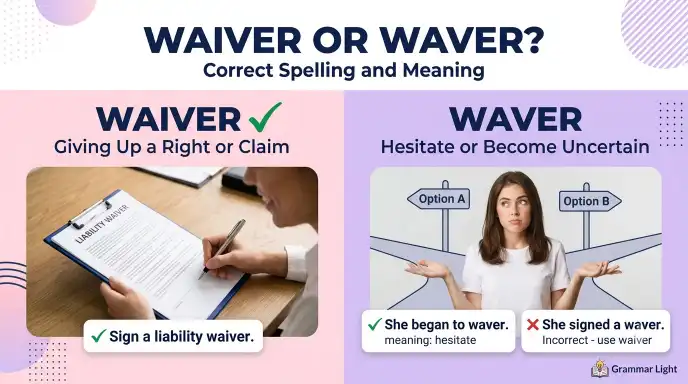
Waiver and waver are two different words with different meanings. A waiver is usually a document or an act of giving up a right, claim, fee, or requirement. In contrast, waver is a verb that means to hesitate, become uncertain, or move unsteadily. Although these words look and sound similar, they cannot be used interchangeably.
People often search for waiver or waver when writing legal documents, completing forms, discussing fees, or describing someone who is unsure about a decision. Choosing the wrong word can change the meaning of a sentence. For example, signing a waiver means agreeing to give up a particular right or claim, while wavering means struggling to remain confident or make a firm decision.
Understanding the difference is useful for students, professionals, writers, and anyone who wants to communicate clearly in English. The easiest way to remember the distinction is to focus on the action or idea being described: waiver relates to giving something up, while waver relates to hesitation or instability. This guide explains their meanings, origins, grammatical roles, common mistakes, and everyday examples to help you choose the correct word confidently.
Waiver or Waver: Quick Answer
Waiver is a noun that refers to the act of giving up a right or requirement, or to a document that confirms such an arrangement. Waver is a verb that means to hesitate, become uncertain, or move unsteadily.
Here is the difference at a glance:
- Waiver: The student received a tuition fee waiver.
- Waver: She began to waver before accepting the offer.
In the first sentence, waiver refers to an exemption from paying a fee. In the second, waver describes uncertainty before making a decision.
Remember these simple rules:
- Use waiver when discussing a document, exemption, or surrendered right.
- Use waver when describing hesitation, uncertainty, or unsteady movement.
- Waiver is a noun, while waver is generally a verb.
Definition and Meaning of Waiver
A waiver is a noun that means voluntarily giving up a right, claim, privilege, or requirement. It can also refer to a written document that records this decision or confirms that a particular condition does not apply.
The word appears frequently in legal agreements, education, sports, business, and everyday administrative situations. A waiver does not always mean that someone gives up every right; its exact effect depends on the terms and circumstances involved.
Common Uses of Waiver
1. Legal documents
A waiver may be used when someone agrees to give up a particular claim or acknowledges certain risks.
Example: Participants signed a liability waiver before joining the climbing activity.
2. Fees and payments
Schools, colleges, businesses, and organizations sometimes reduce or remove fees through a waiver.
Example: The university granted her a tuition fee waiver because she met the eligibility requirements.
3. Rules and requirements
An organization may allow an exception to a specific rule through an approved waiver.
Example: The applicant requested a waiver of the experience requirement.
4. Sports and recreational activities
Sports facilities may ask participants to sign waivers before taking part in certain activities.
Example: Every player had to complete a participation waiver before the tournament began.
More Examples of Waiver in Sentences
- The company approved a waiver of the late payment fee.
- Please read the liability waiver before signing it.
- His application for a medical fee waiver was accepted.
- The school offered a waiver for eligible students.
- She signed the waiver after reviewing the conditions.
Key point: Use waiver when the sentence refers to giving up a right, receiving an exemption, or discussing a document that records such an arrangement.
Definition and Meaning of Waver
Waver is a verb that means to hesitate, become uncertain, weaken in determination, or move unsteadily. It describes a change in confidence, intention, or physical steadiness rather than a document or formal exemption.
The word is often used when someone struggles to make a decision or becomes less certain about a choice. It can also describe something that moves irregularly, such as a flame flickering in the wind.
Common Uses of Waver
1. Hesitation when making a decision
A person may waver when they are unsure which option to choose.
Example: He began to waver when the interviewer asked him to make a final decision.
2. Confidence or determination
Someone’s resolve may waver when they face pressure, criticism, or difficulty.
Example: Despite the challenges, her determination never wavered.
3. Feelings and beliefs
The verb can describe uncertainty about a belief, opinion, or commitment.
Example: His confidence in the plan started to waver after the unexpected setback.
4. Physical movement
Waver can also describe movement that is not steady or consistent.
Example: The candle flame began to waver in the evening breeze.
More Examples of Waver in Sentences
- Do not waver when you know you have made the right choice.
- Her voice began to waver as she spoke about the emotional experience.
- The candidate did not waver in his commitment to the project.
- My confidence started to waver after receiving the criticism.
- The light seemed to waver in the distance.
Key point: Use waver when describing hesitation, weakening confidence, uncertainty, or unsteady movement.
The Origin of Waiver and Waver
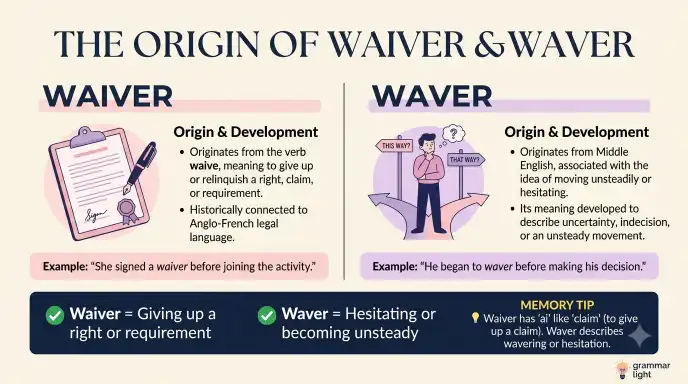
Although waiver and waver look similar, they developed different meanings and grammatical uses.
Waiver is connected to the verb waive, which means to give up, surrender, or refrain from enforcing a right or claim. Over time, waiver became the noun used for the act of giving something up and for documents recording that decision.
Waver developed with the meaning of moving unsteadily or becoming hesitant. Its modern use includes uncertainty in decisions, confidence, beliefs, and physical movement.
The similarity between the words can make them confusing, especially when someone is writing quickly. However, their meanings provide a reliable way to distinguish them.
For example:
- Waiver: The manager approved a waiver of the additional charge.
- Waver: The manager began to waver after hearing the objections.
The first sentence describes an exemption. The second describes uncertainty.
Remember: Their spellings are similar, but their meanings and grammatical roles are different.
Waiver vs. Waver: Key Differences
The main difference between waiver and waver is their meaning and part of speech. Understanding these differences helps you choose the correct word in formal and informal writing.
| Feature | Waiver | Waver |
| Part of speech | Noun | Verb |
| Main meaning | Giving up a right or receiving an exemption | Hesitating or becoming uncertain |
| Common contexts | Legal forms, fees, rules, permissions | Decisions, confidence, beliefs, movement |
| Example | She signed the waiver. | She began to waver. |
| Related word | Waive | Wavered, wavering |
How to Remember the Difference
A simple memory trick can help you avoid this spelling mistake.
- Waiver = a right or requirement is waived.
- Waver = a person or thing becomes unsteady or uncertain.
Consider these examples:
Correct: The athlete signed a waiver before the competition.
Correct: The athlete did not waver under pressure.
Both sentences are grammatically correct, but the words serve different purposes. The first refers to a document, while the second describes the athlete’s determination.
Important: If you can replace the word with document or exemption, you probably need waiver. If you can replace it with hesitate or become uncertain, you probably need waver.
British English vs. American English: Waiver or Waver
The words waiver and waver have the same meanings and spellings in British English and American English. There is no regional spelling difference between these two words.
Writers in both countries use waiver when referring to an exemption or the act of giving up a right. Similarly, waver is used to describe hesitation, uncertainty, or unsteady movement.
| Usage | British English | American English |
| Giving up a right | Waiver | Waiver |
| An exemption from a fee | Waiver | Waiver |
| Hesitating before a decision | Waver | Waver |
| Becoming less confident | Waver | Waver |
Examples in British and American English
- British English: The student received a fee waiver.
- American English: The student received a fee waiver.
- British English: She did not waver in her determination.
- American English: She did not waver in her determination.
The sentences are correct in both varieties of English. The words do not need to change based on the intended audience.
Key takeaway: Choose between waiver and waver according to the meaning of your sentence, not the country where you are writing.
Which Word Should You Use: Waiver or Waver?
Choosing the correct word becomes easier when you identify what you want to communicate. Think about if your sentence describes an exemption or someone’s uncertainty.
Use Waiver for Documents and Exemptions
Choose waiver when discussing a document, a right being surrendered, or an exception to a requirement.
Examples:
- The college approved my tuition waiver.
- You must sign a liability waiver before participating.
- The organization granted a waiver of the application fee.
- The applicant requested a waiver of the usual requirement.
In these examples, the word refers to a formal arrangement, an exemption, or the act of giving something up.
Use Waver for Hesitation and Uncertainty
Choose waver when someone hesitates, loses confidence, or struggles to remain firm in a decision.
Examples:
- She began to waver when she heard the unexpected news.
- His determination did not waver during the difficult period.
- I started to waver between the two options.
- The speaker’s voice began to waver with emotion.
Here, the word describes an action or change in someone’s confidence or steadiness.
A Simple Test Before You Write
Ask yourself one question: Am I describing an exemption, or am I describing hesitation?
- If the answer is an exemption or surrendered right, choose waiver.
- If the answer is hesitation or uncertainty, choose waver.
This quick check works in emails, essays, business documents, applications, and everyday conversations.
Common Mistakes When Using Waiver and Waver
Because the two words look similar, writers sometimes choose the wrong spelling. The following mistakes show how to recognize and correct them.
Mistake 1: Using Waver for a Legal Document
Incorrect: Please sign the waver before entering the gym.
Correct: Please sign the waiver before entering the gym.
Why: The sentence refers to a document that participants must sign. Therefore, waiver is the correct noun.
Mistake 2: Using Waiver to Describe Hesitation
Incorrect: She began to waiver before accepting the offer.
Correct: She began to waver before accepting the offer.
Why: The sentence describes uncertainty about a decision. The correct verb is waver.
Mistake 3: Confusing a Fee Waiver With Uncertainty
Incorrect: The student requested a waver of the registration fee.
Correct: The student requested a waiver of the registration fee.
Why: A fee waiver removes or reduces a payment requirement. It does not describe hesitation.
Mistake 4: Assuming the Words Are Interchangeable
Incorrect: His confidence began to waiver during the interview.
Correct: His confidence began to waver during the interview.
Why: Confidence can waver when someone becomes uncertain. A waiver is not the correct word for this meaning.
Mistake 5: Forgetting the Grammatical Difference
The two words also behave differently in sentences.
- Waiver is a noun: The company approved the waiver.
- Waver is a verb: The company refused to waver in its decision.
Remember: Checking the meaning and grammatical role of the word is more reliable than choosing whichever spelling looks familiar.
Waiver or Waver in Everyday Examples
Seeing the words in different situations can help you understand how to use them naturally.
Examples With Waiver
1. Education
The school offered a fee waiver to eligible students.
2. Sports
Every participant signed a liability waiver before the event.
3. Business
The customer asked the company for a waiver of the cancellation fee.
4. Applications
The applicant submitted a request for a waiver of the experience requirement.
5. Travel and activities
Visitors were asked to complete a waiver form before participating in the activity.
Examples With Waver
1. Decision making
I began to waver when I realized how difficult the choice would be.
2. Confidence
Her confidence did not waver after the criticism.
3. Public speaking
His voice started to waver when he discussed the personal experience.
4. Determination
The team refused to waver in its commitment to the goal.
5. Physical movement
The candlelight seemed to waver as the wind entered the room.
Compare Both Words in Similar Situations
Consider these paired examples:
- The employee signed a waiver before beginning the assignment.
- The employee began to waver after hearing the concerns.
- The organization approved a waiver of the fee.
- The manager did not waver in the final decision.
- The participant completed the waiver form.
- The participant’s confidence began to waver.
These examples demonstrate the essential distinction: a waiver concerns a right, requirement, or document, while waver describes hesitation or instability.
Tips for Avoiding the Waiver or Waver Spelling Mistake
A few practical habits can help you remember which word belongs in your sentence.
1. Connect Waiver With Waive
The noun waiver is closely related to the verb waive. Both involve giving up or setting aside a right, fee, or requirement.
Example: The manager agreed to waive the charge and issued a waiver.
2. Connect Waver With Hesitation
Think of waver as a word that describes uncertainty or a lack of steadiness.
Example: She began to waver when she had to choose between two opportunities.
3. Identify the Part of Speech
Check how the word functions in the sentence. If it names a document or exemption, waiver is usually appropriate. If it describes an action, such as hesitating or becoming uncertain, waver is the better choice.
4. Read the Entire Sentence
Do not select a spelling based on the words immediately around it. Read the whole sentence to determine its intended meaning.
For example, “He signed the ” points toward waiver, while “He began to ” may point toward waver, depending on the context.
5. Proofread Important Documents
Legal forms, applications, professional emails, and school assignments deserve careful proofreading. A single spelling choice can change the meaning of your sentence, so confirm that the word communicates the intended idea.
Frequently Asked Questions About Waver or Waiver
Q.1 What is the difference between waiver and waver?
Waiver is a noun referring to the act of giving up a right or to a document that records an exemption. Waver is a verb meaning to hesitate, become uncertain, or move unsteadily.
Q.2 Is waiver a noun or a verb?
Waiver is a noun. It commonly refers to an exemption, a surrendered right, or a document confirming that arrangement. The related verb is waive.
Q.3 Is waver a noun or a verb?
Waver is primarily a verb. It describes hesitation, uncertainty, weakening determination, or unsteady movement.
Q.4 How do you use waiver in a sentence?
You can use waiver when discussing a document or exemption.
Example: The student received a waiver of the application fee.
Q.5 How do you use waver in a sentence?
Use waver when describing uncertainty or hesitation.
Example: She refused to waver in her decision to pursue her goals.
Q.6 Is it a fee waiver or fee waver?
The correct expression is fee waiver because it refers to the removal or reduction of a fee. Fee waver is incorrect for this meaning.
Q.7 Is it a liability waiver or liability waver?
The correct expression is liability waiver. It refers to a document concerning liability or the giving up of certain claims, depending on its terms.
Q.8 Can waver mean to change your mind?
Waver can describe becoming uncertain or hesitating about a decision. It does not necessarily mean that someone has changed their mind; the person may simply be struggling to decide.
Example: He began to waver but ultimately kept his original decision.
Q.9 Are waiver and waver pronounced the same way?
In standard English pronunciation, waiver and waver are pronounced the same or very similarly, which helps explain why people confuse them. Their meanings and grammatical roles are different.
Q.10 Do British and American English use different spellings?
No. Both British and American English use waiver and waver with the same spellings and meanings. The correct choice depends on context rather than regional spelling conventions.
Final Thoughts: Waiver or Waver
The difference between waiver and waver is straightforward once you understand what each word means. Waiver is a noun used for an exemption, a surrendered right, or a document that records such an arrangement. Waver is a verb that describes hesitation, uncertainty, weakening determination, or unsteady movement.
Use waiver when discussing fee exemptions, liability forms, permissions, and requirements. Choose waver when describing a person who hesitates or becomes less confident.
Both words have the same spellings in British and American English, so regional differences are not the issue. The key is understanding the meaning of your sentence.
Quick reminder: Waiver means giving up a right or requirement; waver means hesitating or becoming unsteady. Keeping this distinction in mind will help you write more accurately in everyday conversations, academic work, and professional documents.
YOU MAY LIKE!

I’m a grammar writer focused on making English rules, word usage, and sentence structure simple and easy to understand.





1 thought on “Waiver or Waver: The Simple Trick to Remember the Difference”