
ASCAP and BMI are performing rights organizations (PROs) that help songwriters, composers, and music publishers collect royalties when their music is publicly performed. However, they differ in their membership terms, organizational structure, licensing practices, and contract details. Choosing between them depends on your career goals, music catalog, and the agreement that best fits your needs.
Musicians often search for ASCAP or BMI because they want to understand which organization is better for collecting performance royalties. New songwriters may also be confused about If joining both organizations is necessary, how payments work, and If their choice affects their ability to earn money from music.
The good news is that both organizations serve a similar purpose: they help music creators receive compensation when their songs are performed in settings such as concerts, restaurants, radio broadcasts, television programs, and other licensed public performances.
Understanding the differences between ASCAP and BMI can help you make a more informed decision before registering your songs. This guide explains their meanings, origins, key differences, membership considerations, common mistakes, and practical examples so you can choose the option that suits your music career.
ASCAP or BMI : Quick Answer
ASCAP and BMI are both U.S. performing rights organizations that collect and distribute performance royalties to songwriters, composers, and music publishers. Neither organization is automatically better for every musician.
- ASCAP: The American Society of Composers, Authors and Publishers. It operates as a membership based organization representing music creators and publishers.
- BMI: Broadcast Music, Inc. Historically, BMI was established to represent a broad range of music creators and publishers and operates under its current corporate structure.
For example, if you write a song that is played on the radio or performed publicly, your performing rights organization may collect eligible performance royalties and distribute your share according to its rules.
The best choice depends on the membership agreement, payment policies, registration requirements, and your individual circumstances.
Definition and Meaning of BMI or ASCAP
What Does ASCAP Mean?
ASCAP stands for the American Society of Composers, Authors and Publishers. It is a U.S. performing rights organization that represents songwriters, composers, and music publishers.
Its primary role is to license public performances of musical works, collect applicable royalties, and distribute payments to its affiliated members.
ASCAP may be relevant to people who write songs, compose instrumental music, or publish musical works. Its licensing activities help music users legally perform covered music while compensating the people who created and own the relevant rights.
What Does BMI Mean?
BMI stands for Broadcast Music, Inc. It is another major U.S. performing rights organization that licenses public performances of musical compositions and distributes performance royalties to eligible songwriters, composers, and publishers.
BMI works with music users such as broadcasters, venues, businesses, and other organizations that publicly perform music. It collects applicable licensing fees and distributes royalties according to its policies and agreements.
For songwriters, joining BMI can provide a way to manage performance royalty collection for registered musical works.
What Is the Simple Difference Between ASCAP and BMI?
The simple difference is that ASCAP and BMI are separate organizations performing a similar function. Both help music creators collect royalties from covered public performances, but their contracts, administrative processes, and membership arrangements may differ.
| Feature | ASCAP | BMI |
| Full name | American Society of Composers, Authors and Publishers | Broadcast Music, Inc. |
| Main purpose | Performance licensing and royalty distribution | Performance licensing and royalty distribution |
| Serves | Songwriters, composers, and publishers | Songwriters, composers, and publishers |
| Organization | Membership based organization | Operates under its current corporate structure |
| Main consideration | Membership terms and services | Membership terms and services |
Both organizations focus on performance royalties for musical compositions. They do not automatically collect every type of music related income, such as all recording sales, merchandise revenue, or every form of streaming income.
The Origin of ASCAP and BMI
How Did ASCAP Begin?
ASCAP was founded in 1914 in the United States. It was established to protect the rights of composers, authors, and publishers whose musical works were being performed publicly.
Before performing rights organizations became established, it was difficult for individual creators to monitor every public performance of their work and collect appropriate compensation. ASCAP helped create a system through which music users could obtain licenses and creators could receive royalties.
Over time, the organization expanded its licensing and royalty distribution activities to serve a wide range of musical styles and creators.
How Did BMI Begin?
BMI was founded in 1939 in the United States. It emerged during a period when radio broadcasting and recorded music were changing the music industry.
The organization helped broaden the representation of musical works and creators within the performing rights system. Its history includes representing genres and songwriters that were not always as widely represented in the established industry.
BMI subsequently developed into a major organization for licensing musical performances and distributing royalties.
Why Are ASCAP and BMI Different Names?
ASCAP and BMI were created at different times and developed through different organizational histories. Their names reflect their original identities and purposes.
Although both organizations now perform similar core functions, they remain separate entities with their own agreements, systems, policies, and administrative processes.
Their different names do not mean that one collects all music royalties while the other collects only a particular type. Both primarily deal with public performance rights in musical compositions.
British English vs American English Spelling
ASCAP and BMI are proper names and acronyms, not alternative British and American spellings of the same word. Their official names do not change according to the English variety you use.
However, musicians in the United States, United Kingdom, and other English speaking countries may encounter different spelling conventions when reading about music rights.
| American English | British English | Example |
| Organization | Organisation | A music rights organization |
| License (noun or verb, in U.S. usage) | Licence (noun) / License (verb) | A public performance licence |
| Catalog | Catalogue | A songwriter’s music catalogue |
| Royalties | Royalties | Performance royalties |
| Copyright | Copyright | Copyright protection for a song |
The table illustrates general spelling differences rather than differences in the official names of ASCAP and BMI.
Do ASCAP and BMI Change Names in British English?
No. ASCAP remains ASCAP, and BMI remains BMI, regardless of If an article follows American or British spelling conventions.
For example, a British publication might write, “The organisation collects royalties,” while an American publication might use, “The organization collects royalties.” Both can refer to the same U.S. organization.
The important distinction is to preserve official names and use consistent spelling in the surrounding text.
Which Spelling Should You Use?
For American Readers
If your audience is based in the United States, use American English spelling throughout the article. Write “organization,” “license,” and “catalog” where appropriate.
When discussing the two organizations, use their official names on first mention and their abbreviations afterward.
For British and Commonwealth Readers
For readers in the United Kingdom and other regions that commonly follow British English, use conventions such as “organisation,” “licence” as a noun, and “catalogue.”
However, do not alter the official names of ASCAP or BMI. Both are U.S. organizations, and their names remain unchanged.
For a Global Audience
If your content targets musicians worldwide, use clear, internationally understandable English. Explain technical terms such as “performing rights organization” when they first appear.
The most important rule is consistency. Your spelling style should match your intended audience, but the names ASCAP and BMI must remain accurate.
It is also important to understand that ASCAP and BMI are U.S. organizations. Songwriters living in other countries may need to consider their local performing rights organization, international royalty arrangements, and the eligibility requirements of any organization they plan to join.
Common Mistakes With ASCAP or BMI
Assuming One Organization Is Always Better
A common mistake is believing that every songwriter should choose ASCAP or that BMI is always the better option. The right choice depends on the songwriter’s circumstances, membership agreement, and professional needs.
Correction: Compare current terms, eligibility, administrative services, and royalty policies before making a decision.
Confusing Performance Royalties With All Music Income
ASCAP and BMI primarily handle performance royalties for musical compositions. These are different from royalties earned through sound recording sales, certain recording related uses, merchandise, and other revenue streams.
Correction: Learn which rights and income streams each organization covers. Other agreements or services may be necessary to collect other forms of income.
Believing Song Registration Replaces Copyright Protection
Registering a composition with a performing rights organization is not the same as registering a copyright with the U.S. Copyright Office.
Correction: Understand the separate purposes of copyright protection and performing rights administration.
Thinking You Must Join Both Organizations
Songwriters sometimes assume they need memberships with both ASCAP and BMI to collect all performance royalties.
Correction: A songwriter generally affiliates with one performing rights organization for the same role and repertoire at a time, subject to applicable contracts and rules. Review the current agreement before joining or switching.
Ignoring Contract Terms
Membership duration, resignation procedures, payment schedules, and other conditions can affect your decision.
Correction: Read the current agreement carefully. Do not rely on outdated blog posts or assumptions about fees and contract lengths.
Forgetting to Register Songs Correctly
Even after joining an organization, creators need to follow the applicable work registration process and provide accurate ownership information.
Correction: Check that song titles, co writers, publisher details, and ownership shares are correct. Accurate information helps reduce administrative problems.
ASCAP or BMI in Everyday Examples
Understanding these organizations becomes easier when you consider how songwriters may encounter them in everyday professional situations.
Example 1: A Songwriter Releases a New Song
A songwriter creates an original song and wants to collect performance royalties when it is played publicly.
They compare ASCAP and BMI, review their eligibility requirements, and choose an organization. After joining, they follow the relevant process to register their composition and provide accurate information.
Key point: Joining an organization and correctly registering a song are important steps, but royalty payments depend on applicable licensing, reporting, and distribution rules.
Example 2: A Song Is Played on the Radio
A songwriter’s composition is broadcast on a licensed radio station. The relevant performance data may be used to determine royalties payable under the applicable system.
The songwriter’s performing rights organization processes eligible performance information and distributes royalties according to its policies.
Key point: A public performance can generate performance royalties, but the amount and eligibility depend on the circumstances and reporting rules.
Example 3: A Musician Performs at a Venue
A singer performs original songs at a public venue. Depending on the circumstances, the venue may need a public performance licence covering the music performed.
ASCAP or BMI may license the relevant compositions if those works are within its represented repertoire and the applicable licensing arrangements.
Key point: Licensing responsibilities and royalty distributions depend on the venue, repertoire, and relevant agreements.
Example 4: Two Songwriters Collaborate
Two writers create a song together and agree on their respective ownership shares. They need to provide accurate information when registering the composition.
If both writers are affiliated with different organizations, they should check the relevant registration, representation, and royalty administration rules rather than assuming the same song can be handled identically in every situation.
Key point: Co writer details and ownership shares should be agreed upon and recorded accurately.
Example 5: A British Songwriter Works With a U.S. Publisher
A songwriter living in the United Kingdom collaborates with an American publisher. The songwriter may need to understand the publisher’s agreement, the role of the relevant performing rights organizations, and how international performance royalties are administered.
Key point: Living outside the United States does not automatically explain which organization or arrangement is best. Eligibility, representation, and contractual terms should be checked individually.
ASCAP vs. BMI: Key Differences for Songwriters
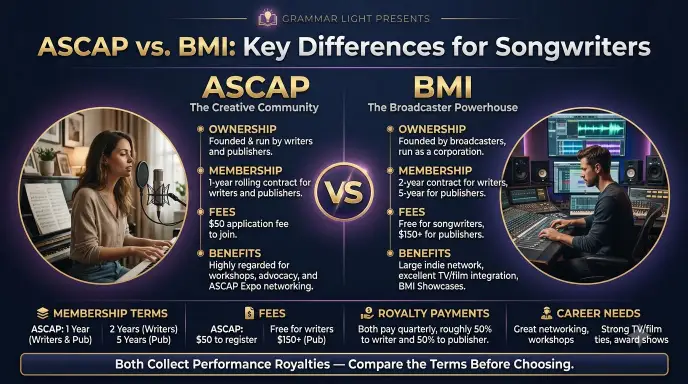
Although ASCAP and BMI perform similar functions, several practical differences may influence a songwriter’s decision. Before choosing an organization, compare its current membership rules, payment procedures, contract conditions, and services.
Membership and Eligibility
ASCAP and BMI have their own membership requirements for songwriters, composers, and publishers. The application process and eligibility criteria can vary according to the type of membership.
Before applying, confirm that you meet the current requirements for your role. A songwriter’s eligibility may differ from that of a music publisher, so do not assume that every applicant follows the same process.
Membership Fees
Membership costs can be an important consideration, particularly for independent musicians who are starting their careers.
ASCAP has historically charged an application fee for certain songwriter and publisher memberships, while BMI has offered songwriter membership without an application fee under its applicable terms. Fees and policies can change, so check the organizations’ official websites before applying.
Do not choose an organization based on an old fee comparison alone. Review the current requirements and any costs that apply to your particular membership.
Royalty Collection and Distribution
Both organizations collect performance royalties for musical compositions within their respective licensing and representation arrangements.
However, the amount a songwriter receives can depend on several factors, including the type of performance, applicable distribution rules, reporting data, and the songwriter’s ownership share.
Neither ASCAP nor BMI guarantees that every member will earn more money. Your results depend largely on how, where, and how often your music is used, along with the rules governing eligible royalties.
Contracts and Membership Terms
Contract terms deserve careful attention before you join either organization. Membership duration, resignation procedures, renewal conditions, and restrictions may affect your ability to change organizations later.
Read the agreement that applies to your membership category. If you are already affiliated with a performing rights organization, verify the applicable resignation and transition requirements before making a switch.
Is ASCAP or BMI Better for Independent Artists?
Independent artists often write, record, release, and promote their own music. If you are an independent musician, both ASCAP and BMI may be relevant options for collecting eligible performance royalties.
The best choice depends on your needs rather than your status as an independent artist.
When ASCAP May Suit You
ASCAP may be a suitable choice if its membership structure, services, and current terms fit your situation. Songwriters who value its available resources and administrative services may find it appropriate for their professional needs.
Before joining, review the membership requirements, applicable fees, and policies concerning your musical works.
When BMI May Suit You
BMI may be a suitable choice if its current membership arrangements and services fit your needs. Its songwriter representation and performance royalty administration can make it an option worth considering.
As with ASCAP, review the relevant agreement and payment policies before applying.
What Should Independent Artists Compare?
Consider these factors before making your decision:
- Eligibility: Confirm that you qualify for the membership category you need.
- Fees: Check current application costs and any other applicable charges.
- Contract terms: Understand the membership period and switching procedures.
- Royalty administration: Review how performances are identified and royalties are distributed.
- Support and resources: Compare available tools, educational materials, and member services.
- Career plans: Consider your future songwriting, publishing, and collaboration arrangements.
Practical advice: Choose the organization whose current terms and services best fit your circumstances. Do not assume that joining a particular organization will automatically increase your royalties.
Can You Join ASCAP and BMI at the Same Time?
In general, a songwriter cannot simply affiliate with both ASCAP and BMI simultaneously for the same songwriter role and musical repertoire as though the memberships were interchangeable. The applicable agreements and affiliation rules determine what is permitted.
Songwriters should distinguish between their own songwriter affiliation and the separate arrangements that may apply to music publishers, co writers, or other rights holders.
What If You Want to Switch Organizations?
Switching may be possible, but the process depends on your current agreement and the rules in effect when you request the change.
Before leaving one organization, check:
- Your current membership agreement and term.
- Any notice or resignation requirements.
- The appropriate timing for a new affiliation.
- How existing compositions and publisher relationships will be handled.
- If any outstanding royalty payments or administrative matters need attention.
Avoid cancelling an existing membership before understanding the transition process. Incorrect timing or incomplete registrations can create unnecessary administrative difficulties.
For the most accurate guidance, consult the current membership terms published by ASCAP or BMI.
Do ASCAP and BMI Collect Royalties From Spotify?
ASCAP and BMI can collect performance royalties associated with eligible public performances of musical compositions, including certain digital music uses. However, music streaming involves different rights and royalty streams, so it is important not to treat every Spotify payment as a performing rights royalty.
A recording of a song involves at least two distinct copyright interests:
- The musical composition: The underlying lyrics and music written by the songwriter or composer.
- The sound recording: The particular recorded performance of that composition.
Performing rights organizations primarily deal with performance royalties for musical compositions. Payments associated with sound recordings and other streaming income may be administered through different agreements and services.
How Can Songwriters Receive Streaming Related Royalties?
The relevant payment route depends on the type of royalty, the songwriter’s agreements, the country involved, and the service’s licensing arrangements.
A songwriter may need to consider a performing rights organization alongside a publisher, publishing administrator, or other royalty collection arrangement.
Joining ASCAP or BMI does not automatically collect every royalty generated by a song on Spotify. Understand which rights you own and which organizations or services administer each income stream.
Common Questions About ASCAP or BMI
Q.1 Is ASCAP better than BMI?
Neither organization is automatically better for every songwriter. Both help collect performance royalties for musical compositions, but their membership terms, fees, services, and administrative policies may differ. Compare current agreements and choose the option that best fits your professional needs.
Q.2 Is BMI free to join?
BMI has historically offered songwriter membership without an application fee under its applicable terms, while ASCAP has charged fees for certain memberships. Because policies can change, verify the current cost directly with each organization before applying.
Q.3 Does ASCAP pay more than BMI?
Not necessarily. Payments depend on eligible performances, reporting data, royalty distribution policies, ownership shares, and other factors. There is no universal guarantee that a songwriter will earn more with one organization than the other.
Q.4 Can I switch from ASCAP to BMI?
A switch may be possible, but you must follow the resignation, notice, and affiliation requirements that apply to your existing agreement. Check the current terms before starting the process to avoid problems with your membership or song registrations.
Q.5 Do I need ASCAP or BMI if I am an independent artist?
You may benefit from joining a performing rights organization if you write or own musical compositions that receive eligible public performances. However, If you need one depends on your rights, career plans, and existing royalty arrangements.
Q.6 Do ASCAP and BMI protect my copyright?
No. Their primary role is licensing public performances and administering related royalties for musical compositions. Copyright protection is a separate legal matter. In the United States, copyright generally arises when an original work is fixed in a tangible medium, while registration with the U.S. Copyright Office provides additional legal benefits.
Q.7 Can producers join ASCAP or BMI?
Producers may qualify if they also work as songwriters, composers, or music publishers and meet the applicable membership requirements. Merely producing a recording does not automatically make someone a songwriter or entitle them to a songwriter’s share of performance royalties.
Q.8 Do ASCAP and BMI collect royalties internationally?
Both organizations participate in arrangements that can facilitate the administration of performance royalties involving music uses in different countries. International collection depends on reciprocal agreements, local rights organizations, applicable laws, and the particular use of the music.
Final Thoughts: ASCAP or BMI
Choosing between ASCAP and BMI is an important decision for songwriters who want to manage their performance royalties effectively. Both organizations help music creators receive compensation for eligible public performances, but their membership arrangements, fees, contract terms, and services should be evaluated separately.
The best option is the one that fits your membership needs, career goals, and contractual circumstances not necessarily the organization another musician recommends.
Before joining, verify the latest requirements, understand which royalties the organization handles, and make sure your musical works and ownership information are registered correctly. If you write music for international audiences, also consider how performance royalties are administered across countries.
By comparing the details carefully, you can make a more informed decision about ASCAP or BMI and build a clearer plan for managing your music rights.
DISCOVER MORE!