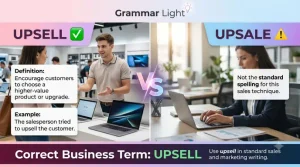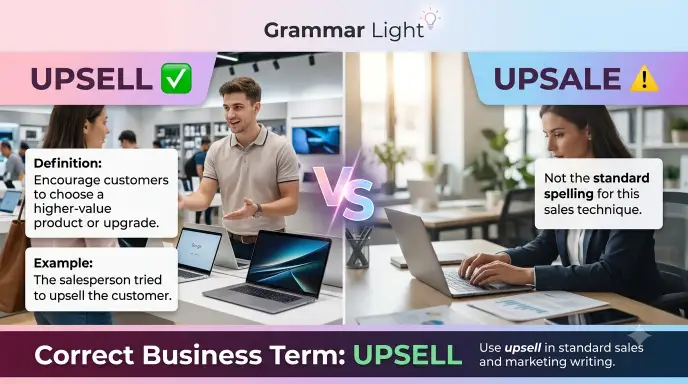
Upsell is the standard English word used in sales and marketing when a business encourages a customer to purchase a more expensive product, upgrade, or additional feature. Upsale is not the standard spelling of this common sales term. People often confuse these forms because they sound similar and both appear related to selling. However, using the correct word is important in business reports, marketing materials, emails, product descriptions, and professional communication.
For example, a phone company may upsell a customer by recommending a model with more storage, while a software company may encourage users to upgrade to a premium subscription. In both situations, upsell is the appropriate term.
Understanding upsell or upsale helps you avoid common spelling mistakes and communicate more clearly. The distinction is particularly useful for students, writers, business owners, sales professionals, and marketers who want to use accurate English.
This guide explains the definitions, origins, regional usage, and differences between these terms. You will also learn how to use upsell in everyday sentences and recognize common mistakes.
Upsell or Upsale : Quick Answer
The main difference between upsell and upsale is their accepted usage in modern English.
- Upsell: The established term for encouraging a customer to buy a more expensive product, upgrade a service, or purchase additional features.
- Upsale: An uncommon form that is generally considered a misspelling when used instead of the standard sales term upsell.
The correct choice for ordinary sales and marketing writing is upsell.
Examples of Upsell
- The salesperson tried to upsell me to a more powerful laptop.
- Our company uses product recommendations to upsell existing customers.
- The restaurant server offered to upsell us to a larger meal.
- The software provider wants to upsell customers to its premium plan.
- The marketing team developed a new upsell strategy to encourage customers to choose upgraded products.
These examples show how upsell describes an attempt to increase the value of a sale by offering a higher priced product or service.
What About Upsale?
Upsale is not the preferred spelling of the standard sales and marketing term.
For example:
Incorrect: The company uses upsale techniques to increase revenue.
Correct: The company uses upsell techniques to increase revenue.
Other preferred expressions include:
- Upsell strategy
- Upsell opportunity
- Upsell offer
- Upsell campaign
- Upsell revenue
Quick rule: If you mean encouraging a customer to spend more by choosing an upgrade or a higher priced option, use upsell, not upsale.
Definition and Meaning of Upsell and Upsale
Understanding the meaning of each form makes it easier to choose the right word in business communication.
What Does Upsell Mean?
Upsell is a sales term that means encouraging a customer to purchase a more expensive product, a higher level version, or an upgraded service.
Businesses commonly use upselling to increase the value of a sale by offering additional features, better performance, greater convenience, or an enhanced customer experience.
Upselling takes place across many industries, including retail, restaurants, technology, travel, and online services.
Examples include:
- A laptop retailer recommends a model with more memory and a faster processor.
- A hotel offers a guest a room with a better view for an additional fee.
- A streaming service encourages a subscriber to upgrade to a premium plan.
- A car dealership presents a more advanced model with extra features.
- A web hosting company recommends a higher tier hosting package for a growing business.
In each example, the business encourages the customer to select a higher value option.
Upsell can function as both a verb and a noun.
As a verb:
- The company hopes to upsell its existing customers.
- The salesperson upsold me to the premium model.
- The business is upselling additional services.
As a noun:
- The premium package was an effective upsell.
- The sales team identified an opportunity for an upsell.
One useful grammatical detail is that the usual past tense of upsell is upsold, not upselled.
What Does Upsale Mean?
Upsale is not the standard term for the common sales technique described above. In many business contexts, it appears as a mistaken alternative to upsell.
Writers may choose upsale because it resembles the familiar noun sale. However, the established industry term uses sell, giving us upsell.
Here are examples of the preferred wording:
- Use upsell strategy, not upsale strategy.
- Use upsell opportunity, not upsale opportunity.
- Use upsell customers, not upsale customers.
- Use upsell techniques, not upsale techniques.
If you encounter upsale in a company document or a specialized context, consider how the writer defines it. A business may use an unusual expression as a specific name or label, but that does not make it the standard spelling for the sales technique.
For general readers, students, marketers, and business professionals, upsell is the safer and more widely recognized choice.
The Origin of Service Upgrade
The structure of a word can help explain why one spelling becomes established while another remains uncommon.
Where Does Upsell Come From?
Upsell combines the word up with sell. It developed in commercial and retail contexts to describe selling a customer a higher priced item or encouraging an upgrade.
The meaning connects to the idea of increasing the value of a transaction. Rather than simply completing a basic sale, a business offers an option that may provide additional value to the customer while generating more revenue.
Today, upsell is widely used in sales management, marketing, e commerce, customer service, and subscription based businesses.
For example:
- An online store recommends a more advanced product.
- A software company offers a higher subscription tier.
- A travel business presents an upgraded holiday package.
- A mobile provider suggests a plan with more data.
Each example illustrates a situation in which a seller encourages a customer to choose a higher value option.
The word focuses on upgrading or increasing the value of a purchase, rather than simply selling an ordinary product.
Why Is Upsale Less Common?
The spelling upsale may appear logical because sale is the noun associated with selling products. However, the established commercial term developed as upsell, based on the verb sell.
English contains many expressions whose accepted spelling may not match what a learner expects. Correct spelling depends on established usage, not simply on which combination of letters looks reasonable.
Compare these related terms:
- Sell: To exchange something for money.
- Sale: An act of selling or an event when goods are offered at reduced prices.
- Upsell: To encourage a customer to purchase a higher value product or service.
- Upsale: An uncommon form that is not the standard spelling of this sales term.
For example, a retailer might advertise a seasonal sale, while a salesperson might upsell a customer to a more advanced product. The words are related to commerce, but they serve different grammatical and practical purposes.
Remember: sell and sale are related words, but they are not interchangeable in every expression. The established sales term is upsell.
British English vs. American English: Service Upgrade?
Some English words have different spellings in British and American English. For example, British English commonly uses organise, while American English commonly uses organize. However, upsell does not have a separate British or American spelling.
Is Upsell Different in British and American English?
No. Upsell is the standard spelling in both British and American English when referring to the sales technique.
Examples in American English:
- The company plans to upsell its premium subscription.
- The retailer introduced a new upsell strategy.
- The sales team is looking for new upsell opportunities.
Examples in British English:
- The company plans to upsell its premium subscription.
- The retailer introduced a new upsell strategy.
- The sales team is looking for new upsell opportunities.
The spelling remains the same in both varieties of English. The wording of a sentence may vary according to context, but the choice between upsell and upsale is not a British versus American spelling difference.
| Context | Preferred form |
| American English | Upsell |
| British English | Upsell |
| International business writing | Upsell |
| Formal marketing reports | Upsell |
| Standard term for the sales technique | Upsell |
Which Spelling Should You Use?
Choose upsell when writing professional emails, academic assignments, marketing campaigns, product pages, sales presentations, and business reports.
Avoid using upsale as a substitute for the established term unless it is part of a specific name or a clearly defined, unusual usage.
The key point is simple: use upsell for this sales technique, regardless of If your audience uses British or American English.
Common Mistakes With Upsell and Upsale
Writers sometimes confuse upsell and upsale because both appear connected to sales. However, using the established spelling helps keep business communication professional and easy to understand.
Mistake 1: Writing Upsale Instead of Upsell
The most common mistake is using upsale when referring to the sales technique.
Incorrect: Our company wants to improve its upsale strategy.
Correct: Our company wants to improve its upsell strategy.
Why it matters: Upsell is the recognized term used in sales and marketing. Using the standard form helps readers understand the intended meaning immediately.
Mistake 2: Confusing Upselling With Offering a Discount
Upselling does not simply mean reducing a product’s price or advertising a sale.
Incorrect: The store used an upsell by reducing the price of all shirts.
Better: The store used a sale to attract customers and an upsell to encourage them to purchase a higher priced item.
A sale involves selling or offering goods at reduced prices, while upselling encourages customers to choose a higher value option.
Mistake 3: Using the Wrong Past Tense
Some writers assume the past tense of upsell should be upselled. In standard business usage, upsold is the established past tense form.
Incorrect: The salesperson upselled the customer to a premium package.
Correct: The salesperson upsold the customer to a premium package.
Other forms include:
- Present: upsell
- Past: upsold
- Present participle: upselling
Mistake 4: Using Upsell When Cross Sell Is More Accurate
Upselling and cross selling are related sales techniques, but they describe different approaches.
Upselling encourages customers to choose a higher priced version or upgrade. Cross selling encourages them to purchase an additional, related product or service.
For example:
- Upsell: A customer chooses a laptop with more storage and better performance.
- Cross sell: The customer purchases a laptop bag and wireless mouse alongside the laptop.
Using the correct term makes sales reports, marketing plans, and business discussions more precise.
Upsell in Everyday Business Examples
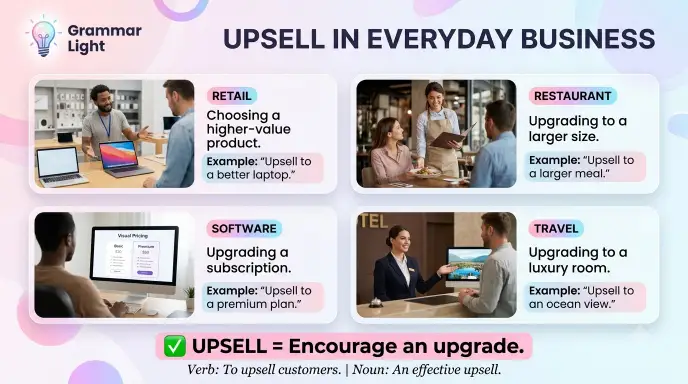
The word upsell appears in many industries. Understanding these examples will help you recognize and use it naturally.
Upsell in Retail Stores
Retailers may recommend more advanced products to customers who want additional features or better performance.
Example:
“The salesperson tried to upsell me to a laptop with a faster processor.”
In this sentence, the salesperson encourages the customer to choose a more expensive model.
Upsell in Restaurants
Restaurants sometimes offer larger portions, premium ingredients, or upgraded meal combinations.
Example:
“The server asked if we wanted to upsell our meals to the larger size.”
A more natural way to phrase the situation is:
“The server tried to upsell us to larger meals.”
The second sentence uses upsell directly to describe the sales action.
Upsell in Software and Technology
Software businesses frequently provide several subscription levels. Customers may be encouraged to move from a basic plan to a premium package.
Example:
“The software company hopes to upsell existing users to its premium subscription.”
The premium plan might offer additional storage, advanced tools, or more user accounts.
Upsell in Hotels and Travel
Hotels and travel companies may offer upgrades that provide additional comfort or convenience.
Examples:
- The hotel offered to upsell guests to rooms with ocean views.
- The airline offered eligible passengers an upgrade to a higher cabin class.
- The travel agency recommended an upgraded holiday package.
In each case, the customer is encouraged to select a higher value option rather than simply purchase an unrelated additional product.
Upsell in Online Shopping
Online stores may display recommendations when customers view a product or proceed to checkout.
Example:
“The website suggested a more powerful model as part of its upsell strategy.”
These suggestions can help customers compare options, provided the recommendations are relevant and clearly explained.
Upsell vs. Cross Sell vs. Sale: Understanding the Differences
These terms all relate to commerce, but they have different meanings. Knowing the difference helps you select the most accurate word.
| Term | Meaning | Example |
| Upsell | Encourage a customer to choose a higher priced version or upgrade | Recommending a laptop with more storage |
| Cross sell | Encourage a customer to buy a related product or service | Recommending a laptop bag with a laptop |
| Sale | An act of selling, or an occasion when goods may be offered at reduced prices | A store advertises a summer sale |
| Upsale | An uncommon form, generally not the standard spelling of the sales technique | Use upsell in an ordinary marketing report |
How Can You Remember the Difference?
Think about what the customer is being offered.
- Upsell: A better or upgraded version of the original choice.
- Cross sell: An additional item related to the original choice.
- Sale: A transaction or a period of promotional pricing.
- Upsale: Generally replace this form with upsell when you mean the established sales technique.
Memory tip: If a customer is encouraged to upgrade, think upsell. If the customer is encouraged to add a related item, think cross sell.
Practical Tips for Using Service Upgrade Correctly
Using upsell correctly is easier when you pay attention to the sentence’s purpose and grammatical structure.
1. Use Upsell in Sales and Marketing Contexts
It is suitable when a business recommends a higher-priced product, premium plan, or upgrade.
2. Remember the Past Tense: Service Upgrade
Write “The salesperson upsold the customer,” rather than “The salesperson upselled the customer.”
3. Distinguish Upgrades From Related Products
Choose upsell for a higher-value version and cross-sell for an additional related product.
4. Use the Same Spelling in British and American English
The standard form is upsell in both varieties of English.
5. Check Business Terminology Before Publishing
When writing product pages, customer emails, or marketing materials, use established industry vocabulary.
6. Focus on Customer Value
A clear upsell explains why the upgraded option may benefit the customer instead of pressuring them to spend more.
For example, rather than writing, “Buy the more expensive plan now,” a business could say, “Upgrade to the premium plan for additional storage and advanced reporting tools.”
Effective upselling focuses on relevant benefits, transparent pricing, and informed customer choices.
Frequently Asked Questions About Upsell or Upsale
Q.1 Is it upsell or upsale?
Upsell is the standard term used in sales and marketing when encouraging a customer to purchase a higher priced product or upgrade. Upsale is not the usual standard spelling for this meaning.
Q.2 What does upsell mean in simple words?
To upsell means to encourage someone to buy a more expensive version of a product or an upgraded service.
For example, a salesperson may recommend a premium laptop instead of the basic model.
Q.3 Is upsale a real word?
Upsale may appear in particular documents or specialized contexts, but it is not the standard spelling of the common sales and marketing term. Use upsell for the established business meaning.
Q.4 What is the past tense of upsell?
The usual past tense is upsold.
Example: “The salesperson upsold the customer to a premium package.”
Q.5 What is the difference between upsell and cross sell?
Upselling means encouraging a customer to upgrade or buy a higher value version. Cross selling means recommending an additional related product or service.
For example, offering a more powerful laptop is an upsell, while recommending a laptop bag is a cross sell.
Q.6 Is upsell one word or two words?
Upsell is written as one word when referring to the standard sales technique.
Examples include upsell strategy, upsell opportunity, and upsell customers.
Q.7 Is upsell used in British and American English?
Yes. Upsell is the standard spelling in both British and American English. You do not need to change the spelling based on your audience’s regional variety.
Q.8 Can upsell be used as a noun?
Yes. Upsell can function as both a verb and a noun.
Verb: “The company plans to upsell its customers.”
Noun: “The premium package was an effective upsell.”
Final Thoughts: Upsale or Upsell?
The difference between upsell and upsale is straightforward once you understand standard business usage. Upsell is the accepted, widely recognized term for encouraging customers to choose a more expensive product, upgrade a service, or select a higher value option. Upsale is generally not the correct substitute in this context.
Remember these essential points:
- Use upsell for the established sales and marketing technique.
- Use upsold as the usual past tense form.
- Use cross sell when recommending an additional, related product.
- Use the spelling upsell in both British and American English.
If you are writing a marketing campaign, a business report, a product description, or a customer email, choosing the right terminology helps your message sound professional and clear.
The easiest rule to remember is this: when you mean encouraging a customer to upgrade or purchase a higher value option, write “upsell,” not “upsale.”
LEARN MORE!

I’m a grammar writer focused on making English rules, word usage, and sentence structure simple and easy to understand.