When choosing between points or cash, the better option depends on how much your points are worth, how you plan to use them, and if the cash price offers better overall value. Points can provide useful rewards or discounts, while cash gives you a simple and direct way to pay without worrying about redemption rules.
People often search for keyword when booking flights, hotels, shopping, using loyalty programs, or deciding how to redeem rewards. The confusion usually comes from trying to determine if spending accumulated points is actually better than paying the regular cash price.
For example, a hotel room might cost $150 in cash or 20,000 points. At first glance, using points may seem attractive because you avoid paying money. However, the real question is how much value those 20,000 points provide compared with the $150 cash price.
Points can be valuable when they are used strategically. Cash can be better when points have low redemption value or when you want to save them for a more valuable opportunity.
Cash or Points : Quick Answer
Choose points when they provide strong value and cash when paying directly is cheaper or more practical.
The right choice depends on the redemption value of your points.
For example, imagine a hotel offers two options:
- Cash price: $200
- Points price: 25,000 points
If those 25,000 points would normally be worth around $250 through other redemptions, using them for the hotel could be worthwhile.
On the other hand, if the same points could only provide about $125 in value, paying $200 in cash would make more sense.
A simple comparison is:
Cash price ÷ Number of points = Value per point
Using the example above:
$200 ÷ 25,000 = $0.008 per point
That means each point provides about 0.8 cents of value in this particular redemption.
The calculation can help you compare different redemption opportunities instead of automatically choosing points.
Definition and Meaning of Points vs Cash
What Does Points Mean?
In loyalty programs, points are reward units that customers earn through purchases, travel, memberships, promotions, or other qualifying activities.
Depending on the program, points may be redeemed for:
- Flights
- Hotel stays
- Shopping
- Gift cards
- Discounts
- Travel upgrades
- Merchandise
- Other rewards
The value of points is not always fixed. One program may offer a consistent redemption value, while another may change the value depending on how the points are used.
What Does Cash Mean?
Cash refers to paying directly with money rather than using accumulated rewards.
In modern transactions, “cash” can also broadly refer to paying with money through methods such as:
- Debit cards
- Bank transfers
- Credit cards
- Digital wallets
- Other direct payment methods
When people compare it they usually mean using rewards versus paying the regular monetary price.
Why the Comparison Matters
A points balance can feel like free money, but points still have an opportunity cost.
Using 30,000 points for one purchase means those points are no longer available for another redemption. Therefore, the best choice is not simply the option that requires less money today.
The goal is to determine which option provides better overall value.
How to Compare Points and Cash
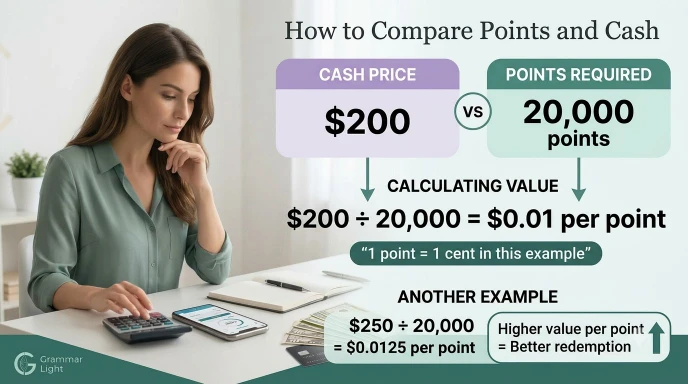
The easiest way to compare the two options is to calculate the approximate value of the points.
Use this formula:
Value per point = Cash price ÷ Points required
Suppose a flight costs:
- Cash: $300
- Points: 25,000
The calculation would be:
$300 ÷ 25,000 = $0.012
That means the redemption provides approximately 1.2 cents per point.
Now imagine another booking costs:
- Cash: $300
- Points: 40,000
The calculation becomes:
$300 ÷ 40,000 = $0.0075
That redemption provides only 0.75 cents per point.
The first option gives better value from the points.
This approach can help prevent you from spending a large number of points simply because the transaction appears to be free.
When Using Points Makes Sense
Using points can be a good choice when the redemption provides strong value.
HighValue Redemption
Points may be especially useful when they reduce the cost of an expensive booking significantly.
Large Points Balance
If you have accumulated more points than you are likely to use soon, redeeming them can make sense.
Travel Rewards
Some loyalty programs can provide attractive redemption opportunities for flights and hotels.
Promotional Redemptions
Special offers can sometimes increase the value you receive from your points.
Saving Cash
Using points can also make sense when you prefer to keep your available cash for other expenses.
However, always check the actual value before redeeming a large number of points.
When Paying Cash Makes Sense
Cash can be the better option when the points redemption provides poor value.
For example, if a purchase costs $100 or 20,000 points, using the points may not be worthwhile if those 20,000 points could provide significantly more than $100 of value elsewhere.
Cash may also be preferable when:
- The points requirement is unusually high.
- You are saving points for a better redemption.
- The cash price is heavily discounted.
- You need to earn rewards on the cash purchase.
- The points have limited flexibility.
- You want to keep your points for future travel.
The important thing is to compare value rather than simply looking at the amount of money saved today.
Points or Cash: The Main Difference
The biggest difference is the type of resource you are spending.
| Factor | Points | Cash |
| Payment type | Rewards | Money |
| Source | Earned through a program | Personal funds |
| Flexibility | Depends on the program | Usually high |
| Value | Can vary | Usually straightforward |
| Best use | Highvalue redemptions | Lowcost or discounted purchases |
| Opportunity cost | Losing future reward value | Losing available money |
Points can offer excellent value in the right situation. Cash provides simplicity and predictable spending.
The best choice depends on the price, points required, redemption value, and your personal priorities.
Understanding the Value of Your Points
Not all points should be treated as equal.
One program might allow 10,000 points to cover $100 worth of purchases. Another might require 15,000 points for the same $100 value.
This means the number of points alone does not tell you if a redemption is good.
Consider both:
How many points are required?
and
How much would the same purchase cost in cash?
Then compare the result with other ways you could use those points.
A redemption that looks expensive in points may still be worthwhile if it replaces a very high cash price. Likewise, a small points requirement may not always represent a good deal if the cash price is already very low.
Points or Cash: Which Option Gives Better Value?
There is no universal answer to which option is better. The right choice depends on the cash price, number of points required, point value, and how you could use those points elsewhere.
Suppose a hotel costs $180 or 15,000 points. The points option may provide good value if those points are normally worth around $150 or less. However, if you could use the same 15,000 points for a future booking worth $250, paying $180 in cash may be the smarter choice.
The key is to compare the opportunity cost rather than focusing only on the amount you pay today.
Best choice = the option that gives you greater overall value.
How to Calculate Points Value
A simple calculation can help you decide if using points is worthwhile.
Use this formula:
Points value = Cash price ÷ Points required
For example:
- Cash price: $250
- Points required: 20,000
The calculation is:
$250 ÷ 20,000 = $0.0125 per point
That means each point provides approximately 1.25 cents of value for that redemption.
Now consider another option:
- Cash price: $250
- Points required: 35,000
The result would be approximately 0.71 cents per point.
The first redemption gives more value for the same $250 purchase.
Points or Cash for Travel
Travel is one of the most common situations where people compare points and cash.
Flights and hotels may offer both options, but the value can vary considerably.
For example, a flight may cost $500 in cash or 30,000 points. Using points could be attractive if the redemption provides strong value.
A different flight might cost $120 or 25,000 points. In that case, paying cash may be more sensible because you would be using a large number of points to replace a relatively small payment.
Travelers should also consider additional charges, taxes, fees, and restrictions before deciding.
A low cash price often makes saving points more attractive.
Points & Cash for Shopping
Shopping rewards can work differently from travel programs.
Some stores offer a fixed value for points. For example, 1,000 points might always equal a certain discount.
When the value is fixed, the decision becomes easier because you can directly compare the discount with your available points.
However, some reward programs offer different redemption rates for:
- Products
- Gift cards
- Travel
- Discounts
- Special offers
Before redeeming points for merchandise, check if another redemption method provides better value.
Factors to Consider Before Choosing
The number of points required is only one part of the decision.
Cash Price
Start by checking the actual price you would pay with money.
Points Required
Compare that price with the number of points needed.
Redemption Value
Calculate how much value each point provides.
Alternative Uses
Think about if those points could be more valuable somewhere else.
Expiration Rules
Some reward programs have expiration policies. If your points are approaching expiration, using them may become more attractive.
Fees and Taxes
A points booking may still require additional cash payments. Include those costs in your comparison.
Earning Opportunities
A cash purchase may sometimes allow you to earn additional rewards, while a points redemption may not.
Common Mistakes When Choosing Points or Cash
Mistake 1: Assuming Points Are Always Better
Points are not automatically the better option just because they reduce the cash amount you pay.
Their value depends on the redemption.
Mistake 2: Ignoring the Cash Price
Some people focus only on how many points they need. Always check the regular cash price before redeeming.
Mistake 3: Spending Points on LowValue Purchases
Using a large number of points for a small discount can waste a valuable reward balance.
Mistake 4: Forgetting Fees
A points redemption may still include taxes, booking charges, or other fees.
Mistake 5: Using All Your Points
Keeping some points available for future opportunities can be useful, especially when better redemption options may appear.
Tips for Getting More Value From Points
To make your rewards work harder, consider these strategies:
- Compare points and cash before every redemption.
- Calculate the approximate value per point.
- Look for special redemption offers.
- Avoid spending large amounts of points on lowvalue purchases.
- Compare multiple redemption options.
- Check taxes and additional fees.
- Keep valuable points for highervalue opportunities.
- Monitor expiration policies.
- Consider if paying cash allows you to earn additional rewards.
The goal is not to use points as quickly as possible. The goal is to use them when they provide meaningful value.
Points or Cash: Everyday Examples
Example 1: Hotel
A hotel costs $200 or 20,000 points.
$200 ÷ 20,000 = 1 cent per point
If 1 cent per point is a strong redemption for that program, using points may be reasonable.
Example 2: Flight
A flight costs $150 or 25,000 points.
That gives a value of 0.6 cents per point.
Paying cash may be better if you can use those points for a more valuable booking later.
Example 3: Shopping
A purchase costs $50 or 5,000 points.
If your points are worth about 1 cent each, the redemption provides approximately $50 of value.
In that situation, either option could make sense depending on your other priorities.
FAQs About Points or Cash
Q.1 Which Is Better, Points or Cash?
Neither option is always better. The better choice depends on the cash price, number of points required, and value you can get from those points.
If a redemption gives strong value, using points may be worthwhile. If the cash price is low or the points requirement is high, paying cash may be the better option.
Q.2 How Much Cash Is 10,000 Points?
The cash value of 10,000 points depends on the specific rewards program.
For example, if a program values each point at 1 cent:
10,000 points × $0.01 = $100
If each point is worth 0.5 cents, the same 10,000 points would equal approximately $50.
Always check the specific program’s redemption rules before converting points into a cash value.
Q.3 How to Calculate Points vs Cash?
Use this simple formula:
Cash price ÷ Points required = Value per point
For example, if something costs $200 or 20,000 points:
$200 ÷ 20,000 = $0.01
That means the points provide 1 cent of value per point for that redemption.
You can then compare this value with other ways to use your points.
Q.4 How Much Cash Is 50,000 Points?
There is no universal cash value for 50,000 points because every rewards program can value points differently.
If each point is worth 1 cent, then:
50,000 × $0.01 = $500
If each point is worth 0.5 cents, the value would be:
50,000 × $0.005 = $250
Therefore, the actual value depends on the program and how you redeem the points.
Q.5 Should I Convert My Points to Cash?
Converting points to cash can make sense when the program offers a reasonable cash value and you do not have a better redemption option.
However, some programs provide greater value when points are used for travel, products, upgrades, or other rewards.
Before converting, compare the cash value with the value available through other redemption options.
Q.6 What Are 5 Disadvantages of Credit Cards?
Five common disadvantages of credit cards are:
- Interest charges : Carrying a balance can result in significant interest costs.
- Overspending : Easy access to credit may encourage spending beyond your budget.
- Fees : Some cards have annual fees, latepayment fees, foreign transaction fees, or other charges.
- Debt accumulation : Unpaid balances can grow over time and become difficult to manage.
- Credit impact : Missed or late payments can negatively affect your credit history.
Credit cards can offer useful benefits, but responsible spending and timely payments are important.
Final Thoughts
Points or cash is ultimately a value comparison. Points can be useful when they provide strong redemption value, while cash may be preferable when the purchase is inexpensive or the points requirement is too high.
Before choosing, compare the cash price, points required, possible fees, and alternative ways to use your rewards.
The simplest rule is:
Use points when they provide good value. Pay cash when keeping your points offers greater value.
This approach helps you make a more informed decision instead of automatically choosing one payment method every time.
LEARN MORE!

I’m a grammar writer focused on making English rules, word usage, and sentence structure simple and easy to understand.








1 thought on “Points or Cash: Which Payment Option Is Better?”