Pantoprazole and omeprazole are both effective medicines for reducing stomach acid, and neither is automatically better for everyone; the best choice depends on the condition being treated, other medicines, dose, and how your body responds.
*Pantoprazole vs Omeprazole at a Glance
Pantoprazole and omeprazole belong to the same group of medicines called proton pump inhibitors (PPIs). They reduce the amount of acid produced in the stomach and are commonly used for problems such as acid reflux, GERD, heartburn, and some stomach or intestinal ulcers.
Although they work in a similar way, they are not exactly the same medicine. Their doses, drug interactions, approved uses, and individual responses can differ.
| Feature | Pantoprazole | Omeprazole |
| Medicine type | Proton pump inhibitor | Proton pump inhibitor |
| Main action | Reduces stomach acid | Reduces stomach acid |
| Common use | GERD, acid related esophageal damage | GERD, heartburn, ulcers and other acid related conditions |
| Available forms | Prescription and some other formulations depending on country | Prescription and OTC forms |
| Drug interactions | Has important interactions with some medicines | Has several important interactions, including with clopidogrel |
| Best for everyone? | No | No |
What Is Pantoprazole?
Pantoprazole is a proton pump inhibitor that lowers stomach acid production. It is commonly prescribed for GERD and conditions in which stomach acid damages the esophagus. It can also be used for conditions involving excessive acid production, such as Zollinger Ellison syndrome.
By reducing acid, pantoprazole can give irritated tissue time to heal and can help relieve symptoms such as:
- Heartburn
- Acid reflux
- Regurgitation
- Burning discomfort related to excess stomach acid
The medicine is generally taken before food, and the exact dose and treatment duration depend on the condition being treated.
What Is Omeprazole?
Omeprazole is also a proton pump inhibitor (PPI). It reduces the production of stomach acid and is used for several acid related conditions, including GERD, esophageal damage caused by reflux, ulcers, and conditions involving excessive acid production. It is also commonly included in combination treatment for H. pylori infection.
Omeprazole is also available in some over the counter products for frequent heartburn in adults. Prescription treatment may use different doses or schedules depending on the medical condition.
Are Pantoprazole and Omeprazole the Same?
No. They belong to the same drug class, but they are different active medicines.
Think of them as two medicines that work toward the same basic goal: reducing stomach acid. Their effects can be similar, but the dose, formulation, interactions, and response can vary from person to person.
This is also why 20 mg of omeprazole should not simply be considered identical to 20 mg of pantoprazole. PPI doses are not directly interchangeable based only on the number printed on the package.
Which Is Better for Acid Reflux?
For many people with acid reflux or GERD, both pantoprazole and omeprazole can work well.
Clinical studies comparing the two medicines have generally found similar healing and symptom relief results at commonly studied doses. For example, studies comparing pantoprazole with omeprazole in reflux esophagitis found comparable healing rates and tolerability.
That means there is no universal winner.
The better option for an individual may depend on:
- How severe the reflux is
- The dose being used
- Other medicines being taken
- Other health conditions
- Previous response to a PPI
- The reason the medicine was prescribed
Pantoprazole vs Omeprazole for GERD
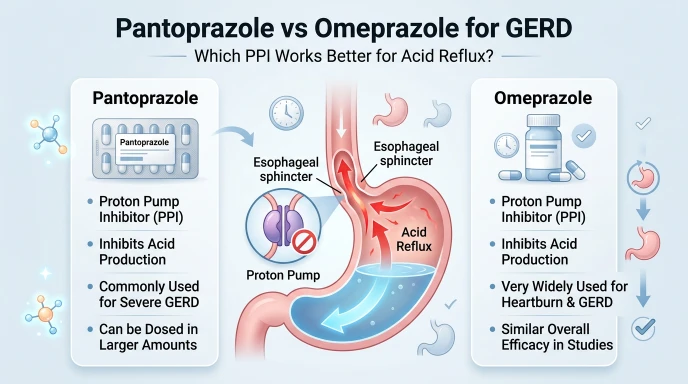
GERD happens when stomach contents repeatedly flow back into the esophagus, causing symptoms such as heartburn and regurgitation.
Both medicines can reduce the acid responsible for irritating the esophagus. The important point is that reducing acid does not necessarily stop the physical reflux itself; it mainly makes the refluxed stomach contents less acidic.
For people with GERD, taking a PPI at the appropriate time can also matter. PPIs are commonly taken before a meal because they work best when acid producing pumps are being activated by eating.
If symptoms continue despite treatment, increasing the dose or switching medicines should not be done automatically. The cause of persistent symptoms may need to be reassessed.
Is Pantoprazole Stronger Than Omeprazole?
Pantoprazole is not simply a “stronger” version of omeprazole. The amount of acid suppression depends on the specific medicine, dose, timing, and individual response.
Research comparing different PPIs shows that acid suppression can vary according to the drug and dose used.
So comparing the medicines only by their milligram numbers can be misleading.
Pantoprazole vs Omeprazole: Effectiveness, Dose, and How to Take Them
Is Pantoprazole More Effective Than Omeprazole?
For common acid related conditions, pantoprazole and omeprazole can both provide effective acid suppression. Studies comparing the two medicines in people with reflux esophagitis have generally found similar healing and symptom relief results when appropriate doses are used.
However, individual results can differ. One person may feel better after switching to pantoprazole, while another may respond equally well to omeprazole.
The goal is not simply to choose the medicine considered “stronger.” The goal is to use the right PPI at an appropriate dose for the condition being treated.
Pantoprazole and Omeprazole Dosage
The usual dose depends on the condition, age, formulation, and treatment plan. Commonly used adult doses include pantoprazole 20 or 40 mg and omeprazole 20 or 40 mg, but these numbers should not be treated as directly equivalent.
For example, pantoprazole 40 mg is not simply the same as omeprazole 40 mg in terms of acid suppression. PPI potency varies by medicine and dose, so a healthcare professional should determine an appropriate equivalent when changing treatment.
Prescription instructions can also differ for conditions such as GERD, ulcers, H. pylori infection, or excessive stomach acid production.
When Should You Take Pantoprazole or Omeprazole?
Timing can affect how well a PPI works.
PPIs are generally taken before a meal, because the medicines work most effectively when the acid producing pumps in the stomach are being activated. MedlinePlus notes that PPIs are commonly taken before meals, with the exact schedule depending on the medicine and reason for treatment.
Follow the instructions on your prescription or medicine label rather than changing the timing yourself.
Pantoprazole vs Omeprazole for Heartburn
For occasional heartburn, lifestyle changes may sometimes be enough. Frequent heartburn, however, can be a sign of GERD or another condition that needs proper evaluation.
Omeprazole is available in some over the counter products for frequent heartburn, while pantoprazole is commonly used as a prescription treatment in many settings. Availability differs by country and product.
If heartburn keeps returning, simply taking acid reducing medicine repeatedly may not address the underlying problem.
Pantoprazole vs Omeprazole for GERD
Both medicines can be used to treat GERD and help heal acid related damage to the esophagus.
Clinical comparisons have found similar effectiveness between pantoprazole and omeprazole for reflux esophagitis in several studies.
The choice may become more important when other factors are involved, particularly drug interactions. This is one area where pantoprazole and omeprazole are not completely interchangeable.
Pantoprazole vs Omeprazole for Ulcers
Omeprazole has established uses for certain stomach and intestinal ulcers and is also used as part of combination treatment for H. pylori infection.
Pantoprazole is also used for several acid related conditions, but the appropriate medicine and combination depend on the diagnosis and treatment guidelines being followed.
For an ulcer, treating the cause is important. An ulcer related to H. pylori, for example, generally requires combination therapy rather than a PPI alone.
Can You Take Pantoprazole and Omeprazole Together?
Usually, there is no reason to take both at the same time. They belong to the same PPI class and both reduce stomach acid.
Taking two PPIs together does not automatically provide better treatment and can increase unnecessary medication exposure.
If one medicine is not controlling symptoms, a doctor may adjust the dose, change the timing, switch to another treatment, or investigate another cause of the symptoms.
The Most Important Difference: Other Medicines
One of the biggest practical differences between the two medicines involves drug interactions.
Omeprazole can interact significantly with clopidogrel, an antiplatelet medicine used to reduce the risk of blood clots. Professional guidance recommends avoiding omeprazole with clopidogrel when possible and using alternatives such as pantoprazole when a PPI is needed.
This does not mean pantoprazole is always the better medicine. It means that the choice of PPI can matter when a person takes certain other medicines.
Bottom Line
For acid reflux and GERD, pantoprazole and omeprazole are both effective options for many people. The difference is not simply about which one is stronger.
The right choice can depend on the condition, dose, treatment duration, other medicines, and individual response. Never change or combine these medicines without checking with a doctor or pharmacist.
Frequently Asked Questions
Which is better, omeprazole or pantoprazole?
For most people with acid reflux or GERD, omeprazole and pantoprazole can both work well, and neither is universally better. They belong to the same class of medicines and generally have similar effects, although individual response, dose, other medicines, and the condition being treated can influence the choice.
Pantoprazole may be preferred in some situations because of its lower potential for interaction with clopidogrel compared with omeprazole.
Can you switch from omeprazole to pantoprazole?
Yes, a doctor or pharmacist can recommend switching from omeprazole to pantoprazole when appropriate. The medicines are in the same drug class, but their doses are not directly interchangeable based only on the milligram amount.
A healthcare professional may recommend a switch if omeprazole is not controlling symptoms, causes troublesome side effects, or has an interaction with another medicine. Do not switch or change the dose on your own.
Which is better, omeprazole, esomeprazole, or pantoprazole?
All three are proton pump inhibitors (PPIs) and reduce stomach acid. There is no single best choice for every person. MedlinePlus notes that most PPIs work about equally well, although side effects and drug interactions can vary between medicines.
Esomeprazole is closely related to omeprazole, while pantoprazole has a somewhat different interaction profile. One important example is clopidogrel: omeprazole and esomeprazole are generally avoided with it because of a significant interaction, while pantoprazole is commonly considered a preferred alternative when a PPI is needed.
Why do doctors recommend pantoprazole?
Doctors may recommend pantoprazole because it is an effective PPI for conditions such as GERD and acid related damage to the esophagus. It may also be a useful choice when a patient takes medicines that make omeprazole less suitable.
A particularly important example is clopidogrel. Professional pharmacy guidance recommends avoiding omeprazole and esomeprazole with clopidogrel and using alternatives such as pantoprazole, lansoprazole, or rabeprazole when PPI treatment is needed.
This does not mean pantoprazole is automatically better for everyone.
What is more powerful than omeprazole?
A different PPI is not automatically “more powerful” than omeprazole. Esomeprazole, pantoprazole, rabeprazole, lansoprazole, and other PPIs can all reduce stomach acid, but their effects depend on the medicine, dose, timing, and individual response.
If omeprazole is not controlling symptoms, the solution may be a different dose, better timing, another PPI, or evaluation for a different cause of the symptoms. Simply choosing the strongest sounding medicine is not the best approach.
Who should not take pantoprazole?
Pantoprazole is not appropriate for everyone. Anyone with a known allergy to pantoprazole or a previous serious reaction to it should not take it. People with certain medical conditions or those taking particular medicines may also need special medical advice before using it.
Important medication interactions can involve drugs such as certain HIV medicines, methotrexate, warfarin, and some antifungal medicines.
People taking long term PPI treatment may also need periodic review because prolonged acid suppression can be associated with certain risks.
Pantoprazole vs Omeprazole: Safety, Side Effects, and Drug Interactions
Both pantoprazole and omeprazole are generally well tolerated when used appropriately. However, like all medicines, they can cause side effects and interact with other drugs. The risks can also become more important when a PPI is used for a long time.
Common Side Effects
The most common side effects are usually mild and may include:
- Headache
- Nausea
- Diarrhea
- Constipation
- Stomach discomfort
- Gas
Not everyone experiences these effects, and symptoms may improve as the body adjusts to treatment.
Pantoprazole vs Omeprazole: Which Has Fewer Side Effects?
There is no clear winner for everyone.
Pantoprazole and omeprazole have broadly similar safety profiles, and many people can take either medicine without major problems. Individual tolerance can differ, so a person who experiences side effects with one PPI may sometimes do better with another.
The medicine that causes fewer problems for one person may not be the same for someone else.
Long Term Use of PPIs
PPIs are often very useful, but long term treatment should be reviewed periodically. Extended acid suppression has been associated with potential problems such as vitamin B12 deficiency, low magnesium levels, certain infections, and kidney related problems. Some studies have also reported associations with bone fractures, although the level of risk varies and the benefits of appropriate PPI treatment can outweigh these concerns.
This does not mean people should stop a prescribed PPI suddenly. For some conditions, long term treatment is medically appropriate.
The usual principle is to use the lowest effective dose for the appropriate duration, with regular review when long term treatment is needed.
Pantoprazole and Omeprazole Drug Interactions
Drug interactions are one of the most important differences to consider when comparing these medicines.
Omeprazole can affect the activity of an enzyme called CYP2C19, which is involved in activating clopidogrel. Because of this interaction, professional guidance recommends avoiding omeprazole and esomeprazole with clopidogrel when possible. Pantoprazole is among the PPIs generally preferred when a PPI is necessary for someone taking clopidogrel.
Other medicines can also interact with PPIs. Depending on the medicine, these may include:
- Warfarin
- Certain HIV medicines
- Methotrexate
- Some antifungal medicines
- Rifampicin
- Phenytoin
- Digoxin
- Certain herbal products
The exact interaction depends on the medicine and dose, so always tell your doctor or pharmacist about prescription medicines, over the counter drugs, vitamins, and supplements you take.
Pantoprazole or Omeprazole With Clopidogrel
This deserves special attention.
Clopidogrel is an antiplatelet medicine used to help prevent blood clots, including after certain heart attacks, strokes, and coronary stent procedures.
If someone taking clopidogrel also needs a PPI, pantoprazole is generally preferred over omeprazole because omeprazole can interfere with clopidogrel activation.
However, never stop clopidogrel or change a PPI without medical advice. Both medicines may have been prescribed for important reasons.
Can Pantoprazole and Omeprazole Be Taken Together?
They generally should not be combined unless a healthcare professional specifically tells you to do so.
Both medicines reduce stomach acid through the same general mechanism. Taking them together does not normally provide a simple “double effect.”
If your current PPI is not working well, a doctor may consider changing the dose, adjusting when you take it, switching to another medicine, or checking for another cause of persistent symptoms.
When Should You Seek Medical Advice?
Persistent heartburn is not always simply a need for stronger acid medicine. Medical evaluation is particularly important if you experience difficulty swallowing, unexplained weight loss, persistent vomiting, vomiting blood, black stools, or significant chest pain.
These symptoms can indicate a condition that needs prompt assessment rather than simply increasing a PPI dose.
Key Takeaway
Pantoprazole and omeprazole are both effective and generally well tolerated, but their interaction profiles are not identical. Pantoprazole can be a particularly useful option for people taking clopidogrel, while the best choice for others depends on their condition, medicines, and response to treatment.
Bilkul, thora more natural aur click-worthy:
Omeprazole vs. Pantoprazole: Which One Is Better for You?
Choosing between pantoprazole and omeprazole is usually not about finding the strongest acid reducing medicine. Both are proton pump inhibitors and can be effective for conditions such as GERD, acid reflux, and other acid related problems. The better option depends on the reason for treatment, the dose, other medicines, and how well the individual responds.
When Omeprazole May Be a Good Choice
Omeprazole is widely used for GERD, heartburn, ulcers, and other conditions involving excess stomach acid. It is also commonly used as part of combination treatment for H. pylori infection. Some omeprazole products are available without a prescription for frequent heartburn in adults.
It may be a practical option when there are no important drug interactions or other reasons to choose a different PPI.
When Pantoprazole May Be a Better Choice
Pantoprazole may be preferred in certain situations, particularly when drug interactions are an important consideration.
A well known example is clopidogrel. Guidance recommends avoiding omeprazole and esomeprazole with clopidogrel when possible and considering alternatives such as pantoprazole.
Pantoprazole is also an established treatment for GERD and acid related damage to the esophagus.
Can You Switch Between Pantoprazole and Omeprazole?
Yes, switching between PPIs can be appropriate when medically indicated.
A doctor may recommend a switch if:
- Symptoms are not adequately controlled
- Side effects occur
- Another medicine creates an interaction
- A different dose or formulation is more suitable
- The original diagnosis or treatment plan changes
Because PPI doses are not directly interchangeable by milligram amount, the new dose should be selected by a healthcare professional.
What If Neither Medicine Works?
If symptoms continue despite taking pantoprazole or omeprazole correctly, taking more medicine is not always the answer.
Persistent symptoms may have another cause, or the timing, dose, diagnosis, or treatment plan may need to be reviewed. Your doctor may recommend adjusting treatment or investigating other possible causes.
Lifestyle measures can also help some people with reflux. Depending on the individual, these may include avoiding meals close to bedtime, identifying foods that trigger symptoms, maintaining a healthy weight, and raising the head of the bed when nighttime reflux is a problem.
When Should You Talk to a Doctor?
Occasional heartburn can be common, but persistent or severe symptoms deserve medical attention.
Seek medical advice promptly if you have:
- Difficulty or pain when swallowing
- Unexplained weight loss
- Persistent vomiting
- Vomiting blood
- Black or tarry stools
- Severe or unexplained chest pain
- Symptoms that continue despite treatment
These symptoms should not simply be treated by increasing the dose of an acid reducing medicine.
Final Verdict: Pantoprazole or Omeprazole?
For many people, pantoprazole and omeprazole are similarly effective choices for acid related conditions. Neither medicine is universally better.
Omeprazole has a broad range of established uses and is available in prescription and some over the counter products. Pantoprazole is also effective for GERD and other acid related conditions and may be preferred in certain drug interaction situations, especially when clopidogrel is involved.
The most appropriate choice depends on the condition being treated, prescribed dose, other medicines, treatment duration, and individual response.
Do not take pantoprazole and omeprazole together or switch between them without guidance from a doctor or pharmacist.
DISCOVER MORE ARTICLE!

I’m a grammar writer focused on making English rules, word usage, and sentence structure simple and easy to understand.








5 thoughts on “Pantoprazole vs Omeprazole: Differences, Uses & Which Is Better”