
Talent and skill are related, but talent is usually a natural ability, while a skill is an ability developed through learning and practice. Understanding this difference can make it easier to describe someone’s abilities accurately.
People often search for “talent or skill” because the two words are frequently used in similar situations. Someone may be naturally good at singing, drawing, writing, mathematics, or sports, so we may call that person talented. However, performing the same activity successfully can also require training, experience, and repeated practice. Those developed abilities are skills.
For example, a person may have a natural talent for music. That talent can give them a strong starting point, but learning musical techniques and practicing an instrument can turn that potential into a valuable skill. Another person may not have obvious natural talent but can become highly skilled through dedication and consistent training.
The distinction is therefore useful in education, careers, sports, creative activities, and everyday conversations. Talent can provide natural potential, while skill shows what someone has learned to do well.
Talent or Skill : Quick Answer
Talent is a natural ability, while skill is an ability developed through learning, training, and practice. Talent may give someone a natural advantage, but skill usually comes from deliberate effort and experience.
For example:
- A child may have a natural talent for drawing.
- Practicing drawing techniques can develop that talent into an artistic skill.
- Someone may have a talent for speaking.
- Public speaking training can turn that ability into a professional skill.
Talent and skill can work together. A talented person still needs practice to improve, while a person without obvious natural talent can become highly skilled through consistent effort.
A simple way to remember the difference is:
Talent = natural ability.
Skill = developed ability.
This distinction is especially useful when describing someone’s strengths, professional abilities, or potential.
Definition and Meaning
What Does Talent Mean?
Talent means a natural ability or aptitude for doing something well. It often suggests that a person has an unusual or noticeable ability without requiring extensive training at the beginning.
For example:
She has a talent for painting.
This means painting comes naturally to her or she shows a strong natural ability in that area.
Talent can exist in many areas, including:
- Music
- Art
- Writing
- Mathematics
- Sports
- Communication
- Leadership
- Problem solving
Having talent does not automatically mean someone has mastered an activity. A talented person may still need education, practice, and experience.
What Does Skill Mean?
Skill is the ability to perform an activity effectively because of learning, practice, training, or experience.
For example:
He developed excellent writing skills through years of practice.
Writing may not have been a natural talent at first. Education, reading, feedback, and repeated practice can help someone become an effective writer.
Skills can include:
- Communication skills
- Cooking skills
- Computer skills
- Writing skills
- Driving skills
- Management skills
- Public speaking skills
Unlike natural talent, skills can usually be deliberately developed and improved.
How Are Talent and Skill Connected?
Talent and skill are not completely separate. Natural talent can make learning certain skills easier, while practice can strengthen an existing talent.
For example, someone may naturally have a good singing voice. Vocal lessons, breathing techniques, and regular practice can develop that natural ability into a strong singing skill.
Someone else may not have an obvious natural singing talent but can still become a capable singer through proper training and consistent practice.
The Origin of Talent and Skill
The words talent and skill have different historical backgrounds.
The word talent originally referred to a unit of weight and a monetary unit in the ancient world. Its meaning later became connected with ability through the biblical Parable of the Talents, where talents represented valuable resources entrusted to individuals.
Over time, talent developed its modern meaning of a natural ability or aptitude.
The word skill has Germanic roots and was historically connected with ideas such as knowledge, understanding, and discernment. Its meaning gradually developed toward the ability to do something effectively through knowledge and practice.
Today, the two words have distinct but related meanings.
Talent generally points to natural potential, while skill emphasizes developed ability.
Talent vs. Skill: The Main Difference
The main difference is how the ability is acquired and developed.
| Feature | Talent | Skill |
| Meaning | Natural ability | Learned ability |
| Development | May appear naturally | Developed through practice |
| Training | May not be needed initially | Usually involves training |
| Practice | Helps improve it | Essential for development |
| Main idea | Potential | Ability in action |
| Example | Natural musical ability | Playing an instrument proficiently |
For example, a person might have a natural talent for mathematics. However, solving advanced mathematical problems requires learned knowledge and practiced skills.
Similarly, an athlete might have natural physical talent, but professional performance depends on training, technique, discipline, and experience.
This is why talent alone does not always determine achievement.
Is Talent More Important Than Skill?
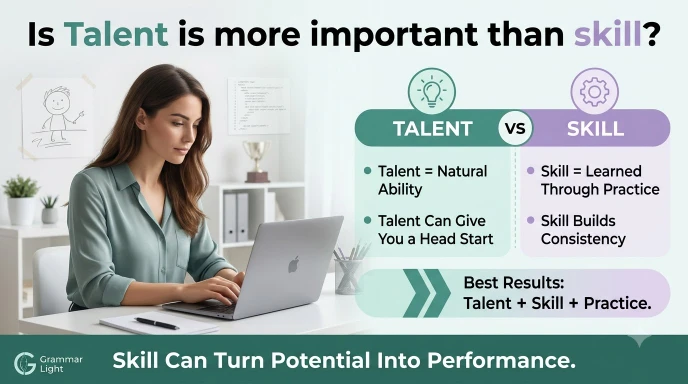
Talent can provide an advantage, but skill is often what turns potential into consistent performance.
A naturally talented person may progress quickly at first. However, without practice, that advantage may not last.
Someone with less natural ability can improve significantly through focused training and persistence. In many situations, developed skill can compensate for a lack of obvious natural talent.
Consider two people learning to play the piano. One person may naturally recognize musical patterns but rarely practice. The other may struggle initially but practices every day and receives professional instruction.
After several years, the second person could become the more skilled musician.
This example shows why talent and skill should not be treated as competing concepts. Talent may influence where someone starts, while skill reflects how much they have developed their ability.
How Talent Becomes Skill
Talent can develop into skill through a gradual process.
Natural Ability
A person may naturally find a particular activity easier or more enjoyable.
Learning
They begin learning techniques, rules, and methods connected to that activity.
Practice
Repeated practice improves accuracy, confidence, and consistency.
Experience
Real world situations teach the person how to apply what they have learned.
Improvement
Feedback and continued learning help refine the ability.
For example:
Natural talent for drawing → art lessons → regular practice → experience → advanced drawing skills
The same pattern can apply to music, sports, writing, public speaking, technology, and many other areas.
Talent may provide the starting point, but skill develops through action and experience.
Talent or Skill: Common Confusion
People often use talent and skill as if they mean exactly the same thing. They are related, but there is an important difference. Talent usually refers to a natural ability or a strong potential in a particular area. Skill is something a person develops through learning, practice, training, and experience.
For example, someone may have a natural talent for singing, but becoming a skilled singer requires regular practice. In the same way, a person may not have an obvious natural talent for drawing but can develop strong drawing skills through education and consistent practice.
Can You Have Skill Without Talent?
Yes, a person can develop a skill without having a strong natural talent for it.
Practice, education, repetition, and experience can help people become highly skilled. Someone who is not naturally gifted at mathematics, for example, can still become good at mathematics by studying regularly and solving problems.
Skill can grow through effort even when natural talent is limited.
Can Talent Exist Without Skill?
Yes. A person can have natural talent without having a developed skill.
Someone may naturally have a good singing voice but may not know how to control breathing, pitch, or technique. Those abilities can become skills through proper training.
Talent can provide a starting advantage, while skill turns that potential into reliable performance.
Talent or Skill in Everyday Examples
Music
A person may naturally recognize musical patterns or have a pleasant singing voice. That can be considered talent. Learning vocal techniques, reading music, or playing an instrument involves developing skills.
Sports
Natural speed, coordination, or balance may give an athlete an advantage. Training, technique, strategy, and discipline develop those abilities into sports skills.
Writing
A person may naturally have a strong imagination or an instinct for storytelling. Grammar, structure, editing, and research are skills that can be learned and improved.
Cooking
Some people have a natural sense of flavors and ingredients. Cooking techniques, food preparation, and kitchen safety are skills that become stronger with practice.
Communication
A person may naturally be confident and comfortable around others. Public speaking, active listening, negotiation, and professional communication can all be developed as skills.
Ability or Expertise in the Workplace
Talent and skill can both contribute to professional success.
A naturally creative person may have an advantage in a design related role. However, professional design also requires technical skills, software knowledge, communication, deadlines, and experience.
Employers often value developed skills because skills can be demonstrated and applied consistently. Talent can help someone learn quickly, but continued practice is usually necessary to turn potential into dependable performance.
Common Mistakes With Talent and Skill
One common mistake is assuming that talent means someone does not need practice. Even naturally gifted people need to develop their abilities.
Another mistake is believing that a lack of natural talent means a person cannot become good at something. Many abilities can improve significantly through education and deliberate practice.
People also sometimes use the words talent and skill interchangeably. Although they overlap, talent generally points to natural ability, while skill usually refers to developed ability.
Ability or Expertise: Which One Should You Use?
Use talent when you are talking about a natural ability, gift, or strong potential.
Use skill when you are describing an ability that has been learned or developed through practice and experience.
For example:
She has a talent for painting.
She developed excellent painting skills through years of practice.
Both words can describe ability, but the context determines which one fits better.
FAQs
Q.1 What Is the Difference Between Talent and Skill?
Talent is generally a natural ability or potential that a person may have from an early stage. Skill is an ability developed through learning, practice, training, and experience.
For example, someone may have a natural talent for singing, while vocal control and performance techniques are skills developed through practice.
Q.2 Can You List 10 Talents?
Yes. Ten examples of talents include:
- Singing
- Dancing
- Drawing
- Writing
- Storytelling
- Public speaking
- Playing music
- Acting
- Leadership
- Creative problem solving
A talent can be expressed differently from person to person and can often become stronger through practice.
Q.3 What’s Better, Talent or Skill?
Neither is automatically better. Talent can provide a natural advantage, while skill provides developed ability and consistency.
A talented person may learn something quickly, but a skilled person who practices consistently can achieve excellent results. In many situations, the combination of talent and skill is most useful.
Q.4 What Are 10 Talents?
Ten common examples of talents are singing, dancing, drawing, writing, acting, storytelling, leadership, public speaking, musical ability, and creative thinking.
Not every talent is artistic. Talents can also appear in communication, organization, problem solving, sports, leadership, and other areas.
Q.5 Is Talent Just a Skill?
No. Talent and skill are closely related, but they are not exactly the same.
Talent usually describes natural ability or potential. Skill usually describes an ability that has been learned and developed. Talent can make learning easier in some cases, while skill comes from practice, training, and experience.
Q.6 What Are the 7 Types of Skills?
The seven broad types of skills commonly discussed are:
- Technical skills : Knowledge needed to perform a specific task or job.
- Communication skills : The ability to express ideas and understand others.
- Interpersonal skills : Skills used when working and interacting with people.
- Problem solving skills : The ability to identify problems and find effective solutions.
- Leadership skills : Abilities related to guiding, motivating, and managing others.
- Time management skills : The ability to organize tasks and use time effectively.
- Adaptability skills : The ability to adjust to new situations, tools, responsibilities, or environments.
These categories can overlap. For example, a manager may use communication, leadership, problem solving, and time management skills at the same time.
Final Thoughts
Talent and skill are connected, but they describe different parts of ability. Talent can provide natural potential, while skill is developed through learning and practice.
A person does not need exceptional natural talent to become skilled at something. Consistent practice, useful feedback, education, and experience can turn an ability into something reliable and valuable.
In many real life situations, skill becomes especially important because it reflects what a person can consistently do. Talent may give someone a head start, but practice and development help turn potential into performance.
YOU MAY LIKE!

I’m a grammar writer focused on making English rules, word usage, and sentence structure simple and easy to understand.


3 thoughts on “Talent and Skill: How to Discover, Build, and Earn From Both”