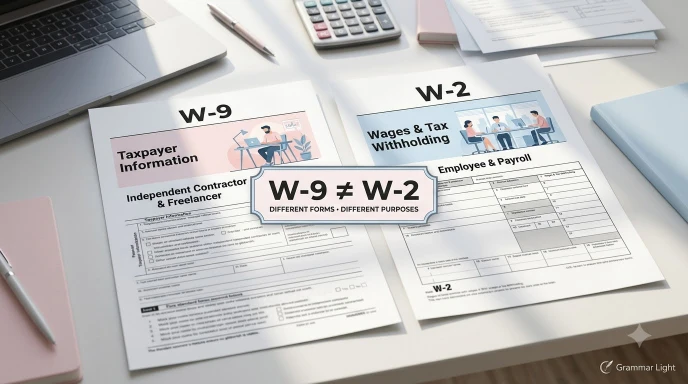
A w 9 or w2 are both U.S. tax forms, but they serve very different purposes. A W 9 is generally completed by an independent contractor or another person who needs to provide taxpayer identification information to a business.
W 2 is issued by an employer to an employee to report wages and certain taxes withheld during the year. Knowing the difference is important because the forms are connected to different types of working relationships and tax reporting requirements.
People often search for “W 9 or W 2” when starting a new job, working as a contractor, receiving payments from a business, or preparing their tax return. The confusion is understandable because both forms contain personal and tax related information. However, they are not interchangeable.
The biggest distinction is simple: W 9 provides information to the payer, while W 2 reports an employee’s wages and tax withholding. A W 9 does not function as an employee wage statement, and a W 2 is not the form an independent contractor normally completes when providing taxpayer information to a client.
This guide explains what each form means, who uses it, how the forms differ, and when you may encounter each one.
W 9 or W 2 :Quick Answer
Use a W 9 when a business needs your taxpayer identification information, commonly when you are working as an independent contractor. A W 2 is issued by an employer to an employee to report annual wages and taxes withheld.
W 9
A W 9 is generally completed by the person receiving certain payments and provided to the requester or payer.
It typically provides information such as:
- Legal name
- Business name, if applicable
- Federal tax classification
- Taxpayer identification number
- Certification
W 2
A W 2 is prepared and provided by an employer for an employee.
It reports information such as:
- Wages
- Federal income tax withheld
- Social Security wages
- Medicare wages
- Certain other payroll information
A simple way to remember the difference is:
W 9 = taxpayer information for the payer
W 2 = employee wages and withholding
What Is a W 9?
Form W 9 is used to provide a taxpayer identification number and certain other information to a person or business that may need to report payments to the IRS.
The official name is Form W 9, Request for Taxpayer Identification Number and Certification.
A business may ask an independent contractor to complete a W 9 before making reportable payments.
What Information Does a W 9 Provide?
A W 9 generally includes information such as:
- Name
- Business name, when applicable
- Federal tax classification
- Address
- Taxpayer identification number
- Required certification
The form helps the payer obtain the information needed for its tax reporting obligations.
Who Usually Completes a W 9?
A W 9 may be requested from people or businesses receiving certain types of payments.
For example, an independent contractor may receive a W 9 request from a company before beginning paid work.
A freelancer, consultant, or other self employed worker may encounter this form when working with a business.
What Is a W 2?
Form W 2 is an employer provided wage and tax statement that reports an employee’s earnings and certain taxes withheld during the year.
The official name is Form W 2, Wage and Tax Statement.
Employees generally receive a W 2 from their employer after the end of the tax year.
What Information Appears on a W 2?
A W 2 can include:
- Employee wages
- Federal income tax withheld
- Social Security wages and tax
- Medicare wages and tax
- State and local tax information, when applicable
- Employer identification information
Employees use the information on the W 2 when preparing their federal and applicable state tax returns.
Who Receives a W 2?
A W 2 is generally associated with employees.
For example, if you work for a company as an employee and receive wages through its payroll system, the employer generally provides a W 2 reporting your annual wages and applicable withholding.
W 9 vs. W 2: The Main Difference
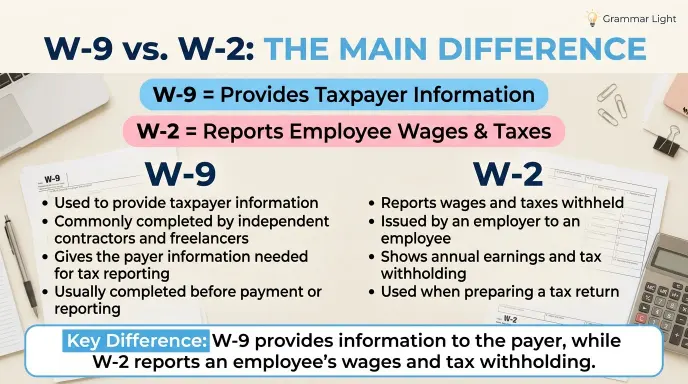
The main difference is the working relationship and purpose of the form.
| Feature | W 9 | W 2 |
| Main purpose | Provides taxpayer information | Reports employee wages and withholding |
| Common user | Independent contractor or other payee | Employee |
| Usually completed by | Person or business receiving payment | Employer prepares it |
| Reports wages? | No | Yes |
| Reports tax withholding? | No | Yes |
| Used for employee payroll? | No | Yes |
| Given to | Requesting payer | Employee and tax authorities as required |
The forms therefore belong to different stages of tax reporting.
W 9 or W 2 for Employees
If you are a traditional employee, you generally receive a W 2 from your employer after the tax year ends.
You may still be asked to complete other tax forms when starting employment, but a W 9 is generally associated with providing taxpayer information for payments rather than standard employee payroll.
For example:
Maria works full time for a company and receives regular wages through payroll.
Her employer generally provides her with a W 2 to report those wages.
The important point is that employee status and contractor status are not determined simply by which form someone receives. The actual working relationship matters.
W 9 or W 2 for Independent Contractors
Independent contractors commonly encounter Form W 9 when a business needs their taxpayer identification information.
For example:
David provides freelance design services to a company.
The company may ask David to complete a W 9 so it has the information needed for applicable information reporting.
A contractor may later receive a different tax form reporting payments, depending on the circumstances.
A W 9 itself is not a payment statement. It provides information that the payer may use for its reporting obligations.
When Do You Use a W 9?
A W 9 may be requested when a business needs taxpayer information from someone receiving certain reportable payments.
Common situations can include:
Freelance Work
A freelancer working for a business may be asked to provide a W 9.
Consulting
An independent consultant may complete a W 9 for a client.
Business Services
A business may request a W 9 from another person or business before making certain reportable payments.
The exact reporting requirements can depend on the type of payment and the circumstances.
When Do You Receive a W 2?
Employees generally receive a W 2 from their employer after the end of the tax year.
The form helps employees understand how much they earned and how much certain taxes were withheld.
For example:
An employee earns wages throughout the year. The employer reports those wages and applicable withholding on a W 2.
The employee can then use the information when preparing a tax return.
W 2 or W 9: Which One Applies to You?
The answer depends mainly on why you are being paid and the nature of your working relationship.
If you are an employee receiving wages through an employer’s payroll system, a W 2 is generally the relevant wage statement.
If you are an independent contractor and a business requests your taxpayer identification information, you may be asked to complete a W 9.
When the classification of a worker is unclear, the answer should not be based only on the form being requested. Worker classification has specific legal and tax considerations.
Important Difference to Remember
The easiest way to remember the distinction is:
W 9 → You provide information to the payer.
W 2 → Your employer provides you with a wage statement.
A W 9 helps a payer obtain information needed for applicable reporting. A W 2 summarizes employee wages and certain tax withholding.
Understanding this basic difference can prevent confusion when starting freelance work, beginning employment, or preparing tax documents.
W 9 and W 2 for Freelancers and Employees
The difference between a W 9 and W 2 becomes clearer when you look at how someone works.
A freelancer or independent contractor may be asked to complete a W 9 so the payer has the necessary taxpayer identification information.
An employee generally receives a W 2 from the employer showing wages and certain taxes withheld during the year.
Freelancer Example
Alex provides writing services to a company as an independent contractor.
The company may ask Alex to complete a W 9. The form gives the company information it may need for applicable information reporting.
Employee Example
Emma works as an employee for a company and receives wages through payroll.
Her employer generally provides a W 2 showing her annual wages and applicable tax withholding.
The important distinction is the relationship with the payer, not simply the name of the form.
Is a W 9 a Tax Return?
No. A W 9 is not a tax return.
A W 9 is used to provide taxpayer identification information and certification to the person or business requesting it.
A tax return is a separate document used to report income, deductions, credits, and other information to the tax authorities.
For example, completing a W 9 does not mean that you have filed your annual federal income tax return.
W 9 vs. 1099
A W 9 and a 1099 are different forms with different purposes.
The W 9 is generally used to provide taxpayer information to a payer.
A 1099 is generally an information return or statement used to report certain types of payments or income.
For example:
A company may ask a contractor for a W 9 before making reportable payments.
Later, depending on the payment and reporting requirements, the company may issue an appropriate 1099.
The W 9 provides information to the payer. The 1099 reports applicable payments or income.
W 9 or W 2: Common Mistakes
One common mistake is assuming that a W 9 is the contractor version of a W 2.
They are not direct equivalents.
A W 2 reports an employee’s wages and certain withholding. A W 9 generally provides taxpayer identification information to a payer.
Another mistake is assuming that receiving a W 9 automatically determines someone’s worker classification. The actual working relationship and applicable rules matter.
People also sometimes confuse a W 9 with a 1099. The two forms serve different purposes.
W 9 or W 2: What Happens After You Complete the Form?
If a business asks you to complete a W 9, you generally provide the requested information to the requesting payer rather than sending the W 9 directly to the IRS simply because you completed it.
The payer may use the information for applicable reporting requirements.
A W 2 works differently. An employer prepares the W 2 and provides it to the employee after the tax year, with copies handled according to applicable reporting requirements.
Always keep copies of important tax documents and protect taxpayer identification information from unnecessary disclosure.
W 9 or W 2 for U.S. Tax Purposes
Both forms are associated with the U.S. tax system, but they are used in different circumstances.
A W 9 is generally connected with providing a U.S. taxpayer identification number and certification to a requester when the form applies.
A W 2 is connected with employee wages and tax withholding.
Citizenship alone does not determine which form applies. The relevant tax status, type of payment, and working relationship matter.
FAQs About W 9 or W 2
Q.1 What does W 9 mean?
W 9 refers to Form W 9, Request for Taxpayer Identification Number and Certification.
It is generally used when a person or business needs to provide taxpayer identification information to a requester or payer.
The form can include information such as the person’s name, business name when applicable, tax classification, address, and taxpayer identification number.
Q.2 What is the difference between W 2 and W 9?
A W 2 is generally issued by an employer to an employee to report wages and certain taxes withheld.
A W 9 is generally completed by a person or business to provide taxpayer identification information to a requester.
In simple terms:
W 2 = employee wages and withholding
W 9 = taxpayer information provided to a payer
Q.3 What is a US W 9 form for?
A U.S. W 9 form is generally used to provide a taxpayer identification number and certification to a person or business that needs the information for applicable reporting purposes.
Independent contractors and other payees may encounter a W 9 when receiving certain types of payments from businesses.
The requester generally uses the information to meet its own information reporting obligations.
Q.4 Is a W 9 the same as a tax return?
No. A W 9 is not a tax return.
A W 9 provides taxpayer identification information to the requester.
A tax return is used to report income and other relevant tax information to the IRS or applicable state tax authority.
Completing a W 9 does not itself mean that you have filed a tax return.
Q.5 Is a W 9 only for US citizens?
No. Citizenship alone does not determine if someone uses a W 9.
The form is generally associated with certain U.S. persons who need to provide taxpayer identification information to a requester.
People who are not U.S. persons may have different documentation requirements depending on their tax status and circumstances.
If you are unsure which IRS form applies to you, the appropriate form depends on your specific tax status rather than simply your citizenship.
Q.6 Is a W 9 the same as a 1099?
No. A W 9 and a 1099 serve different purposes.
A W 9 generally provides taxpayer identification information to the payer.
A 1099 is generally used to report certain payments or types of income.
For example, a business may request a W 9 from a contractor and later use the information to prepare an applicable information return or statement.
Final Thoughts
W 9 and W 2 are not interchangeable forms. A W 9 generally provides taxpayer identification information to a payer, while a W 2 reports an employee’s wages and certain tax withholding.
The easiest way to remember the difference is that you generally provide a W 9 to a requester, while your employer provides you with a W 2.
A W 9 is also not the same as a tax return or a 1099. Each document has its own purpose within the U.S. tax reporting system.
If you are unsure which form applies to your situation, consider your worker status, type of payment, and tax status rather than relying on the form name alone.
CONTINUE READING!

I’m a grammar writer focused on making English rules, word usage, and sentence structure simple and easy to understand.