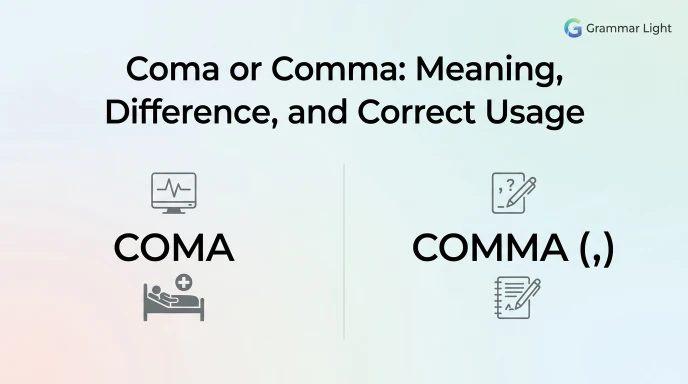
“Coma” and “comma” are two completely different words. A coma is a serious medical condition involving prolonged unconsciousness, while a comma is a punctuation mark used to separate words, phrases, or parts of a sentence.
Coma vs Comma at a Glance
The spelling may look similar, but the meanings are unrelated.
| Word | Meaning | Example |
| Coma | A prolonged state of unconsciousness | The patient remained in a coma. |
| Comma | A punctuation mark (,) | I bought apples, oranges, and bananas. |
The easiest way to remember the difference is that comma is punctuation, while coma is a medical condition.
What Does Coma Mean?
A coma is a state of deep unconsciousness in which a person cannot be awakened normally or respond appropriately to their surroundings.
A person in a coma may not respond to voices, touch, or other forms of stimulation. It can happen because of serious problems affecting the brain.
Possible causes include:
- Severe head injury
- Stroke
- Lack of oxygen to the brain
- Certain infections
- Serious metabolic problems
- Drug or medication poisoning
- Very low or high blood sugar in some circumstances
A coma is a medical emergency and requires immediate professional evaluation and treatment.
What Does Comma Mean?
A comma is a punctuation mark written as (,). It is used to make written sentences clearer and easier to read.
For example:
Without a comma:
After dinner we went for a walk.
With a comma:
After dinner, we went for a walk.
A comma can separate introductory phrases, items in a list, and certain parts of a sentence.
Coma or Comma: Which Spelling Is Correct?
Both coma and comma are correct spellings, but they are used in completely different situations.
Use coma when discussing unconsciousness or a medical condition.
Use comma when discussing punctuation or writing.
For example:
- “The accident left him in a coma.”
- “Put a comma after the introductory phrase.”
Using one word in place of the other can completely change the meaning of a sentence.
How to Remember Coma and Comma
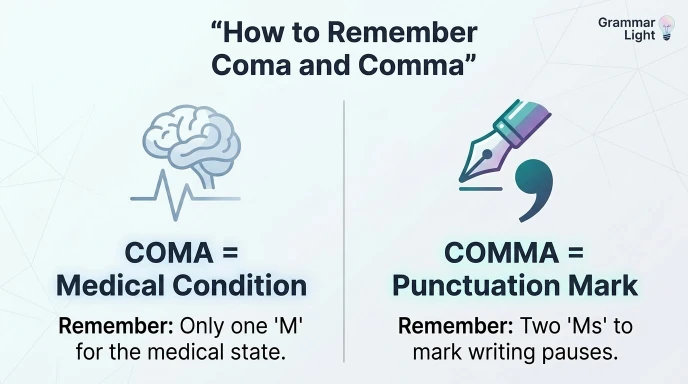
A simple memory trick can help you distinguish the two words.
Comma has two m’s, just like the punctuation mark has a small curved shape that helps divide parts of a sentence.
Coma has only one m and refers to a state of unconsciousness.
Remember:
Coma = medical condition
Comma = punctuation mark
Coma and Comma in Everyday Sentences
Understanding how each word works in a sentence makes the difference much easier to remember.
Examples With “Coma”
The word coma is used when talking about a prolonged state of unconsciousness.
- The patient was placed in a coma after the severe injury.
- Doctors monitored him closely while he remained in a coma.
- The family hoped that she would eventually wake from the coma.
Examples With “Comma”
The word comma is used when discussing punctuation.
- Add a comma after the introductory phrase.
- There is a comma between the two items.
- I forgot to put a comma in the sentence.
Common Mistakes With Coma and Comma
Because the words look and sound similar, they are sometimes confused in writing.
One common mistake is using coma when referring to punctuation. For example, saying “put a coma after the name” is incorrect. The correct word is comma.
Another mistake is using comma when discussing unconsciousness. In that context, the correct word is coma.
Coma or Comma in Grammar
In grammar and writing, the correct term is always comma.
A comma can be used to separate items in a series:
I bought bread, milk, eggs, and fruit.
It can also separate certain introductory words or phrases:
After school, we went home.
A comma can also help separate independent clauses when used with an appropriate conjunction:
I wanted to go, but it started raining.
Coma or Comma in Medical Writing
In medical writing, coma refers to a condition involving profound unconsciousness.
For example:
The patient was admitted to the hospital after falling into a coma.
The word comma would not be appropriate in this medical context unless the sentence is specifically discussing punctuation.
Pronunciation Difference
The two words also have slightly different pronunciations.
Coma is pronounced with emphasis on the first syllable.
Comma also begins with a similar sound, but its ending differs. Listening carefully to the final sound can help distinguish the words in conversation.
Coma or Comma: Quick Rule
If you are talking about punctuation, use comma.
If you are talking about unconsciousness, use coma.
This simple distinction covers most everyday uses and helps prevent one of the most common spelling and vocabulary mix ups.
Frequently Asked Questions About Coma and Comma
These common questions cover the spelling, meaning, and correct use of coma and comma.
Is It Comas or Commas?
Both comas and commas are correct, but they are plural forms of different words.
- Comas = more than one coma, the medical condition.
- Commas = more than one comma, the punctuation mark.
Example: The sentence contains several commas.
How Do I Type a Comma?
To type a comma on a standard keyboard, press the comma key (,). On most keyboards, it is located next to the period key (.).
On a phone or tablet, open the numbers or symbols keyboard and select the comma symbol ,.
What Is a Comma Example?
A simple example is:
I bought apples, oranges, and bananas.
Here, the commas separate the items in the list.
Another example is:
After lunch, we went outside.
The comma separates the introductory phrase from the main part of the sentence.
What Is the Correct Spelling of Coma?
The correct spelling is coma when referring to a medical condition involving prolonged unconsciousness.
Example: The patient remained in a coma.
If you are talking about punctuation, the correct spelling is comma, with two m’s.
Which Is Correct: A Coma or a Comma?
Both phrases are correct, but they have different meanings.
- A coma = a medical condition.
- A comma = a punctuation mark.
For example:
He was in a coma.
Add a comma after the name.
How to Use Commas Correctly?
Commas are used in several common situations in English writing.
1. To separate items in a list
I bought bread, milk, eggs, and cheese.
2. After an introductory phrase
After dinner, we watched a movie.
3. Before certain coordinating conjunctions
I wanted to go, but I was too tired.
4. To separate additional information
My brother, who lives in London, is visiting us.
Using commas correctly can make sentences clearer and easier to understand.
Comma Rules That Make Writing Clearer
Using commas correctly can make a sentence easier to read and can sometimes change its meaning.
Commas After Introductory Words
A comma is often used after an introductory word or phrase.
- However, I decided to stay home.
- After school, we went to the library.
- In the morning, she went for a walk.
Commas Between Adjectives
When two adjectives independently describe the same noun, a comma can separate them.
Example:
It was a long, difficult journey.
A useful test is to see if you can place “and” between the adjectives: “long and difficult.”
Commas in Direct Address
Use a comma when directly addressing someone by name.
Example:
John, please close the door.
Without the comma, the sentence can be harder to read correctly.
Commas With Dates and Locations
Commas are commonly used in certain date and location formats.
Example:
She was born on March 15, 2000.
For locations:
Example:
He lives in Dallas, Texas.
The exact comma rules can vary depending on the style guide being followed.
Commas With Nonessential Information
A pair of commas can separate information that is not essential to the basic meaning of a sentence.
Example:
My sister, who lives in Canada, is visiting next month.
The sentence still makes sense without the extra information.
When Should You Not Use a Comma?
A comma should not be added simply because you pause while speaking.
For example, avoid separating the subject from its verb:
Incorrect: My best friend, lives nearby.
Correct: My best friend lives nearby.
Learning the basic rules and checking how commas affect sentence structure can help you use them more confidently.
Comma Tips for Better Writing
A few simple habits can help you avoid common comma mistakes and make your writing more polished.
Read the Sentence for Meaning
Do not place a comma only where you naturally pause while speaking. Instead, look at how the sentence is structured and what information needs to be separated.
Example:
After the meeting, we went home.
Here, the comma clearly separates the introductory phrase from the main clause.
Avoid Comma Splices
A comma splice happens when two complete sentences are joined only with a comma.
Incorrect:
I was tired, I went to bed early.
Better options include:
Incorrect: I was tired, I went to bed early.
Correct: I was tired; I went to bed early.
Correct: Because I was tired, I went to bed early.
Use Commas in Lists
Commas make lists easier to read.
Example:
She packed clothes, shoes, toiletries, and books.
The final comma before “and” is called the Oxford comma. Its use depends on the writing style being followed.
Check Commas Around Extra Information
If information can be removed without changing the basic meaning of the sentence, it may need commas around it.
Example:
My car, which is ten years old, still runs well.
The middle information provides additional detail rather than identifying which car is being discussed.
Remember the Main Difference
The easiest way to avoid confusion is to remember:
Comma (,) = punctuation
Coma = medical condition
So, if you are writing about grammar, punctuation, sentences, or lists, you almost certainly need comma. If you are discussing prolonged unconsciousness, the correct word is coma.
Final Examples of Coma and Comma in Sentences
Seeing both words in different contexts makes the distinction easier to remember.
Examples Using “Coma”
- The patient was placed in a coma after the serious accident.
- Doctors continued to monitor the patient while he remained in a coma.
- The family was waiting for signs that she might recover from the coma.
Examples Using “Comma”
- Please add a comma after the introductory phrase.
- The sentence needs a comma before the conjunction.
- I bought apples, oranges, and grapes, so the list contains several commas.
Coma vs Comma in a Sentence
Compare these two sentences:
He remained in a coma for several days.
She added a comma to the sentence.
The first sentence describes a medical condition, while the second discusses punctuation.
Why the Difference Matters
Although coma and comma look and sound similar, confusing them can make a sentence mean something completely different.
If you are discussing writing, grammar, or punctuation, use comma. If you are discussing a person’s state of unconsciousness, use coma.
Easy Way to Remember
Think of the extra m in comma as a reminder that it belongs to writing and punctuation.
Coma → medical condition
Comma → punctuation mark (,)
This simple distinction will help you choose the correct word in most situations.
Final Thoughts
Understanding the difference between coma and comma is simple once you remember their meanings. Coma refers to a medical state of prolonged unconsciousness, while comma is a punctuation mark used to organize and clarify written sentences.
Remember: coma = medical condition, comma = punctuation (,).
RELATED MORE ARTICLE!

I’m a grammar writer focused on making English rules, word usage, and sentence structure simple and easy to understand.








3 thoughts on “Coma or Comma: Meaning, Difference, and Correct Usage”