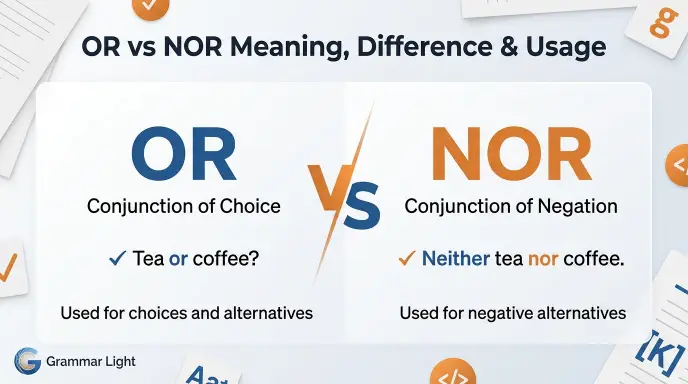
“Or” and “nor” are both conjunctions, but they are used differently: “or” usually presents an alternative or choice, while “nor” introduces a negative alternative, often after “neither” or another negative statement. Understanding the difference makes sentences clearer and helps avoid common grammar mistakes.
These two small words can be confusing because both can connect ideas, people, actions, or choices. However, they do not normally have the same grammatical function. Or is commonly associated with alternatives, while nor is associated with negative alternatives.
For example, you can say, “Would you like tea or coffee?” The sentence gives two choices. In contrast, “She likes neither tea nor coffee” connects two things that are both rejected.
The difference becomes especially important in structures such as either…or and neither…nor. Once these patterns are understood, choosing between “or” and “nor” becomes much easier.
Or or Nor : Quick Answer
Use “or” when you are presenting an alternative, choice, or possibility. Use “nor” when connecting a second negative alternative, especially after “neither.”
Compare these examples:
- Would you like tea or coffee?
- You can call me or send me a message.
- She likes neither tea nor coffee.
- He did not call, nor did he send a message.
The simplest way to remember the difference is:
Or = alternative or choice
Nor = negative alternative
“Or” can appear in both positive and negative sentences, while “nor” most commonly appears in negative constructions.
Definition and Meaning of Or
“Or” is a coordinating conjunction used to connect alternatives or choices. It can connect individual words, phrases, or complete clauses.
Or as a Choice
One of the most common uses of “or” is to offer two or more possibilities.
For example:
- Do you want tea or coffee?
- Should we walk or take the bus?
- Is your appointment on Monday or Tuesday?
In each sentence, “or” connects alternatives.
Or as a Possibility
“Or” can also introduce another possible situation.
For example:
- You can finish it today or tomorrow.
- We could watch a movie or play a game.
- The package may arrive today or tomorrow.
The alternatives do not always have to be mutually exclusive. The exact meaning depends on the context.
Definition and Meaning of Nor
“Nor” is a conjunction used to introduce another negative alternative or idea. It is especially common after neither.
For example:
She speaks neither French nor Spanish.
The sentence means that she does not speak French and does not speak Spanish.
Another example is:
He neither called nor emailed.
Here, “nor” connects two negative actions.
Nor Without Neither
“Nor” can sometimes appear without “neither,” particularly when it follows another negative statement.
For example:
He did not apologize, nor did he explain what happened.
This construction connects two negative ideas.
Notice the word order:
nor + auxiliary verb + subject + main verb
So we say:
Nor did he explain.
Not:
Nor he did explain.
Or vs. Nor: The Main Difference
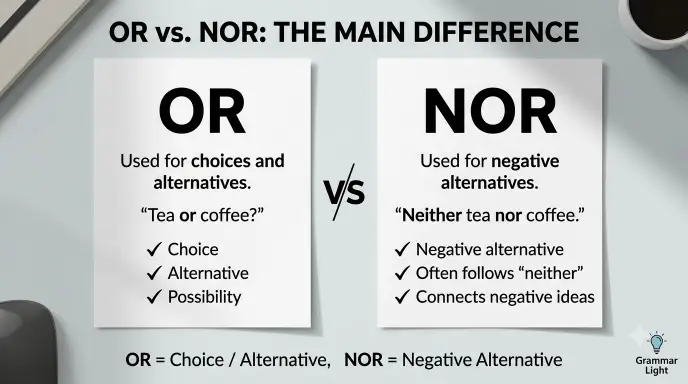
The main difference is the type of relationship each word creates.
| Word | Main Function | Example |
| Or | Presents an alternative | Tea or coffee? |
| Nor | Adds a negative alternative | Neither tea nor coffee |
| Or | Can connect positive or negative choices | I don’t want tea or coffee |
| Nor | Common after “neither” | She likes neither option nor the alternative |
Simple Comparison
Consider these two sentences:
You can choose red or blue.
This sentence gives a choice.
You can choose neither red nor blue.
This sentence rejects both choices.
The meaning changes because “or” presents alternatives, while “nor” connects negative alternatives.
When to Use Or
Use or when you want to present alternatives, choices, possibilities, or different options.
Offering a Choice
Would you like pizza or pasta?
The speaker is asking the listener to choose.
Connecting Alternatives
We can meet today or tomorrow.
Both possibilities are presented as alternatives.
Connecting Clauses
“Or” can also connect complete clauses.
You can stay here, or you can come with us.
Each side of “or” contains a complete idea.
Showing Another Possibility
Sometimes “or” means something similar to “otherwise” or introduces another possible explanation.
For example:
Hurry up, or we will miss the bus.
Here, “or” introduces the consequence that could happen if the first action is not taken.
When to Use Nor
Use nor when adding another negative idea, especially in the construction neither…nor.
After Neither
The most familiar pattern is:
neither + option A + nor + option B
Examples:
- She likes neither cats nor dogs.
- He speaks neither French nor German.
- We visited neither London nor Paris.
In each sentence, both alternatives are negative.
After a Negative Statement
“Nor” can also connect a second negative statement.
For example:
She didn’t call, nor did she send a message.
The first clause is negative, and “nor” introduces another negative action.
Examples of Or in Sentences
Here are some everyday examples showing how or works:
Choices
- Would you like water or juice?
- Should I call you or text you?
- Do you want the red dress or the blue one?
Possibilities
- It may rain today or tomorrow.
- The package could arrive this evening or in the morning.
- We might travel by car or train.
Alternatives in Instructions
- Call the office or send an email.
- Save the document or you may lose your work.
- Take an umbrella or you may get wet.
The common feature is that or connects alternatives or possibilities.
Examples of Nor in Sentences
“Nor” is commonly found in negative structures.
Neither…Nor
- I like neither coffee nor tea.
- She owns neither a car nor a bicycle.
- They visited neither the museum nor the gallery.
- He is neither angry nor upset.
Nor After a Negative Clause
- He didn’t complain, nor did he leave.
- She wasn’t invited, nor was her sister.
- They haven’t arrived, nor have they called.
These examples show why “nor” can look more complicated than “or.” When “nor” introduces an independent clause, the auxiliary verb often comes before the subject.
Or and Nor in Everyday English
In ordinary conversation, or appears much more frequently because people regularly use it to make choices and discuss possibilities.
For example:
Do you want to stay home or go out?
“Nor” is more common in specific grammatical patterns, particularly:
neither…nor
It can also appear in formal or carefully structured sentences:
He did not respond, nor did he provide an explanation.
In casual speech, people may use other constructions instead, but “nor” remains standard English and is especially useful when connecting negative ideas clearly.
Why Or and Nor Are Often Confused
The confusion usually comes from the fact that both words connect alternatives.
The important distinction is positive choice versus negative connection.
Compare:
You can have tea or coffee.
The sentence presents two options.
You can have neither tea nor coffee.
The sentence says that both options are rejected.
Another common source of confusion is the phrase either…or compared with neither…nor.
These paired structures are easy to remember:
Either…or = one alternative or another
Neither…nor = not one and not the other
Learning these patterns makes the difference between “or” and “nor” much easier to recognize.
Or and Nor in Negative Sentences
Understanding how or and nor work with negative sentences is important because both can appear in negative contexts, but they do not always mean the same thing.
Using Or in Negative Sentences
“Or” can appear in a negative sentence when alternatives are being connected.
For example:
I don’t want tea or coffee.
In everyday English, this can mean that the speaker wants neither option.
Another example is:
She doesn’t watch movies or television.
The exact meaning can depend on context.
Using Nor in Negative Sentences
“Nor” is commonly used to add a second negative idea.
For example:
He didn’t call, nor did he send a message.
The first clause is negative, and “nor” introduces another negative action.
This structure is especially common in formal or carefully written English.
Neither…Nor vs. Either…Or
Neither…nor and either…or are two important paired constructions.
Either…Or
Use either…or when presenting two alternatives.
Examples:
- You can choose either tea or coffee.
- We can either stay home or go outside.
- She will either call or send a message.
The basic idea is that one alternative or another is possible.
Neither…Nor
Use neither…nor when both alternatives are negative.
Examples:
- I want neither tea nor coffee.
- She speaks neither French nor Spanish.
- He chose neither option nor the alternative.
A useful memory rule is:
Either…or = alternatives
Neither…nor = negative alternatives
Common Mistakes With Or and Nor
Although these words are short, they can cause several grammar mistakes.
Using Nor After a Positive Choice
Incorrect:
I want tea, nor coffee.
Better:
I want tea or coffee.
“Nor” normally requires a negative context or a structure such as neither…nor.
Forgetting Neither
Incorrect:
I like nor tea nor coffee.
Correct:
I like neither tea nor coffee.
Incorrect Word Order After Nor
Incorrect:
He didn’t call, nor he sent a message.
Correct:
He didn’t call, nor did he send a message.
When “nor” introduces an independent negative clause, auxiliary inversion is normally used.
Mixing Either and Nor
Incorrect:
Either tea nor coffee.
Correct:
Either tea or coffee.
Or:
Neither tea nor coffee.
These paired structures should remain consistent.
How to Choose Between Or and Nor
Choosing the correct word becomes easier when you look at the meaning of the sentence.
Use Or for Choices
Ask yourself you are giving someone an option.
Do you want tea or coffee?
If yes, or is usually the correct choice.
Use Nor for Negative Alternatives
Ask if the sentence means that two things are both rejected.
I want neither tea nor coffee.
If yes, nor fits the negative construction.
Use Neither…Nor Together
When both alternatives are negative, the easiest structure to remember is:
neither + first option + nor + second option
For example:
She likes neither cats nor dogs.
This pattern works in many everyday situations.
Everyday Examples of Or and Nor
Here are some natural examples that show the difference.
Examples With Or
- Do you want pizza or burgers?
- We can leave now or wait until later.
- Call me or send me a message.
- Is this your book or mine?
- You can walk or take the bus.
Examples With Nor
- She likes neither tea nor coffee.
- He speaks neither English nor French.
- They didn’t complain, nor did they leave.
- I have neither the time nor the energy.
- She wasn’t ready, nor was her friend.
FAQs
When to use nor or or?
Use or to present a choice, alternative, or possibility. Use nor to connect a negative alternative, especially after neither. For example, “Would you like tea or coffee?” presents a choice, while “I want neither tea nor coffee” rejects both options.
What is or and nor?
Or and nor are conjunctions. “Or” connects alternatives or choices, while “nor” connects negative alternatives. The common paired forms are either…or and neither…nor.
Is or the same as nor?
No. Or and nor are not interchangeable. “Or” generally presents an alternative, while “nor” normally introduces another negative alternative. Compare “tea or coffee” with “neither tea nor coffee.”
What is the difference between nor and or?
The main difference is their grammatical meaning. Or is used for alternatives, choices, and possibilities. Nor is used to connect negative alternatives, especially after “neither” or following another negative statement.
What are 5 examples of nor in a sentence?
Here are five examples:
- She likes neither tea nor coffee.
- He speaks neither English nor Spanish.
- I have neither the time nor the money.
- They didn’t call, nor did they send a message.
- She wasn’t ready, nor was her brother.
How can I use nor?
Use nor to add a negative alternative. The most common pattern is neither…nor, as in “He likes neither cats nor dogs.” It can also follow a negative clause: “She didn’t call, nor did she text.”
Final Thoughts
Or and nor have related but different functions. “Or” is mainly used to present alternatives, choices, and possibilities, while “nor” connects negative alternatives.
The easiest patterns to remember are either…or for alternatives and neither…nor for negative alternatives. Once these structures become familiar, choosing between the two words becomes much simpler.
FIND MORE!

I’m a grammar writer focused on making English rules, word usage, and sentence structure simple and easy to understand.