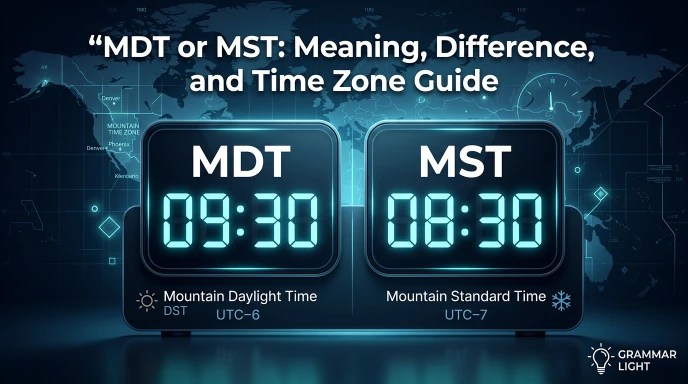
MDT means Mountain Daylight Time, while MST means Mountain Standard Time. Both are used in the Mountain Time Zone, but MDT is used during daylight saving time and MST is used during standard time.
What Is MDT?
It is stands for Mountain Daylight Time and is the daylight saving version of Mountain Time.
MDT UTC Offset
MDT is UTC−6, meaning it is six hours behind Coordinated Universal Time.
For example, when it is 12:00 noon UTC, it is 6:00 a.m. MDT.
When Is MDT Used?
MDT is generally used during the daylight saving period, when clocks in participating locations move forward by one hour. In the United States, this typically occurs from spring until fall.
What Is MST?
MST stands for Mountain Standard Time. It is the standard time version of Mountain Time.
MST UTC Offset
MST is UTC−7, which means it is seven hours behind Coordinated Universal Time.
For example, when it is 12:00 noon UTC, it is 5:00 a.m. MST.
When Is MST Used?
MST is generally used during the standard time part of the year in locations that switch between standard time and daylight saving time. Some areas, however, use MST throughout the entire year.
MDT MST conversion: Key Difference
The main difference between MDT MST time zone difference is one hour.
| Feature | MDT | MST |
| Full name | Mountain Daylight Time | Mountain Standard Time |
| UTC offset | UTC:6 | UTC:7 |
| Clock position | One hour ahead | One hour behind MDT |
| Typical use | Daylight saving period | Standard time period |
| Time zone | Mountain Time | Mountain Time |
When a location changes from Mountain Time difference, the clock typically moves forward by one hour. When it changes back from Mountain Daylight vs Standard Time, the clock moves back by one hour.
Is MDT the Same as MST?
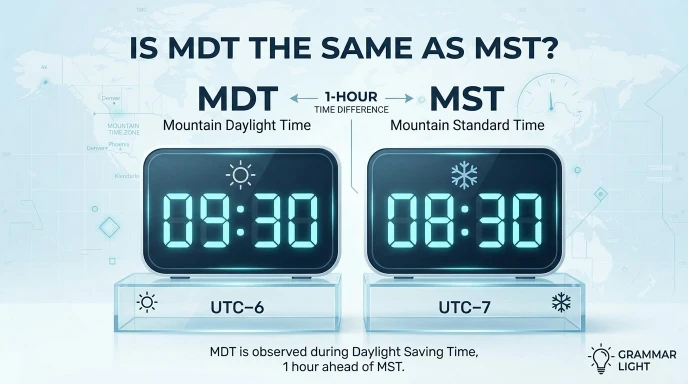
No. MDT and MST are not the same time. MDT is one hour ahead of MST.
For example:
- 10:00 a.m. MDT = 9:00 a.m. MST
- 3:00 p.m. MDT = 2:00 p.m. MST
- 8:00 p.m. MDT = 7:00 p.m. MST
The difference remains one hour when comparing the two offsets directly.
Why Does Mountain Time Have Mountain Daylight vs Standard Time?
Mountain Time uses two different offsets because of daylight saving time.
Standard Time
During standard time, the clock uses MST (UTC:7).
Daylight Saving Time
During daylight saving time, participating locations move the clock forward and use MDT (UTC:6).
This seasonal change is why you may see both abbreviations used for the same general region at different times of the year.
Mountain Time difference: Which One Should You Use?
The correct abbreviation depends on the date and location.
If the location is observing daylight saving time, MDT may be appropriate. If it is observing standard time, MST may be appropriate. Some locations remain on MST year round, so the location must also be considered.
Mountain Time difference Examples
Understanding a few simple examples makes the difference easier to remember.
Example 1: Comparing the Same Clock Time
If a meeting is scheduled for 2:00 p.m. MDT, the corresponding MST time is 1:00 p.m.
Example 2: Converting Mountain Time difference
If the time is 6:00 p.m. MST, it would be 7:00 p.m. MDT when comparing the same moment.
Example 3: Remembering the Difference
A simple way to remember the offsets is:
MDT = UTC:6
MST = UTC:7
Mountain Daylight vs Standard Time Conversion
Converting between Mountain Time difference is simple because the two time standards are separated by exactly one hour.
Mountain Daylight vs Standard Time
To convert Mountain Time difference, subtract one hour.
For example:
- 9:00 a.m. MDT → 8:00 a.m. MST
- 1:00 p.m. MDT → 12:00 p.m. MST
- 7:00 p.m. MDT → 6:00 p.m. MST
Mountain Time difference
To convert MST to MDT, add one hour.
For example:
- 8:00 a.m. MST → 9:00 a.m. MDT
- 2:00 p.m. MST → 3:00 p.m. MDT
- 10:00 p.m. MST → 11:00 p.m. MDT
These conversions compare the two time offsets directly. The actual abbreviation used in a location depends on its date and daylight saving rules.
Mountain Time difference and Daylight Saving Time
Daylight saving time is the main reason both MDT and MST exist.
What Happens in Spring?
In locations that observe daylight saving time, clocks typically move one hour forward in spring. Mountain Time changes from MST to MDT.
What Happens in Fall?
In fall, clocks typically move one hour backward, changing from MDT back to MST.
The exact transition dates depend on the location and applicable laws.
Does Every Mountain Time Location Use MDT?
No. Not every location associated with Mountain Time follows the same daylight saving rules.
Some areas observe daylight saving time and switch between MST and MDT. Other areas remain on MST throughout the year.
This means you should consider both the location and date when determining the correct abbreviation.
Mountain Time difference vs UTC
UTC provides a useful reference for understanding the two Mountain Time offsets.
MDT Compared With UTC
MDT is 6 hours behind UTC (UTC−6).
MST Compared With UTC
MST is 7 hours behind UTC (UTC−7).
How to Remember Mountain Time difference
A simple memory trick can make the difference easier to remember.
Remember the “D”
The D in MDT stands for Daylight, so MDT is associated with daylight saving time.
Remember the “S”
The S in MST stands for Standard, so MST represents standard time.
You can also remember the numbers:
MDT = UTC−6
MST = UTC−7
MDT or MST for Meetings and Schedules
Time zone abbreviations can be important when scheduling online meetings, appointments, travel, or events.
Check the Date
A meeting listed as “2:00 p.m. Mountain Time” may correspond to MDT or MST depending on the date.
Consider the Location
Do not assume that every location in the Mountain Time region changes its clocks in the same way. Check the applicable time zone rules for the specific location.
Use a Full Time Zone Identifier When Possible
For international scheduling, a named location or standard time zone identifier can be clearer than relying only on MDT or MST. This helps avoid confusion caused by seasonal clock changes.
Common Questions About MDT and MST
These quick answers cover some of the most common questions about the two Mountain Time abbreviations.
Is MDT One Hour Ahead of MST?
Yes. MDT is one hour ahead of MST because MDT is UTC−6 and MST is UTC−7.
Which Is Earlier, Mountain Time difference?
For the same moment, MST shows an earlier clock time than MDT by one hour.
Is MST the Same as Mountain Time?
MST is the standard time offset used within Mountain Time. However, locations that observe daylight saving time use MDT during the daylight saving period.
Is MDT Always Used in Summer?
MDT is generally associated with the daylight saving period, but the exact dates and rules depend on the location.
What Does MDT Stand For?
MDT stands for Mountain Daylight Time.
What Does MST Stand For?
MST stands for Mountain Standard Time.
Mountain Time difference: Quick Reference
| Question | Answer |
| What does MDT mean? | Mountain Daylight Time |
| What does MST mean? | Mountain Standard Time |
| MDT offset | UTC−6 |
| MST offset | UTC−7 |
| Difference | 1 hour |
| MDT compared with MST | MDT is 1 hour ahead |
| Main reason for the difference | Daylight saving time |
| Does every location switch? | No |
Which Should You Choose:Mountain Time difference?
Use MDT when the location is observing Mountain Daylight Time and MST when it is observing Mountain Standard Time. If you are scheduling something, always check the specific location and date instead of choosing an abbreviation based only on the season.
FAQs About Mountain Time difference
Are Mountain Time difference the Same?
No.Mountain Daylight vs Standard Time are different time standards. MDT is Mountain Daylight Time (UTC:6), while MST is Mountain Standard Time (UTC:7). MDT is one hour ahead of MST.
Is Colorado on Mountain Time difference Right Now?
Colorado uses MDT during daylight saving time and MST during standard time. The applicable abbreviation depends on the date.
Is Alberta Mountain Daylight vs Standard Time?
Alberta observes Mountain Standard Time (MST) during standard time and Mountain Daylight Time (MDT) during daylight saving time.
What Time Is Mountain Daylight vs Standard Time?
To convert MDT to MST, subtract one hour. For example, 4:00 p.m. MDT is 3:00 p.m. MST.
What Does MST Stand For?
MST stands for Mountain Standard Time. It has a UTC offset of UTC:7.
What Does MDT Stand For?
MDT stands for Mountain Daylight Time. It has a UTC offset of UTC:6 and is used during daylight saving time in locations that observe it.
Where Are Mountain Daylight vs Standard Time Used?
Mountain Daylight vs Standard Time are mainly associated with locations in the Mountain Time region of North America, but the abbreviation in use can change based on the location and time of year.
U.S. Locations That Change Between Mountain Time difference
Several areas in the United States use MST during standard time and MDT during the daylight saving period. Colorado is a common example.
This means the same location can have two different UTC offsets during the year:
- MST: UTC:7
- MDT: UTC:6
Locations That Stay on MST
Some places do not change their clocks for daylight saving time and can remain on MST throughout the year. This is why checking the specific location is important when planning meetings or events.
Mountain Time difference for Travel and Flights
Time zone abbreviations can create confusion when booking flights or planning travel.
Check the Local Time
Airlines and travel services usually display departure and arrival times in the local time of each airport. The abbreviation may change during different parts of the year.
Avoid Assuming the Same Offset
A location listed as Mountain Time is not always UTC:7. During daylight saving time, many locations move to UTC:6 and use MDT instead.
For accurate planning, check the local time and date rather than relying only on a general Mountain Time label.
Mountain Time difference for Online Meetings
Choosing the correct abbreviation is important when scheduling virtual meetings with people in different regions.
Use the Date and Location
Before scheduling a meeting, confirm both the meeting date and the location. A meeting scheduled months in advance may occur after a daylight saving change.
Write the Time Clearly
Instead of writing only “10:00 a.m. Mountain Time,” use a clearer format when necessary, such as:
10:00 a.m. MDT (UTC:6)
or
10:00 a.m. MST (UTC:7)
This can reduce confusion for people joining from other time zones.
Common Mistakes When Using Mountain Time difference
Understanding a few common mistakes can help you avoid scheduling errors.
Mistake 1: Treating Mountain Time difference as the Same
MDT and MST are one hour apart, so using the wrong abbreviation can cause someone to join a meeting early or late.
Mistake 2: Ignoring Daylight Saving Time
Some people assume a location uses the same UTC offset throughout the year. In reality, many locations switch between MST and MDT.
Mistake 3: Forgetting Location Differences
Not every location in the Mountain Time region follows the same daylight saving rules. Always check the specific place when accuracy matters.
Quick Tips for Choosing Mountain Time difference
The easiest way to choose the correct abbreviation is to follow three simple steps.
Step 1: Identify the Location
Find out exactly where the event, meeting, or activity is taking place.
Step 2: Check the Date
Determine if the location is observing daylight saving time on that specific date.
Step 3: Confirm the UTC Offset
Use MDT for UTC:6 and MST for UTC:7.
Mountain Time difference: Simple Summary
MDT is one hour ahead of MST, with MDT at UTC−6 and MST at UTC−7. The correct abbreviation depends on the location and the date.
For schedules, travel, meetings, and international communication, checking the specific local time is the safest way to avoid confusion.
Mountain Time difference for Everyday Scheduling
Knowing the difference between MDT and MST can help prevent mistakes when planning calls, appointments, travel, and online events.
For Business Meetings
When arranging a meeting across different locations, include the time zone abbreviation or UTC offset with the meeting time. This makes the schedule easier for everyone to understand.
For Events and Appointments
If an event takes place in a location that changes between MDT and MST, confirm the time zone for the exact event date. This is especially useful for events scheduled months in advance.
Mountain Daylight vs Standard Time for Different Time Zones
MDT and MST can be compared with other common North American time zones to understand their position.
Mountain Time and Central Time
During standard time, MST is one hour behind Central Standard Time. During daylight saving time, MDT is one hour behind Central Daylight Time.
Mountain Time and Pacific Time
MST is one hour ahead of Pacific Standard Time, while MDT is one hour ahead of Pacific Daylight Time.
The exact comparison depends on the seasonal time standards being observed.
How to Avoid Mountain Time difference Confusion
A few simple habits can make time zone planning much easier.
Check an Exact Date
Do not rely only on the month or season. Daylight saving rules can vary by location and may change over time.
Use UTC When Necessary
For international communication, adding the UTC offset can make a time easier to interpret.
For example:
MDT = UTC:6
MST = UTC:7
Confirm the Location
Always identify the specific city or region before deciding which abbreviation applies. Different locations can follow different daylight saving rules.
Mountain Time difference: Which One Is Correct?
Neither abbreviation is always correct throughout the year. MDT is correct when a location is observing Mountain Daylight Time, while MST is correct when it is observing Mountain Standard Time.
If you are writing a schedule, invitation, or online meeting notice, use the abbreviation that applies to the location on that particular date.
Frequently Asked Questions About Mountain Time difference
Is MDT Always One Hour Ahead of MST?
Yes. MDT uses UTC:6, while MST uses UTC :7, so MDT is one hour ahead of MST.
Can a Place Use MST All Year?
Yes. Some locations remain on MST throughout the year instead of switching to MDT for daylight saving time.
Does MDT Mean Summer Time?
MDT is generally associated with the daylight saving period in locations that observe it. The exact dates depend on local rules.
How Do I Convert MDT to MST?
Subtract one hour from MDT to get the corresponding MST clock time.
For example, 11:00 a.m. MDT corresponds to 10:00 a.m. MST.
How Do I Convert MST to MDT?
Add one hour to MST to get the corresponding MDT clock time.
For example, 5:00 p.m. MST corresponds to 6:00 p.m. MDT.
MDT or MST: Quick Decision Guide
Use this simple guide when you need to identify the correct abbreviation:
- MDT (UTC−6): Mountain Daylight Time
- MST (UTC−7): Mountain Standard Time
- MDT is one hour ahead of MST
- The correct abbreviation depends on the location and date
- Some locations use MST throughout the year
Understanding these differences makes it easier to manage schedules and communicate accurate times across different regions.
Practical Conclusion
MDT and MST are one hour apart, with MDT at UTC−6 and MST at UTC−7. MDT is used during daylight saving time in locations that observe it, while MST is used during standard time.
When choosing between MDT and MST, always consider the specific location and date. For quick conversion, remember that MDT is one hour ahead of MST. Checking the applicable local time zone is the best way to avoid confusion when planning meetings, travel, appointments, or online events.
EXPLORE MORE!

I’m a grammar writer focused on making English rules, word usage, and sentence structure simple and easy to understand.








2 thoughts on “MDT or MST: Meaning, Difference, and Time Zone Guide”