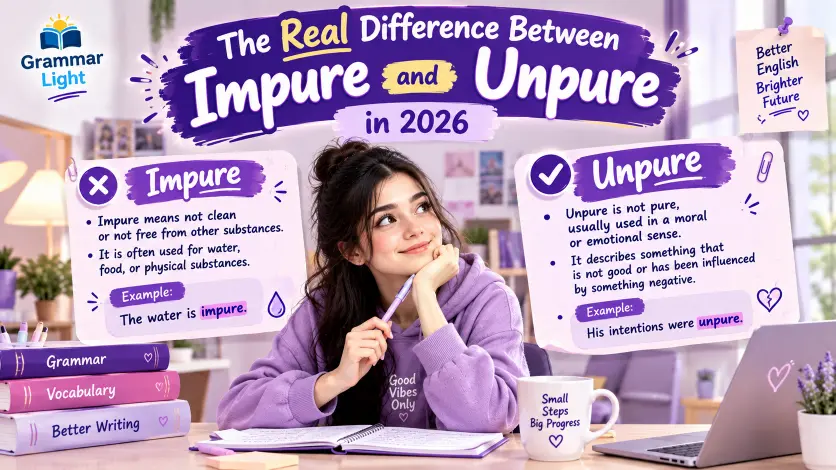
If you are wondering “unpure or impure,” the correct standard English word is “impure.” “Unpure” is uncommon and generally not the preferred form in standard English.
People often get confused because un is a common English prefix used to make opposites, so “unpure” may seem logical. However, English does not form every opposite by simply adding un . The established word is impure.
In this guide, you will learn the meaning of impure, why “unpure” is usually avoided, how to use the word correctly, and the difference between pure, impure, and unpure.
Unpure or Impure : Quick Answer
Impure is the standard and preferred spelling. It means not pure, clean, or free from unwanted substances or qualities.
For example:
- The water is impure.
- The sample was found to be impure.
- The substance contains impurities.
“Unpure” may appear occasionally, but it is not the normal choice in modern standard English.
| Word | Standard Usage | Meaning |
| Impure | ✅ Preferred | Not pure |
| Unpure | ⚠️ Uncommon | Intended to mean not pure |
| Pure | ✅ Correct | Free from unwanted substances |
For formal, academic, professional, and everyday writing, choose impure.
Definition and Meaning of Impure
Impure is an adjective used to describe something that is not pure or contains something unwanted.
What Does Impure Mean?
The exact meaning depends on the context.
For a substance, impure can mean that it contains other materials.
- The laboratory sample was impure.
- The water became impure after contamination.
- The chemical was not completely pure.
The word can also describe ideas, motives, or intentions in certain contexts.
- The decision was made with impure motives.
- The mixture contained impure ingredients.
Impure in Simple English
A simple way to understand the word is:
Pure = clean or free from unwanted elements
Impure = not pure or containing unwanted elements
For example:
Pure water contains very few unwanted substances.
Impure water contains substances that make it less pure.
Why Is Impure Correct Instead of Unpure?
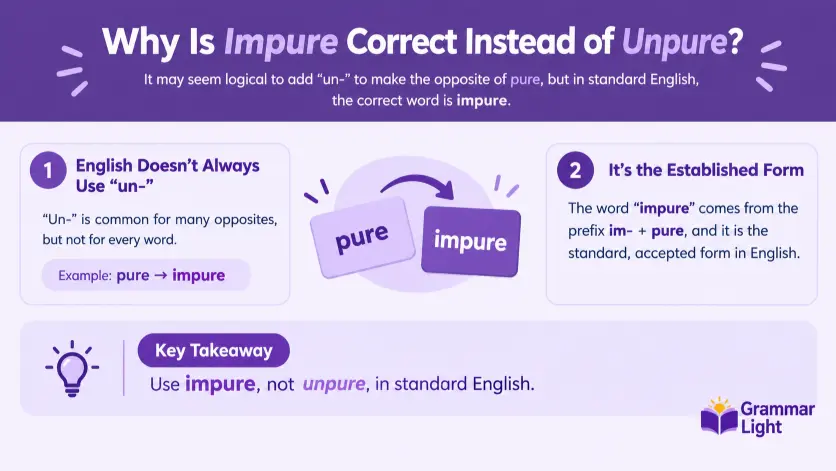
The main reason is that English uses different prefixes to create opposites, and the established form for “not pure” is impure.
The word “impure” comes from the prefix im combined with pure.
im + pure = impure
The prefix im is a form of the negative prefix related to in and commonly appears before certain sounds.
The Prefix “Im ”
You can see similar patterns in other English words:
- possible → impossible
- perfect → imperfect
- patient → impatient
- pure → impure
This does not mean that every word beginning with a negative meaning must use im . English vocabulary developed through historical usage, so individual words have established forms.
The Origin of Impure
The word impure comes through French from Latin roots. It is related to the Latin word impurus, meaning not pure or unclean.
Over time, the word became part of English vocabulary and developed the meaning it has today.
The important point for modern English learners is that impure is the established standard form.
Impure as an Adjective
“Impure” is an adjective, so it describes a noun.
Examples:
- impure water
- impure substance
- impure sample
- impure material
- impure mixture
You can place it before a noun:
The scientist tested the impure sample.
Or after a linking verb:
The sample was impure.
Pure vs Impure
Understanding the opposite pair makes the spelling easier to remember.
Pure
Pure describes something free from unwanted substances, additions, or contamination.
Example:
The laboratory requires pure water.
Impure
Impure describes something that is not completely pure.
Example:
The laboratory rejected the impure sample.
| Pure | Impure |
| Free from unwanted elements | Contains unwanted elements |
| Clean or uncontaminated | Not completely pure |
| Pure substance | Impure substance |
The standard opposite of pure is impure, not “unpure.”
When Should You Use Impure?
Impure is appropriate when discussing substances, materials, mixtures, samples, or anything that is not completely pure.
It can also be used in more abstract contexts, depending on the sentence.
Examples
- The water is impure.
- The chemical contained impure material.
- The test detected an impure sample.
- The mixture became impure after exposure to air.
- The researcher removed the impurities from the substance.
British English vs American English Spelling
The spelling “impure” is the same in both British and American English, so you do not need a different spelling based on region.
British English
British English uses impure as the standard form.
Examples:
- The water was impure.
- The material contained impurities.
- The sample was considered impure.
American English
American English also uses impure.
Examples:
- The substance is impure.
- The test found an impure sample.
- The water may be impure.
| English Variety | Correct Form | Common Incorrect Form |
| British English | impure | unpure |
| American English | impure | unpure |
| International English | impure | unpure |
There is no British versus American spelling difference here.
Which Spelling Should You Use?
For standard English, use impure when you mean “not pure.”
The word is suitable for academic writing, professional documents, articles, everyday communication, and scientific contexts.
In Formal Writing
Use impure in reports, essays, and professional documents:
- The researchers discovered an impure compound.
- The sample was impure because it contained other substances.
- The process helps remove impurities from the material.
In Everyday English
“Impure” can also be used in ordinary sentences:
- The water looks impure.
- The substance is impure.
- The mixture became impure.
If you are unsure, remember this simple rule:
Pure → Impure
Not:
Pure → Unpure
Common Mistakes with Unpure or Impure
The spelling confusion usually comes from treating un as the natural opposite making prefix.
Mistake 1: Writing Unpure
❌ The sample is unpure.
✅ The sample is impure.
Mistake 2: Using Unpure in Academic Writing
❌ The experiment used an unpure substance.
✅ The experiment used an impure substance.
Impure is the established word and is the safer choice for standard writing.
Mistake 3: Confusing Impure With Impurity
Impure is an adjective.
Impurity is a noun that refers to an unwanted substance or quality.
Compare:
- The water is impure.
- The water contains several impurities.
This distinction is useful when writing scientific or technical content.
Unpure or Impure in Everyday Examples
Simple examples can help you remember the correct form.
Examples With Impure
- The water became impure.
- The laboratory rejected the impure sample.
- The substance was impure.
- The mixture contained impurities.
- Scientists worked to remove the impurities.
- The material was found to be impure.
Incorrect Examples
- ❌ The water is unpure.
- ❌ We tested an unpure sample.
- ❌ The substance became unpure.
Replace unpure with impure in these sentences.
Impure vs Impurity
These words are closely related but have different grammatical roles.
Impure describes something.
Impurity names an unwanted substance, element, or quality.
| Word | Part of Speech | Example |
| Pure | Adjective | The water is pure. |
| Impure | Adjective | The water is impure. |
| Purity | Noun | The purity of the water was tested. |
| Impurity | Noun | The test detected an impurity. |
For example:
The chemical was impure because it contained an impurity.
This makes the relationship between the words easy to understand.
How to Remember Impure, Not Unpure
A simple memory trick can help you choose the correct word quickly.
Remember the Opposite Pair
Think of the pair together:
Pure ↔ Impure
This is easier than trying to create the opposite yourself.
Remember the “Im ” Prefix
The standard word is formed as:
im + pure = impure
When you see “pure,” remember that its established negative form begins with im .
Quick Memory Rule
Pure is clean. Impure is not pure.
So, when you mean “not pure,” choose impure.
Related Internal Reading
If your site covers other English word choice and spelling topics, this article can naturally connect with related guides such as Happened or Happend, Halt or Hault, and Coma or Comma. This gives readers more ways to explore related English mistakes across your site.
Impure in Different Contexts
The word impure can be used in several contexts, but its core meaning stays the same: something is not completely pure.
Impure in Science
In science, impure often describes a substance that contains other materials or compounds.
Examples:
- The chemist tested an impure sample.
- The solution became impure after contamination.
- The process removes impurities from the compound.
Impure in Water and Food
The word can describe water, food, or other materials that contain unwanted substances.
Examples:
- The water was considered impure.
- The filter helps remove impurities from drinking water.
- The laboratory tested the impure water sample.
Impure in Abstract Use
“Impure” can also describe something in a non physical sense, such as motives or intentions.
For example:
- The character was accused of having impure motives.
- The decision was made for impure reasons.
The meaning depends on the context, but the spelling remains impure.
Impure vs Unpure: Grammar and Usage
Understanding how these words function in a sentence makes the difference clearer.
Impure as an Adjective
Impure describes a person, thing, substance, idea, or quality.
Examples:
- an impure substance
- an impure mixture
- an impure sample
- impure motives
You can also use it after a linking verb:
The substance is impure.
Unpure as a Nonstandard Form
“Unpure” may be understood by readers because un often means “not,” but it is not the normal standard form for this meaning.
For polished English, choose impure.
Pure, Impure, and Purity
These related words are easy to confuse because they have similar forms.
Pure
Pure is an adjective meaning free from unwanted substances or additions.
The sample is pure.
Impure
Impure is the opposite adjective.
The sample is impure.
Purity
Purity is a noun referring to the state or quality of being pure.
The purity of the sample was tested.
Impurity
Impurity is a noun referring to something that makes a substance or material less pure.
The test detected an impurity in the sample.
| Word | Type | Meaning |
| Pure | Adjective | Completely or highly free from unwanted elements |
| Impure | Adjective | Not pure |
| Purity | Noun | State of being pure |
| Impurity | Noun | An unwanted element or substance |
How to Use Impure Correctly in a Sentence
The easiest way to use impure is to place it before a noun or after a linking verb.
Before a Noun
- Impure water can contain unwanted substances.
- The scientist examined an impure compound.
- The factory rejected the impure material.
After a Linking Verb
- The water is impure.
- The sample was impure.
- The substance became impure.
With “Because”
You can explain why something is impure by using because.
The sample was impure because it contained another substance.
The water became impure because contaminants entered the container.
Common Questions About Unpure or Impure
These quick answers cover the questions readers often have about this spelling.
Is “Unpure” a Correct Word?
Impure is the standard and preferred word for “not pure.” “Unpure” is uncommon and should generally be avoided in standard writing.
Is It Impure or Unpure Water?
The standard phrase is impure water.
Example:
The test showed that the water was impure.
What Is the Opposite of Pure?
The standard opposite of pure is impure.
pure ↔ impure
What Is the Noun Form of Impure?
The noun form is impurity.
Example:
The scientist discovered an impurity in the sample.
Unpure or Impure: Quick Comparison
| Question | Answer |
| Correct standard word? | Impure |
| Is “unpure” preferred? | No |
| Meaning of impure? | Not pure |
| Opposite of pure? | Impure |
| Noun form? | Impurity |
| British spelling? | Impure |
| American spelling? | Impure |
| Example | The sample is impure. |
The easiest rule to remember is: Pure → Impure. Use impure in standard English writing instead of “unpure.”
FAQs About Unpure or Impure
These common questions explain the difference between unpure and impure and how each word is used in English.
Which Is Correct, Unpure or Impure?
Impure is the correct and standard English word in most contexts. It means not pure or containing something unwanted or mixed with another substance.
- Correct: The water is impure.
- Less common: The water is unpure.
For standard, formal, and everyday English, use impure.
What Does It Mean to Be Impure?
To be impure means to lack complete purity. The word can describe a physical substance, mixture, material, or an abstract quality.
For example:
- Impure water contains unwanted substances.
- An impure sample contains other materials.
- The metal was considered impure because it contained other elements.
- The phrase can also describe something viewed as morally or spiritually not pure.
The exact meaning depends on the context.
What Does “Unpure” Mean?
Unpure is an uncommon form that generally means not pure. It may appear in informal writing, older texts, or situations where a writer creates an opposite using the prefix un .
However, impure is the established standard word for this meaning.
So:
Pure → Impure
is the normal English pattern.
What Is Another Word for “Unpure”?
Since unpure usually means “not pure,” several words can work depending on the context:
| Alternative | Meaning |
| Impure | Not completely pure |
| Contaminated | Made impure by harmful or unwanted material |
| Polluted | Containing harmful substances |
| Mixed | Combined with another substance |
| Tainted | Made less pure or acceptable |
| Unclean | Not clean or pure |
Impure is the closest direct replacement for “unpure.”
What Does the Word “Impure” Mean?
Impure is an adjective meaning not pure, clean, or free from unwanted elements.
It can describe both physical and abstract things.
Examples:
- The laboratory found impure chemicals in the sample.
- The water became impure after contamination.
- The material was impure because it contained other substances.
- The story describes impure motives.
The noun forms include impurity and, in some contexts, impureness.
Is “Unpretty” a Word?
Unpretty can be found in English, but it is much less common than standard alternatives such as unattractive, plain, or not pretty.
Unlike impure, which is the established opposite of “pure,” “unpretty” is formed by adding un to “pretty.”
For natural everyday English, these options are usually clearer:
- not pretty
- unattractive
- plain
- unappealing
The word unpretty may appear in creative, informal, or expressive writing, but it is not normally the first choice in formal English.
Impure vs Pure: Key Differences
The easiest way to understand impure is to compare it directly with its opposite, pure.
| Word | Meaning | Example |
| Pure | Free from unwanted or mixed substances | The sample is pure. |
| Impure | Not completely pure or containing other elements | The sample is impure. |
| Impurity | Something that makes a substance less pure | The test found an impurity. |
Pure
Pure describes something that is clean, unmixed, or free from unwanted elements.
- The gold is pure.
- She used pure water.
- The product contains pure ingredients.
*Impure
Impure describes something that contains unwanted material or is not completely pure.
- The water is impure.
- The chemical sample is impure.
- The metal contains impure material.
“Impure in Science and Everyday English“
The word impure is common in both technical writing and everyday conversations.
In Science
Scientists use impure to describe substances that contain other materials or compounds.
For example:
The laboratory sample was impure because it contained several other compounds.
For Water and Food
The word can describe water, food, or other materials that contain unwanted substances.
The test showed that the water was impure.
For Metals and Materials
Impure can also describe metals, chemicals, minerals, and other materials that are not completely free from additional elements.
The impure metal required further processing.
Impure vs Contaminated
These words are related, but they do not always have the same meaning.
Impure means something is not completely pure. Contaminated usually suggests the presence of an unwanted or harmful substance.
| Word | Meaning |
| Impure | Not completely pure |
| Contaminated | Made unsafe or unsuitable by an unwanted substance |
| Polluted | Contaminated, especially in the environment |
| Tainted | Negatively affected or made less pure |
For example:
- The sample is impure because it contains another compound.
- The water is contaminated with harmful bacteria.
Common Sentence Patterns With Impure
Learning common sentence patterns can make impure easier to use correctly.
Impure + Noun
Use impure before a noun.
- impure water
- impure gold
- impure chemicals
- impure materials
- impure substances
Be + Impure
Use impure after linking verbs such as is, was, and became.
- The water is impure.
- The sample was impure.
- The material became impure.
Impure Because of
You can explain the reason something is impure with because of.
The solution was impure because of the additional chemicals.
How to Avoid the Mistake “Unpure”
Remembering one simple pattern can help you avoid this spelling mistake.
Pure → Impure
Do not automatically add un to every adjective to create its opposite. English uses different prefixes and word forms for different words.
For this word, the standard form is:
Impure ✅
Unpure ❌ / uncommon
A useful memory trick is:
PURE becomes IMPURE, not UNPURE.
This is especially helpful when writing formal English, school assignments, professional documents, or edited content.
Unpure or Impure: Final Comparison
This final comparison brings together the main spelling, meaning, and usage points.
| Point | Impure | Unpure |
| Correct standard form | Yes | No, uncommon |
| Meaning | Not completely pure | Generally intended to mean not pure |
| Common usage | Common | Rare |
| Formal writing | Recommended | Usually avoided |
| Related noun | Impurity | |
| Example | The water is impure. | The water is unpure. |
How to Remember the Correct Spelling
A simple word pattern makes the correct form easy to remember.
Pure → Impure → Impurity
Think of im as part of the established word rather than adding un yourself.
Easy Memory Rule
If the opposite of “pure” is needed, write “impure.”
This helps prevent the common mistake of writing unpure in formal or academic English.
Impure in Everyday Sentences
These examples show how impure naturally works in different contexts.
- The water became impure after contamination.
- The laboratory tested the impure sample.
- The metal contained several impurities.
- The company removed impure ingredients from the product.
- Scientists used a purification process to remove the impurities.
- The substance was considered impure because it contained other compounds.
Practical Conclusion
Impure is the standard English word, while unpure is uncommon and generally not preferred. Use impure in everyday, academic, professional, and formal writing.
The easiest rule to remember is:
Pure → Impure
Using this pattern will help you avoid the spelling unpure when you need the standard English form.
YOU MAY LIKE!

I’m a grammar writer focused on making English rules, word usage, and sentence structure simple and easy to understand.







3 thoughts on “The Real Difference Between Impure and Unpure in 2026”