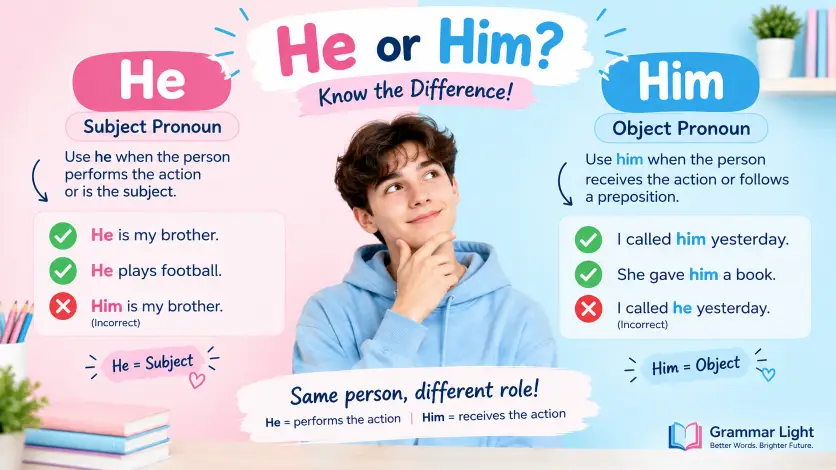
“He” is a subject pronoun, while “him” is an object pronoun. Both words refer to a male person or someone described using these pronouns, but they perform different grammatical roles in a sentence. Understanding when to use each word helps you speak and write English more naturally.
People often confuse he and him because both refer to the same person. The difference becomes clear when you look at who performs an action and who receives an action. For example, “He called me” is correct because he performs the action of calling. In contrast, “I called him” is correct because him receives the action.
These pronouns appear in everyday conversations, text messages, emails, school assignments, and professional writing. Choosing the wrong one can make a sentence sound grammatically incorrect, even when its meaning is understandable.
This guide explains the meanings of he and him, their grammatical roles, common mistakes, and practical examples. Once you understand how subject and object pronouns work, choosing the correct word becomes much easier.
Him or He : Quick Answer
Use he when the person is the subject performing an action. Use him when the person is the object receiving an action or appearing after certain prepositions.
Examples:
- He is my brother.
- He plays football.
- I called him yesterday.
- She gave him a book.
- The teacher spoke to him.
A simple way to remember the difference is to ask what role the person plays in the sentence.
| Pronoun | Grammatical role | Example |
| He | Subject | He is sleeping. |
| Him | Object | I saw him. |
Both words are correct. The right choice depends on how the sentence is structured.
Definition and Meaning of He and Him
He and him are personal pronouns used to refer to a male person or someone who uses these pronouns. Their main difference is grammatical function.
What Does He Mean?
He is a subject pronoun. It is generally used when the person performs an action or is the subject being described.
Examples:
- He works at a hospital.
- He enjoys reading.
- He is very helpful.
- He arrived early.
In each example, he is the person being discussed and serves as the subject of the sentence.
What Does Him Mean?
Him is an object pronoun. It is used when the person receives an action or follows a preposition.
Examples:
- I helped him.
- They invited him to dinner.
- We waited for him.
- She sat beside him.
Here, him refers to the person affected by the action or connected to the preposition.
Are He and Him Interchangeable?
No. Although both pronouns can refer to the same person, they are not normally interchangeable in standard English.
“He helped me” means that he performed the action. “I helped him” means that the speaker performed the action and him received it.
Changing the pronoun can change the sentence’s grammatical structure and sometimes its meaning.
When to Use He
Use he when the pronoun acts as the subject of a sentence or clause.
When He Performs an Action
If the person is doing something, he is usually the correct choice.
Examples:
- He opened the door.
- He cooked dinner.
- He answered the question.
- He fixed the computer.
The person identified by he performs the action in each sentence.
When Describing Someone
He is also used with linking verbs such as is, was, and seems.
Examples:
- He is a good student.
- He was tired after work.
- He seems happy today.
- He became a teacher.
These sentences describe the person rather than showing an action directed toward him.
When He Begins a Sentence
Many English sentences begin with a subject pronoun followed by a verb.
Examples:
- He likes coffee.
- He lives nearby.
- He knows the answer.
- He will arrive tomorrow.
Starting a sentence with he is not a special rule on its own; the important point is that he serves as the subject.
When to Use Him
Use him when the pronoun functions as an object or follows a preposition.
When Someone Does Something to Him
If another person performs an action that affects him, use him.
Examples:
- I saw him at the store.
- We invited him to the party.
- The manager praised him.
- They called him last night.
The other person or group performs the action, and him is the object.
After Prepositions
Use him after prepositions such as to, for, with, from, about, and beside.
Examples:
- I spoke to him.
- This gift is for him.
- She went with him.
- We heard about him.
- Sit beside him.
In these examples, the preposition is followed by the object pronoun him.
When Someone Receives Something
Him can also identify the person who receives an object or benefit.
Examples:
- She gave him a pen.
- I sent him an email.
- They offered him a job.
- We bought him a present.
The person receives something, so him is the correct pronoun.
He vs. Him: The Main Difference
The key difference is the role each word plays in a sentence.
He is used for the subject; him is used for the object.
Compare these examples:
- He called her.
- She called him.
In the first sentence, he performs the action. In the second sentence, him receives the action.
More examples make the pattern clearer:
| Correct sentence | Why it is correct |
| He helped me. | He performs the action. |
| I helped him. | Him receives the action. |
| He spoke to us. | He is the subject. |
| We spoke to him. | Him follows the preposition to. |
To choose correctly, identify the verb and determine who performs the action. If the pronoun is the subject, use he. If it is the object, use him.
Common Mistakes When Using He and Him
These pronouns are easy to confuse, especially in longer sentences or casual conversations.
Mistake 1: Using Him as the Subject
Incorrect: Him is my best friend.
Correct: He is my best friend.
The pronoun begins the sentence as its subject, so he is required in standard English.
Mistake 2: Using He as the Object
Incorrect: I called he yesterday.
Correct: I called him yesterday.
The pronoun receives the action of calling, so him is correct.
Mistake 3: Using He After a Preposition
Incorrect: She went with he.
Correct: She went with him.
The preposition with requires the object form in this sentence.
Mistake 4: Choosing by Sound Instead of Grammar
Some people choose a pronoun based on what sounds familiar in conversation. However, checking the grammatical role is more reliable.
For example, “He gave the book to him” correctly uses both pronouns because each has a different role.
He or Him in Everyday Examples
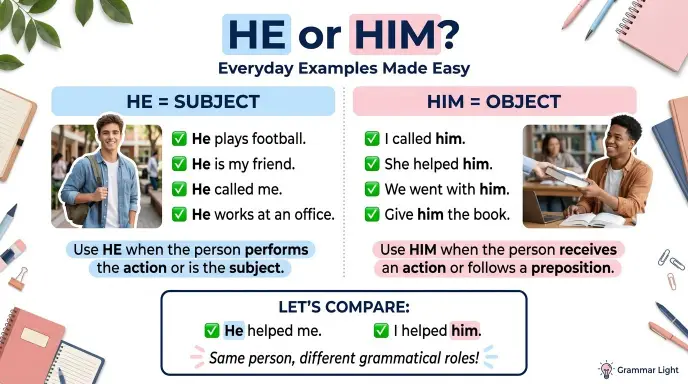
These pronouns are common in conversations, messages, and written communication. Looking at familiar situations helps you understand their use.
In Conversation
- “He is waiting outside.”
- “Did you see him?”
- “He told me the news.”
- “I went shopping with him.”
At School or Work
- He completed the assignment.
- The supervisor thanked him.
- He sent the report this morning.
- We asked him for advice.
In Text Messages
- “He is on his way.”
- “I will call him later.”
- “He said he would help.”
- “Can you message him?”
The grammatical rule remains the same in formal and informal English. The context changes, but the subject and object roles determine which pronoun to use.
Him and He in Longer Sentences
Choosing between he and him becomes easier when you identify the subject and object in a sentence. Even when a sentence contains several people or actions, the same basic rule applies.
When Two People Appear in a Sentence
Examples:
- He and his brother went shopping.
- I invited him and his brother.
- She spoke to him after the meeting.
- He told his friend about the problem.
In the first and fourth examples, he is the subject. In the second and third, him is used as an object.
When Using Names and Pronouns Together
Examples:
- Daniel and he are classmates.
- The teacher called Daniel and him.
- Sarah gave him and Daniel the tickets.
In formal standard English, subject pronouns such as he are used for subjects, while object pronouns such as him are used for objects. In everyday speech, people may phrase these combinations differently, but the grammatical roles remain the same.
He or Him in Questions
Questions can make pronoun choice confusing because the word order may change. However, the grammatical role still determines which pronoun is appropriate.
Examples:
- Is he coming today?
- Did you call him?
- Who told him the news?
- Who is he?
- To whom did you speak?
- In “Is he coming today?” the pronoun he is the subject. In “Did you call him?” the pronoun him is the object.
- In everyday English, people commonly say “Who did you speak to?” rather than the more formal “To whom did you speak?” Both illustrate the use of an object form after a preposition.
He or Him in Online Profiles and Pronouns
You may see he/him written in social media bios, email signatures, workplace profiles, or other online spaces. This indicates the pronouns a person uses when others refer to them.
For example, a profile might say:
- Alex : he/him
- Jordan : she/her
- Taylor : they/them
A person who lists he/him generally wants others to refer to them using those pronouns. The pronouns someone uses are not determined solely by their appearance or name.
A person may also use different pronouns, such as she/her or they/them. If you are unsure, you can politely ask which pronouns they use.
How to Choose Between He and Him
Use this simple method when writing or speaking English.
Step 1: Find the Verb
Identify the action or state in the sentence.
Example: “ called me.”
The verb is called.
Step 2: Identify Who Performs the Action
Ask who called me.
Correct: He called me.
He performs the action, so the subject pronoun is needed.
Step 3: Check if the Pronoun Receives the Action
Example: “I called .”
Ask whom I called.
Correct: “I called him.”
Him receives the action, so the object pronoun is needed.
Step 4: Check for a Preposition
After prepositions such as to, for, with, and beside, use him when referring to someone who uses he/him pronouns.
Examples:
- I went with him.
- This letter is for him.
- She spoke to him.
This quick check helps prevent the most common pronoun mistakes.
FAQs About He or Him
Q.1 Should I Use He or Him?
Use he when the person is the subject performing an action, and him when the person is the object receiving an action or following a preposition.
Examples:
- He helped me.
- I helped him.
Q.2 Where Is Him or He?
The correct choice depends on the sentence. Use he as the subject, such as “He is here.” Use him as the object, such as “I saw him here.”
If you are asking where the words normally appear, he often appears before the main verb as the subject, while him commonly appears after a verb or preposition.
Q.3 Can I Use Him for a Boy?
Yes. Him is commonly used as an object pronoun for a boy or man who uses he/him pronouns.
For example: “I gave him my book.”
Use he when the same person is the subject: “He gave me his book.”
Q.4 Is Him or Her a Boy or Girl?
Traditionally, him is a masculine object pronoun and her is a feminine object pronoun. For example, “I called him” and “I called her.”
However, pronouns do not always tell you a person’s gender identity with certainty. It is best to use the pronouns that the person asks others to use.
Q.5 Can I Use He/Him as a Girl?
Yes. A girl or woman can use he/him pronouns if those are the pronouns she prefers. Pronouns do not have to match assumptions other people make based on someone’s gender or appearance.
The respectful approach is to use the pronouns a person shares for themselves rather than assuming which ones they should use.
Q.6 What Does “Him” Mean?
Him is an object pronoun used to refer to a person who uses he/him pronouns when that person receives an action or follows a preposition.
Examples:
- I saw him.
- She helped him.
- We went with him.
The subject form of him is he.
Final Thoughts
He and him refer to the same person in different grammatical roles. He is a subject pronoun, while him is an object pronoun. Use he when the person performs an action or serves as the subject, and use him when the person receives an action or follows a preposition.
For example, “He called me” and “I called him” are both correct, but the pronouns serve different purposes. Remembering this distinction will help you write clearer sentences, ask better questions, and use English pronouns more confidently.
When you see he/him in a profile, it also communicates the pronouns that person uses. In that context, follow the person’s stated preference instead of making assumptions.
LEARN MORE!

I’m a grammar writer focused on making English rules, word usage, and sentence structure simple and easy to understand.