
Coincidentally is the more common choice when you want to say that something happened by chance, while coincidently generally means that two events happened at the same time. Both words are valid English adverbs, but they are not always interchangeable. Their similar spellings make them confusing for students, writers, and English learners who want to choose the right expression in everyday communication.
For example, if you meet an old friend unexpectedly at a shopping mall, you might say, “Coincidentally, I met my old friend at the mall.” The word highlights an unexpected meeting. However, if two events occur at the same time, coincidently may be appropriate in a more formal sentence.
Understanding coincidently or coincidentally can help you express unexpected events and timing more accurately. Although the words share the same root, their usual meanings differ in an important way. This guide explains their definitions, origins, grammatical usage, and common mistakes. You will also find practical examples, helpful memory tips, and answers to frequently asked questions so you can use both words with confidence.
Coincidently or Coincidentally : Quick Answer
The key difference between coincidently and coincidentally is their usual meaning.
- Coincidentally: Means by chance or in a way that draws attention to an unexpected coincidence.
- Coincidently: A more formal and less common adverb meaning at the same time as something else or in a way that coincides with another event.
Use coincidentally when you mean “by chance.” Use coincidently when you specifically mean that events happened at the same time.
Examples of Coincidentally
- Coincidentally, we both chose the same restaurant.
- I met my former teacher at the airport, coincidentally.
- Coincidentally, my sister and I bought the same book.
- We discovered that we had both visited the same city, coincidentally.
Each sentence highlights an unexpected similarity or meeting.
Examples of Coincidently
- The two activities occurred coincidently with the annual festival.
- The changes happened coincidently with the introduction of a new policy.
- The two events occurred coincidently during the same period.
In these examples, coincidently emphasizes timing rather than an unexpected discovery.
Quick rule: When you want to express an interesting coincidence, choose coincidentally. When you want to emphasize simultaneous timing, coincidently may be suitable in formal writing.
Definition and Meaning of Coincidentally and Coincidently
Both words are adverbs related to the adjective coincidental. However, they usually communicate different shades of meaning.
What Does Coincidentally Mean?
Coincidentally is an adverb meaning by chance or in a way that involves a coincidence. It often introduces a surprising connection between people, events, places, or situations.
Writers frequently use it to tell readers that two things share an unexpected connection without suggesting that one caused the other.
For example:
- Coincidentally, both students chose the same topic for their presentations.
- I was thinking about my childhood friend when she called me, coincidentally.
- Coincidentally, the two families booked rooms at the same hotel.
- My neighbor and I were born on the same day, coincidentally.
In these examples, the word emphasizes an unexpected connection.
Coincidentally does not necessarily mean that events happened at exactly the same moment. The important point is that the connection occurred by chance.
The word can appear at the beginning, middle, or end of a sentence, depending on the intended emphasis.
Examples:
- Coincidentally, we had both applied for the same position.
- The two writers, coincidentally, selected similar titles.
- We arrived at the same conclusion, coincidentally.
The sentence position may change the rhythm of the sentence, but the general meaning remains the same.
What Does Coincidently Mean?
Coincidently is a formal adverb that generally means occurring at the same time as something else or coinciding with another event.
It is less common in everyday conversation than coincidentally, but it is a valid English word.
For example:
- The new schedule was introduced coincidently with the start of the school year.
- The two developments occurred coincidently during the same period.
- The campaign began coincidently with the opening of the new store.
These sentences emphasize timing or the fact that events coincide.
However, when the main idea is simply that two events happened by chance, coincidentally is usually the more natural and recognizable choice.
Consider the difference:
Coincidentally: “Coincidentally, we both chose the same date for our celebrations.”
This highlights an unexpected similarity.
Coincidently: “The two changes occurred coincidently with the start of the new program.”
This emphasizes that the changes occurred at the same time as the program started.
Remember that both words are correct, but the intended meaning determines which one fits best.
The Origin of Coincidently and Coincidentally
Understanding how these words developed makes their meanings easier to remember.
Where Does Coincidentally Come From?
Coincidentally comes from coincidental, which is related to coincide. The word ultimately traces back to Latin roots associated with falling or coming together.
In modern English, coincide can describe events that happen at the same time or things that correspond with one another. From this idea, coincidental developed the meaning of something occurring by chance or sharing an unexpected connection.
Adding the adverb ending ly produces coincidentally.
The word became useful for describing surprising connections without claiming that they happened for a particular reason.
For example:
“Coincidentally, both colleagues discovered that they had attended the same university.”
The sentence describes an unexpected connection between two people.
Today, coincidentally is widely used in conversation, storytelling, journalism, and general writing.
Where Does Coincidently Come From?
Coincidently is also formed from coincident with the adverb ending ly.
The adjective coincident describes things that agree, correspond, or occur at the same time. The adverb coincidently carries this idea into a sentence.
For instance:
“The two events occurred coincidently with the scheduled announcement.”
Here, the word emphasizes when the events occurred.
The difference between the two adverbs reflects their common root but different patterns of use. Coincidentally commonly draws attention to a coincidence, while coincidently tends to emphasize simultaneous timing.
A useful memory trick is to connect coincidently with events that coincide in time and coincidentally with an unexpected coincidence.
Coincidently vs. Coincidentally in British and American English
Both words can appear in British and American English. The main distinction is their meaning and common usage, not a British versus American spelling rule.
Is Coincidentally Used in Both Varieties?
Yes. Coincidentally is widely understood in both varieties of English and is a natural choice when describing something that happens by chance.
Examples:
American English:
- Coincidentally, we both ordered the same meal.
- I met my cousin at the station, coincidentally.
British English:
- Coincidentally, we both ordered the same meal.
- I met my cousin at the station, coincidentally.
The spelling does not change between these varieties.
Is Coincidently Also Correct?
Yes. Coincidently is also a legitimate English word, although it is more formal and less common in everyday usage.
It is generally most appropriate when the writer wants to express that events occurred at the same time or alongside another event.
For example:
“The new regulations took effect coincidently with the start of the financial year.”
In ordinary conversation, many writers may prefer to express this idea more simply:
“The new regulations took effect at the same time as the start of the financial year.”
| Feature | Coincidentally | Coincidently |
| Part of speech | Adverb | Adverb |
| Main meaning | By chance; unexpectedly connected | Occurring at the same time or coinciding |
| Everyday usage | More common | Less common; more formal |
| British English | Used | Used |
| American English | Used | Used |
| Best known context | Unexpected meetings or similarities | Simultaneous timing |
Neither word is exclusively British or American. Choose the form that most accurately expresses the intended meaning.
Common Mistakes With Coincidently and Coincidentally
Because these adverbs look and sound similar, writers sometimes use them without considering the difference in meaning.
Mistake 1: Using Coincidently to Mean By Chance
Incorrect for the intended meaning: “Coincidently, I met my old friend at the airport.”
Better: “Coincidentally, I met my old friend at the airport.”
The second sentence naturally expresses an unexpected meeting.
Mistake 2: Assuming Coincidently Is Always Incorrect
Incorrect assumption: “Coincidently is not a real English word.”
Correct understanding: Coincidently is a valid word, although it is less common and often used to emphasize simultaneous timing.
For example: “The two developments occurred coincidently with the new policy.”
Mistake 3: Using the Words as Exact Synonyms
Although the words share a root, their usual meanings are not identical.
- Coincidentally: We both happened to choose the same book.
- Coincidently: The two events occurred at the same time.
Understanding the intended meaning helps you avoid awkward sentences.
Mistake 4: Replacing Both Words With a More Complicated Expression
Sometimes a simpler phrase communicates the idea more clearly.
Instead of writing, “The two activities happened coincidently with the ceremony,” you could write, “The two activities happened at the same time as the ceremony.”
Likewise, “We coincidentally chose the same destination” could be expressed as “By chance, we chose the same destination.”
The goal is clarity. Use the adverb that fits the meaning, or choose a simpler expression when it communicates your point better.
Coincidently or Coincidentally in Everyday Examples
The easiest way to understand these adverbs is to see how they work in real sentences. Coincidentally is the natural choice when describing an unexpected connection, while coincidently is less common and can emphasize events that happen at the same time. Their meanings can overlap in some contexts, so the surrounding sentence matters.
Examples of Coincidentally in Daily Life
People often use coincidentally when two people, situations, or events share an unexpected connection.
- Coincidentally, my friend and I bought the same shoes.
- I met my former classmate at the airport, coincidentally.
- Coincidentally, both families planned their vacations for the same week.
- My brother and I chose the same restaurant coincidentally.
- Coincidentally, the book I wanted was already on sale.
- We discovered that we had both visited Paris, coincidentally.
- Coincidentally, my teacher and my neighbor have the same birthday.
- The two students selected identical topics coincidentally.
In these examples, the word highlights an unexpected similarity or connection.
Examples of Coincidently in Daily Life
Coincidently is less common in everyday conversation. It may be used when describing events that coincide in time or occur alongside one another.
- The two activities occurred coincidently during the same period.
- The new policy was introduced coincidently with the annual review.
- The two developments happened coincidently with the launch of the project.
- The announcements were made coincidently on the same day.
- The changes took place coincidently with the start of the new program.
In many of these sentences, a more direct expression would sound more natural.
For example:
- Less common: The announcements were made coincidently on the same day.
- More natural: The announcements were made at the same time.
Writing tip: Although coincidently is a valid word, phrases such as at the same time or simultaneously are often clearer when timing is the only point you want to express.
Synonyms and Related Words for Coincidently and Coincidentally
Synonyms can help you communicate more naturally and avoid repeating the same word throughout an article. However, the best alternative depends on if you mean an unexpected event or simultaneous timing.
Synonyms for Coincidentally
When you mean that something happened by chance, consider these expressions:
- By chance: Without being deliberately planned.
- Unexpectedly: In a way that was not anticipated.
- As luck would have it: An informal expression for an unexpected event, often with a fortunate outcome.
- By coincidence: Because of an accidental or unexpected connection.
- Unintentionally: Without intending or planning to do something, although this does not always mean a coincidence.
Examples:
- By chance, I met my old friend at the shopping mall.
- Unexpectedly, both teams selected the same design.
- As luck would have it, we found an available table at the restaurant.
- By coincidence, our families booked rooms at the same hotel.
These expressions can replace coincidentally in many situations, but they do not always communicate exactly the same meaning.
Synonyms for Coincidently
When the intended meaning involves events happening at the same time, these alternatives may be more suitable:
- Simultaneously: Happening at the same time.
- Concurrently: Taking place during the same period.
- At the same time: A clear, everyday expression for simultaneous events.
- In parallel: Happening alongside another activity or process.
- Concurrently with: Occurring during the same period as something else.
Examples:
- The two meetings took place simultaneously.
- The changes were implemented concurrently with the new policy.
- Both projects developed in parallel.
- The announcement was made at the same time as the product launch.
Remember: By chance is a helpful alternative for coincidentally, while simultaneously is often a clearer alternative when you mean that events occurred together in time.
Easy Ways to Remember the Difference
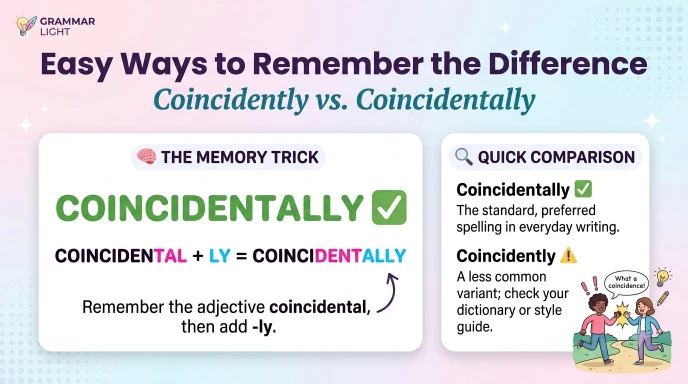
If you frequently confuse these words, a few practical strategies can help you choose the correct one.
1. Connect Coincidentally With Coincidence
The word coincidentally commonly introduces an unexpected similarity or connection.
Example: “Coincidentally, we both chose the same university.”
The sentence tells readers that the shared choice was unexpected.
2. Connect Coincidently With Coinciding Events
Think about the verb coincide, which can describe two events occurring at the same time.
Example: “The two events occurred coincidently during the same period.”
Because coincidently is less common, you may find it easier to use a clearer phrase such as at the same time.
3. Ask Yourself What You Want to Emphasize
Before choosing either word, consider the main idea of your sentence.
- Are you highlighting an unexpected connection? Use coincidentally.
- Are you describing simultaneous timing? Consider coincidently, simultaneously, or at the same time.
- Would a simpler expression be clearer? Choose the simpler wording.
4. Read the Sentence Aloud
Sometimes a sentence sounds unnatural because the chosen word is more formal than necessary.
For example:
Less natural: “The two events happened coincidently.”
Clearer: “The two events happened at the same time.”
The best word is not always the most complicated one. Clear, natural language should be your priority.
Frequently Asked Questions About Coincidently or Coincidentally
Q.1 Is coincidently or coincidentally correct?
Both words are correct English adverbs, but their usual meanings differ. Coincidentally is more common when describing something that happened by chance. Coincidently is less common and may emphasize events occurring at the same time.
Q.2 What is the main difference between coincidently and coincidentally?
Coincidentally usually highlights an unexpected connection, while coincidently often emphasizes simultaneous timing. Their meanings can overlap, so context determines the most appropriate choice.
Q.3 Is coincidently a real word?
Yes. Coincidently is a legitimate English word, not simply a spelling mistake. However, it is less common than coincidentally and is often replaced by clearer expressions such as at the same time.
Q.4 Can I use coincidentally to mean by chance?
Yes. Coincidentally is an appropriate choice when something happens by chance or an unexpected connection appears between events or people.
Example: “Coincidentally, we both arrived at the station at the same time.”
Q.5 Is coincidentally more common than coincidently?
Yes. Coincidentally is generally the more familiar and commonly used form, especially in everyday conversation and general writing.
Q.6 Do coincidently and coincidentally have the same origin?
Both words are related to coincide and coincident. Their shared word root explains their similar spelling and overlapping meanings.
Q.7 Can coincidently and coincidentally be used interchangeably?
Sometimes their meanings overlap, but they are not always equally natural substitutes. Use coincidentally for an unexpected connection and consider simultaneously or at the same time when you simply mean that events occurred together.
Q.8 What is a simple synonym for coincidentally?
By chance and by coincidence are useful alternatives.
Example: “By chance, I met my neighbor while traveling abroad.”
Final Thoughts: Coincidently or Coincidentally?
The difference between coincidently and coincidentally becomes easier to understand when you focus on the message you want to communicate.
Coincidentally is the more common choice when describing unexpected connections, surprising similarities, or events that happen by chance. Coincidently is also a valid English word, but it is less common and may be used to emphasize the timing of events that coincide.
Remember these key points:
- Use coincidentally when highlighting an unexpected connection.
- Recognize coincidently as a valid but less common adverb.
- Use simultaneously or at the same time when you want to express timing clearly.
- Check the context instead of assuming the words are always interchangeable.
- Prioritize clarity in everyday conversations, academic assignments, and professional writing.
For example, “Coincidentally, we both selected the same topic” sounds natural when two people make the same choice unexpectedly. If you simply mean that two activities happened together, “The activities occurred at the same time” is clearer.
The easiest rule to remember is this: use coincidentally for unexpected connections and choose a direct timing expression when you mean that events happened simultaneously.
EXPLORE MORE!

I’m a grammar writer focused on making English rules, word usage, and sentence structure simple and easy to understand.