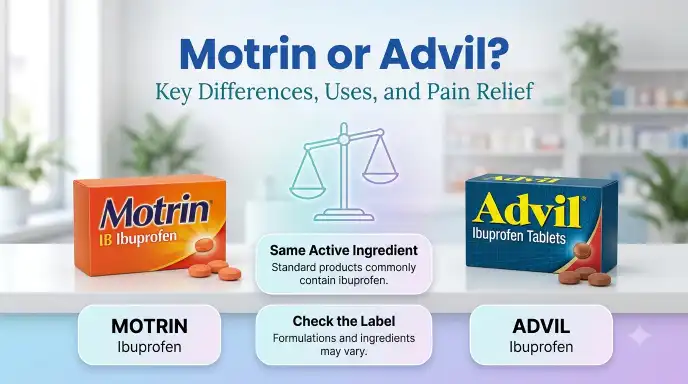
Motrin and Advil both contain ibuprofen in their standard over the counter formulations, so they can provide similar pain relief when the active ingredient, strength, and dosage form are the same. However, different products sold under these brand names may contain different ingredients or come in different formulations, so checking the label is important.
People search for Motrin or Advil because they want to know which medicine works better for headaches, muscle aches, back pain, menstrual cramps, toothaches, or fever. Since both names are widely recognized, it can be difficult to understand if one offers a real advantage over the other. The answer depends largely on the specific product rather than the brand name alone.
Understanding their similarities and differences can help you compare ingredients, choose an appropriate formulation, and avoid accidentally taking too much of the same medicine. It is also important to understand the potential risks of ibuprofen, particularly for people with certain medical conditions or those who take other medications.
This guide explains how Motrin and Advil compare, what they are used for, how they work, and what to consider before choosing either product.
Motrin or Advil : Quick Answer
Motrin and Advil are both brand names associated with ibuprofen, a nonsteroidal anti inflammatory drug (NSAID). Standard Motrin IB tablets and standard Advil tablets commonly contain 200 mg of ibuprofen per tablet in the United States.
When two products contain the same active ingredient at the same strength and in a comparable formulation, they would generally be expected to provide similar pain relieving and fever reducing effects when used as directed.
Here is a quick comparison:
| Feature | Motrin IB | Standard Advil |
| Active ingredient | Ibuprofen | Ibuprofen |
| Common OTC tablet strength | 200 mg | 200 mg |
| Medication class | NSAID | NSAID |
| Common uses | Pain and fever relief | Pain and fever relief |
| Reduces inflammation | Yes | Yes |
| Main difference | Brand and product formulation | Brand and product formulation |
Which One Is Better?
Neither standard brand is automatically better for everyone. If the products contain the same dose of ibuprofen in comparable forms, there is no general reason to expect one brand to consistently provide stronger relief.
Your choice may depend on the available formulation, the product label, personal preference, and cost.
For example, a person who prefers a particular tablet size may choose one product over the other. Someone comparing a standard ibuprofen tablet with a combination medicine must examine the active ingredients carefully because those products are not necessarily equivalent.
Important: Do not take Motrin and Advil together simply because they have different brand names. Standard versions contain the same medicine, and combining them can increase the risk of side effects.
Definition and Meaning of Motrin or Advil
Motrin and Advil are brand names used for medicines that relieve pain and reduce fever. Their standard ibuprofen products belong to a group of medications called nonsteroidal anti inflammatory drugs, commonly abbreviated as NSAIDs.
Although people often compare them as separate medicines, their standard formulations share the same active ingredient.
What Is Motrin?
Motrin is a brand name associated with ibuprofen products. The over the counter product Motrin IB is commonly used for temporary relief of minor aches and pains and for reducing fever.
Depending on the specific product, ibuprofen may help relieve:
- Headaches and minor migraines.
- Toothaches.
- Backaches and muscular aches.
- Menstrual cramps.
- Minor arthritis pain.
- Fever associated with common illnesses.
For example, an adult experiencing ordinary muscle soreness after physical activity may consider an appropriate ibuprofen product if it is safe for them to use.
Motrin is not suitable for everyone, and its safety depends on factors such as medical history, other medications, age, and pregnancy status.
What Is Advil?
Advil is another brand name associated with ibuprofen products. Standard Advil tablets commonly contain 200 mg of ibuprofen per tablet and are used for temporary pain relief and fever reduction.
Common uses include headaches, toothaches, menstrual cramps, backaches, muscular discomfort, and minor arthritis pain.
For example, an adult with an ordinary headache may compare standard Advil tablets with standard Motrin IB tablets. When the products have the same strength and formulation, the active medicine is the same.
However, the Advil brand also includes products with different formulations. Some may contain ibuprofen in a different form, while combination products may contain another active ingredient alongside it.
That is why the product label matters more than the brand name alone when comparing medicines.
What Does Ibuprofen Do?
Ibuprofen is the active ingredient responsible for the primary pain relieving effects of standard Motrin and Advil products.
It works by reducing the production of prostaglandins, chemical substances involved in pain, inflammation, and fever. This action can help reduce discomfort and swelling while bringing down an elevated temperature.
Ibuprofen does not cure every underlying cause of pain. Instead, it provides temporary symptom relief while the underlying problem may still require attention.
Key point: Motrin IB and standard Advil are two branded ways to obtain ibuprofen. Their standard products are similar because they contain the same active medicine, but individual formulations can differ.
Are Motrin and Advil the Same Medication?
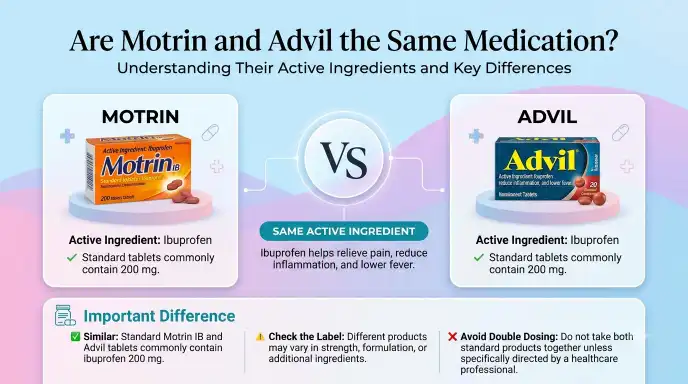
Motrin and Advil are not the same brand, but their standard ibuprofen products contain the same active ingredient. This distinction explains why people often use the names interchangeably when discussing ordinary over the counter pain relief.
Their Active Ingredients Are the Same
Standard Motrin IB and standard Advil tablets commonly contain 200 mg of ibuprofen per tablet.
The active ingredient determines the medicine’s primary therapeutic effects. When the ingredients, strength, and formulation are comparable, the products are generally expected to work similarly.
For example, suppose someone compares a standard Motrin IB 200 mg tablet with a standard Advil 200 mg tablet. Both provide ibuprofen at the same labeled strength.
This does not mean every product sold under the two brands is identical. Different products can vary in dosage form, strength, release characteristics, and additional ingredients.
Their Main Uses Are Similar
Both standard products can provide temporary relief from minor aches and pains and help reduce fever.
Consider these examples:
Example 1: Headache
A person comparing standard Motrin IB and standard Advil may find that either product is an option for temporary headache relief, provided ibuprofen is appropriate for them.
Example 2: Muscle discomfort
An adult with minor muscular aches may compare the labels and choose a suitable ibuprofen formulation.
Example 3: Menstrual cramps
Both standard brands list menstrual cramps among their uses. The choice depends on the product, label directions, and individual safety considerations.
These examples illustrate the overlap between the products. They do not mean that ibuprofen is appropriate for every person or every type of pain.
What Differences Can You Expect?
The main differences may involve the brand, packaging, available strengths, dosage forms, and inactive ingredients. Some products may also include additional active ingredients.
| Comparison point | What to know |
| Active medicine | Standard products contain ibuprofen |
| Standard tablet strength | Commonly 200 mg per tablet |
| Main purpose | Temporary pain relief and fever reduction |
| Formulation | May differ by product |
| Additional ingredients | Some branded combination products contain other medicines |
| Safety precautions | Generally share the major risks associated with ibuprofen |
Remember: Similar active ingredients do not make all products interchangeable. Always read the complete Drug Facts label, particularly when comparing combination medicines or products with different strengths.
What Are Motrin and Advil Used For?
Motrin and Advil’s standard ibuprofen products are used for temporary relief from several types of everyday pain and for reducing fever. Because both contain the same active ingredient, their main uses overlap considerably.
Headaches and Minor Migraines
Ibuprofen can help relieve certain headaches and is also used for migraine pain. The appropriate treatment depends on the type and severity of the headache and the person’s medical history.
For example, someone with an occasional mild headache may consider an over the counter pain reliever if they can safely take it.
Seek medical attention for a sudden, unusually severe headache or one accompanied by concerning symptoms, rather than relying only on an over the counter medicine.
Muscle and Back Pain
Muscle aches and backaches are other common reasons people consider ibuprofen.
The medication reduces pain related inflammation, which can be relevant to some muscular and musculoskeletal conditions.
For instance, an adult experiencing minor back discomfort might compare the labels of Motrin IB and Advil to determine if their standard formulations are suitable.
Persistent, worsening, or severe back pain deserves medical assessment, especially when accompanied by weakness, numbness, fever, or bladder or bowel changes.
Menstrual Cramps
Ibuprofen is commonly used to help relieve menstrual cramps. Prostaglandins contribute to uterine contractions, and reducing their production can help ease this type of discomfort.
Both standard Motrin IB and Advil list menstrual cramps among their temporary pain relief uses.
People with unusually severe menstrual pain, heavy bleeding, or new and persistent symptoms should seek medical advice instead of repeatedly relying on pain relievers.
Toothaches
Ibuprofen may temporarily reduce toothache pain and associated inflammation.
However, pain relief does not treat the underlying dental problem. A toothache caused by decay, infection, or another dental condition may require professional treatment.
Seek prompt dental care if the pain persists or worsens. Facial swelling, fever, or difficulty swallowing or breathing can indicate a more serious problem requiring urgent attention.
Fever
Both standard products may temporarily reduce fever. The appropriate medicine and dose depend on the person’s age, health, and product instructions.
Children require particular care because dosing depends on the exact formulation and, for many products, the child’s weight. Always follow the age specific label or a healthcare professional’s guidance.
Important reminder: Motrin and Advil treat symptoms rather than every underlying cause. Choose a medicine based on its active ingredients, follow its label, and seek professional advice when symptoms are severe, persistent, or unusual.
Side Effects of Motrin and Advil
Motrin and Advil contain the same active ingredient in their standard ibuprofen products, so they share many of the same potential side effects. Most people who use over the counter ibuprofen as directed do not experience serious problems, but side effects can occur.
The likelihood of experiencing side effects depends on factors such as the dose, length of use, other medications, and personal health history.
Common Side Effects
Some people may experience mild digestive or other symptoms when taking ibuprofen.
Common side effects can include:
- Stomach discomfort: Mild stomach pain or irritation.
- Heartburn: A burning feeling in the chest or upper stomach.
- Nausea: Feeling sick to the stomach.
- Dizziness: Feeling lightheaded or unsteady.
- Digestive changes: Symptoms such as constipation, diarrhea, or gas.
Taking ibuprofen with food or milk may help reduce stomach discomfort for some people, but it does not eliminate the risk of stomach bleeding or other serious complications.
Serious Side Effects to Recognize
Although less common, ibuprofen can cause serious adverse effects. These risks apply to both standard Motrin and Advil products.
Seek urgent medical attention if you experience symptoms such as:
- Stomach bleeding: Black, tarry stools or vomiting blood.
- Severe allergic reaction: Difficulty breathing or swelling of the face or throat.
- Cardiovascular problems: Chest pain, sudden weakness, or difficulty speaking.
- Kidney problems: A significant reduction in urine output or unusual swelling.
Stop taking the medicine and seek appropriate medical help if you suspect a serious reaction.
Important: Ibuprofen can increase the risk of heart attack, stroke, stomach bleeding, and kidney problems. Some risks increase with higher doses or longer use, and people with certain medical conditions may be more vulnerable.
Safety Precautions Before Taking Motrin or Advil
Because both medicines contain ibuprofen in their standard formulations, their major safety precautions are similar. Checking the label and considering your health history are important steps before choosing either product.
Who Should Be Careful With Ibuprofen?
Speak with a healthcare professional before using Motrin or Advil if you:
- Have a history of stomach ulcers or gastrointestinal bleeding.
- Have kidney disease, heart disease, high blood pressure, or liver problems.
- Take blood thinners, steroid medicines, or other medications that may interact with ibuprofen.
- Have previously experienced an allergic reaction to ibuprofen, aspirin, or another NSAID.
- Are older or have several long term medical conditions.
People with asthma who have reacted to aspirin or other NSAIDs should also avoid taking ibuprofen unless a healthcare professional specifically advises that it is appropriate.
Can You Take Motrin or Advil During Pregnancy?
Ibuprofen requires particular caution during pregnancy. The US Food and Drug Administration advises avoiding NSAIDs, including ibuprofen, at 20 weeks of pregnancy or later unless specifically recommended by a healthcare professional. These medicines may cause kidney problems in an unborn baby and reduce amniotic fluid.
NSAIDs should generally be avoided from 30 weeks onward because of additional risks to the unborn baby’s heart circulation. Pregnant people should seek professional advice before using ibuprofen, including early in pregnancy.
Can You Take Ibuprofen With Other Medicines?
Some medicines can interact with ibuprofen or increase the risk of adverse effects.
Examples include:
- Other NSAIDs: Such as naproxen or additional ibuprofen products.
- Blood thinners: These may increase the risk of bleeding.
- Aspirin: Ibuprofen can interfere with the protective antiplatelet effect of low dose aspirin in certain circumstances.
- Some blood pressure medicines and diuretics: Ibuprofen may affect kidney function or blood pressure control.
- Certain steroid medicines: These can increase the risk of gastrointestinal complications.
Check with a pharmacist or healthcare professional before combining medicines, particularly if you take prescriptions regularly.
Safety rule: Follow the directions on the exact product label, use the lowest effective dose for the shortest necessary time, and do not combine Motrin and Advil simply because they have different brand names.
Which Is Better for Pain Relief: Motrin or Advil?
For most people comparing standard ibuprofen products, neither Motrin nor Advil has a general advantage when the active ingredient, strength, and formulation are comparable.
The more useful question is which particular product is appropriate for your symptoms and health circumstances.
For Headaches
Both standard products may provide temporary relief from headaches. If the tablets contain the same amount of ibuprofen and use comparable formulations, their expected effects should be similar.
A persistent or unusually severe headache may require medical assessment rather than repeated use of an over the counter pain reliever.
For Muscle Pain and Backaches
Ibuprofen can help relieve certain muscle aches and musculoskeletal pain because it reduces inflammation as well as pain.
When comparing Motrin IB with standard Advil, check the active ingredient and strength first. A different brand name alone does not mean that one product will work better.
For Menstrual Cramps
Both standard brands contain ibuprofen products used to relieve menstrual cramps. Your choice can depend on the available formulation, label instructions, and if ibuprofen is suitable for you.
People with severe, worsening, or unusual menstrual pain should seek professional evaluation.
For Fever
Standard Motrin IB and Advil products can temporarily reduce fever. The appropriate option depends on the person’s age, symptoms, and health circumstances.
For children, use an appropriate pediatric product and follow its age and weight specific directions. Adult tablet instructions should not automatically be applied to children.
For People Who Prefer a Particular Formulation
Some people prefer tablets, caplets, or liquid formulations. The two brands may offer different product options, and certain products may contain additional active ingredients.
Compare the active ingredients, amount per dose, and Drug Facts label rather than choosing based on the brand name alone.
Common Mistakes When Choosing Motrin or Advil
People sometimes assume these brands contain different medicines or that taking both will provide stronger relief. Understanding a few common mistakes can help prevent unnecessary risks.
Mistake 1: Thinking One Brand Is Always Stronger
Motrin is not automatically stronger than Advil, and Advil is not automatically stronger than Motrin.
When standard products contain the same amount of ibuprofen in comparable formulations, they are expected to work similarly for the same uses.
Correction: Compare the product strength and formulation before deciding.
Mistake 2: Taking Motrin and Advil Together
This is an important mistake to avoid. Standard Motrin IB and standard Advil both contain ibuprofen.
Taking them together can increase the total amount of ibuprofen you consume and raise the risk of side effects.
Correction: Do not combine these products unless a healthcare professional has specifically instructed you how to use them.
Mistake 3: Assuming Every Product Has the Same Ingredients
The names Motrin and Advil are used across different product formulations. Some branded products may contain additional active ingredients or use different delivery systems.
Correction: Read the complete label and check every active ingredient, especially when switching from one product to another.
Mistake 4: Taking More Than the Recommended Amount
Taking more ibuprofen than directed does not guarantee better relief. Excessive use can increase the risk of stomach bleeding, kidney damage, and cardiovascular complications.
Correction: Follow the exact package instructions. Do not exceed the recommended amount or duration without professional guidance.
Mistake 5: Ignoring Other Medicines
Some people overlook ibuprofen in combination products or assume two differently branded medicines cannot contain the same ingredient.
Correction: Check all medicines you take, including cold and flu products, and ask a pharmacist if you are unsure if they contain ibuprofen or another NSAID.
Motrin or Advil in Everyday Examples
These practical situations show how the comparison applies to common decisions.
Example 1: Choosing a Medicine for a Mild Headache
An adult has a mild headache and wants to compare Motrin IB with standard Advil.
If both products contain 200 mg of ibuprofen per tablet and have comparable formulations, either may be suitable if ibuprofen is safe for that person and the label instructions are followed.
Example 2: Comparing Two Product Labels
A shopper notices that one package says ibuprofen 200 mg, while another product under the same brand name lists additional active ingredients.
The shopper should not assume the products are interchangeable. Their ingredients, uses, and precautions may differ.
Lesson: Check the complete product label instead of relying only on the brand name.
Example 3: Considering a Second Dose
Someone takes ibuprofen for muscle discomfort but still feels pain later.
The person should follow the timing and maximum amount stated on the product label rather than taking extra tablets early or switching brands without checking the active ingredient.
Example 4: Taking Other Medication
A person who takes daily low dose aspirin considers using Advil for a headache.
Because ibuprofen can interact with aspirin and may increase bleeding risks, the person should ask a pharmacist or healthcare professional about the safest approach.
Example 5: Choosing Pain Relief for a Child
A parent compares a standard adult tablet with a children’s liquid product.
The parent should use an appropriate pediatric formulation and follow its instructions rather than assuming adult products and children’s products have interchangeable dosing directions.
These examples demonstrate why the right choice depends on the product, the intended use, and individual safety considerations rather than the brand name alone.
Frequently Asked Questions About Motrin or Advil
Q1. Are Motrin and Advil the same thing?
Standard Motrin IB and standard Advil products contain ibuprofen, so they are similar in their main effects and safety concerns. However, different branded formulations may vary in strength, dosage form, or additional ingredients.
Q2. Which works faster, Motrin or Advil?
Neither standard brand is universally faster. The onset of relief can depend on the formulation, dose, and individual factors. Products with comparable formulations and equal doses of ibuprofen would generally be expected to behave similarly.
Q3. Can you take Motrin and Advil together?
You should not take them together simply because they are different brands. Both standard products contain ibuprofen, and combining them can increase the risk of side effects and excessive dosing.
Q4. Is Motrin safer for the stomach than Advil?
Neither standard brand has a general stomach safety advantage because both contain ibuprofen. Both can cause stomach irritation, ulcers, and gastrointestinal bleeding.
Q5. Can you take Advil or Motrin every day?
Regular use should be discussed with a healthcare professional, especially if you need pain relief repeatedly or for an extended period. Continued use can increase certain risks and may indicate that an underlying condition needs attention.
Q6. Can children take Motrin or Advil?
Some ibuprofen products are specifically formulated for children. Choose an age appropriate product and follow its instructions for the child’s age and weight. Consult a healthcare professional if you are uncertain about suitability or dosing.
Q7. Are generic ibuprofen products as effective as Motrin or Advil?
An approved generic ibuprofen product with the same active ingredient, strength, and comparable dosage form is generally expected to provide similar effects. Check the label to confirm the formulation and ingredients.
Q8. Which is better for inflammation?
Both standard Motrin IB and standard Advil contain ibuprofen, which reduces inflammation as well as pain. Neither brand is generally superior solely because of its name.
Final Thoughts
The choice between Motrin or Advil is usually straightforward because their standard over the counter products contain the same active ingredient: ibuprofen. When their strength and formulation are comparable, they should provide similar pain relief and fever reduction when used as directed.
The key differences are more likely to involve the individual product, dosage form, packaging, and any additional ingredients rather than the brand name itself.
Before choosing either medicine, check the active ingredients, follow the product directions, and consider your medical history and other medications. Avoid taking both products together, and speak with a healthcare professional if you have underlying medical conditions, are pregnant, or need pain relief regularly.
The bottom line: Neither brand is automatically better for everyone. Choose an appropriate ibuprofen product based on its ingredients, formulation, label instructions, and your individual health needs.
VIEW MORE!

I’m a grammar writer focused on making English rules, word usage, and sentence structure simple and easy to understand.