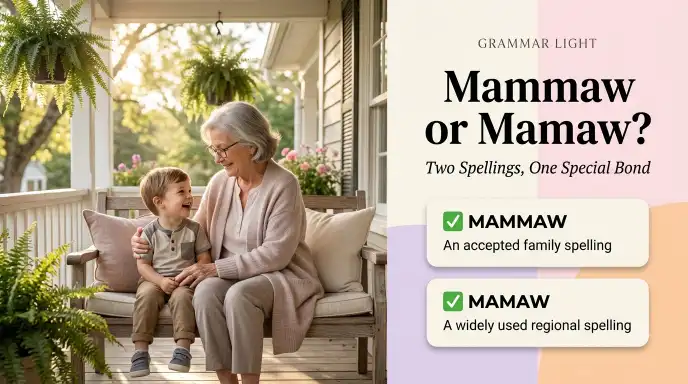
Mamaw is a widely used spelling of an affectionate family name for a grandmother, especially in the Southern United States and Appalachian communities. Mammaw is an alternative spelling used by some families and regional communities. Both words can express the same loving relationship, so the preferred spelling often depends on family tradition.
People search for Mammaw or Mamaw because the two spellings look almost identical and are often pronounced similarly. Unlike many commonly confused English words, this is not simply a case of one spelling being correct and the other being wrong. Both forms are used as informal names for grandmothers, although their popularity can vary by region and family.
Understanding these spellings can help you choose the right word for a family message, greeting card, personal story, or article about Southern American culture. It also explains why one family writes Mamaw while another prefers Mammaw. In this guide, you will learn what both words mean, where they come from, how they are used, and which spelling you should choose for your writing.
Mammaw or Mamaw : Quick Answer
Mamaw is a widely used spelling, while Mammaw is an accepted alternative. Both are affectionate family names for a grandmother, particularly in Southern American and Appalachian English.
Examples:
- Mamaw: “I am visiting my Mamaw this weekend.”
- Mammaw: “My Mammaw makes the best homemade biscuits.”
- Mamaw: “We spent the afternoon telling stories with Mamaw.”
- Mammaw: “I learned that family recipe from my Mammaw.”
All four sentences use the word as a loving name for a grandmother. The spelling changes, but the intended family relationship remains the same.
| Feature | Mamaw | Mammaw |
| Meaning | Grandmother | Grandmother |
| Regional association | Southern United States and Appalachia | Southern United States and Appalachian family usage |
| Spelling | Widely used regional form | Alternative regional form |
| Everyday use | Family conversations and writing | Family conversations and writing |
| Which should you choose? | A practical general choice | Use it when preferred by your family |
Quick tip: If you need a general spelling, Mamaw is a practical choice. However, if your grandmother or family uses Mammaw, keep that spelling. A personal family name does not need to be changed to match another family’s tradition.
Definition and Meaning of Mammaw or Mamaw
Mammaw and Mamaw are informal, affectionate family terms rather than formal titles. They are associated especially with Southern American and Appalachian English, where families often use distinctive names for grandparents.
What Does Mamaw Mean?
Mamaw means grandmother in many Southern American and Appalachian communities. It can refer to either a maternal grandmother, who is your mother’s mother, or a paternal grandmother, who is your father’s mother.
For example:
- “My Mamaw lives in Kentucky.”
- “I called Mamaw to wish her a happy birthday.”
- “Every summer, we visit our Mamaw in Tennessee.”
- “My Mamaw taught me how to bake bread.”
In these examples, Mamaw refers to a grandmother who holds a special place in the speaker’s family.
In some regional usage, similar forms can also be associated with a mother or another close female relative. However, the grandmother meaning is particularly familiar in Southern American English.
What Does Mammaw Mean?
Mammaw generally carries the same meaning as Mamaw. It is an alternative spelling used by some families and communities to represent their affectionate name for a grandmother.
For example:
- “My Mammaw always tells wonderful stories.”
- “We are celebrating Mammaw’s birthday on Sunday.”
- “I kept the handwritten recipe that Mammaw gave me.”
- “When I was little, I loved spending time with my Mammaw.”
The extra m does not usually create a different family relationship. Instead, it reflects spelling variation in an informal family term.
Are Mammaw and Mamaw Different Words?
In most family contexts, the two spellings mean the same thing. The difference is mainly how the name is written, not the relationship it describes.
However, family traditions can make one form more meaningful than the other. A person whose grandmother has always been called Mammaw may consider that spelling part of her name. Another family may consistently use Mamaw.
These names are also related in everyday use to other affectionate terms, including Grandma, Granny, Meemaw, Memaw, and Mawmaw. These terms can have similar meanings, but their use varies by family and region.
Remember: Both Mammaw and Mamaw can be appropriate. When referring to a particular person, follow the spelling that person or family actually uses.
The Origin of Mamaw and Mammaw
The origins of Mammaw and Mamaw are connected to affectionate words for mothers and older female relatives. However, the exact historical development of these specific spellings is not entirely settled, so it is important to distinguish likely explanations from confirmed historical facts.
Where Did Mamaw Come From?
Mamaw is associated with Southern American and Appalachian English, where it developed as an affectionate name for a grandmother.
One possible explanation connects Mamaw with familiar forms such as Ma, Mama, and Maw, which have long been used as affectionate terms for mothers. Short, repeated sounds are common in words children use for parents and close family members.
The precise path from these forms to Mamaw is less certain. Some explanations also suggest a connection with Scots or Scots Irish speech, but this should be treated as a possible influence rather than a definitively established origin.
Over time, regional family names can become part of a community’s everyday vocabulary. Mamaw remains a familiar example of an affectionate name that reflects family relationships and regional speech.
How Did the Spelling Mammaw Develop?
Mammaw is an alternative written form of the same affectionate family name. Informal family terms often develop different spellings because people write them according to how they pronounce them or how they learned them from relatives.
For example, one family might write:
“My Mamaw always made Sunday dinner special.”
Another family might write:
“My Mammaw always made Sunday dinner special.”
Both sentences communicate the same basic idea. The additional m in Mammaw does not, by itself, indicate a separate meaning.
Why Do Both Spellings Exist?
Unlike words governed by a single standardized spelling, informal family names can vary from one household to another. A grandmother might have been called Mammaw by her children, and her grandchildren may continue writing the name that way. A neighbouring family might use Mamaw instead.
These spellings can also carry a sense of regional identity. In parts of Appalachia and the American South, names such as Mamaw and Papaw are familiar across generations and remain part of everyday family speech.
The main point: Mamaw and Mammaw share an affectionate family meaning, but neither spelling needs to be treated as a simple misspelling of the other.
British English vs. American English Spelling
The difference between Mammaw and Mamaw is not a standard British versus American spelling rule. Both forms are primarily associated with regional and family usage in the United States, especially the South and Appalachia.
British English speakers are more likely to use familiar terms such as Grandma or Granny, although individual families can adopt many different names. In American English, Mamaw and Mammaw may reflect regional speech, family tradition, and personal preference.
Is Mamaw Used in American English?
Yes. Mamaw is a familiar regional term for a grandmother in parts of the United States. It often appears in conversations, family stories, social media posts, and personal writing.
Examples:
- “My Mamaw lives in the mountains.”
- “We are taking Mamaw out for dinner.”
- “I learned this recipe from my Mamaw.”
The word can convey warmth, familiarity, and a strong connection to family traditions.
Is Mammaw Used in American English?
Yes. Mammaw is also used by American families, although its popularity varies from household to household and across regions.
Examples:
- “My Mammaw always welcomed everyone into her home.”
- “We are making a photo album for Mammaw.”
- “I still remember the stories my Mammaw told me.”
In these examples, Mammaw functions as a personal family name rather than a formal title.
What About British English?
In British English, Grandma, Granny, and Nan are familiar terms for a grandmother. Mamaw and Mammaw may still appear when British families have adopted those names through relatives, cultural influences, or personal preference.
| Feature | British English | American English |
| Familiar grandmother names | Grandma, Granny, Nan | Grandma, Granny, Mamaw |
| Use of Mamaw | Less familiar generally | Familiar in some regions |
| Use of Mammaw | Mainly family specific | Used by some regional families |
| Spelling rule | No exclusive spelling rule | No exclusive spelling rule |
Key point: Neither spelling is exclusively British or American. Choose the name that reflects the family’s actual usage.
Which Spelling Should You Use?
The best spelling depends on the person you are talking about, the audience you are writing for, and the family’s established tradition.
Use Mamaw for General Regional Writing
If you are writing a general article, story, or explanation about Southern American family vocabulary, Mamaw is a practical spelling to use.
For example:
“My Mamaw taught me to appreciate the little things in life.”
This sentence uses a familiar regional term naturally and respectfully.
Use Mammaw When It Is the Family’s Preferred Spelling
If a particular grandmother is known as Mammaw, keep that spelling in cards, captions, stories, and family documents.
For example:
“Happy birthday to our wonderful Mammaw! Thank you for filling our lives with love.”
Changing the spelling to Mamaw simply because it is shorter could remove a meaningful part of the family’s tradition.
Which Spelling Is Better for Online Articles?
For an article comparing the two terms, include both Mammaw and Mamaw in the title and explain that their usage can vary.
If the article focuses on a particular person’s name or a family’s tradition, use the preferred form consistently throughout the text. If you are discussing the word generally, you can explain that Mamaw is a widely used regional form and Mammaw is an alternative.
Practical advice: There is no universal rule that makes one spelling correct for every family. The most appropriate choice is the one that matches the intended meaning and established usage.
Common Mistakes with Mammaw or Mamaw
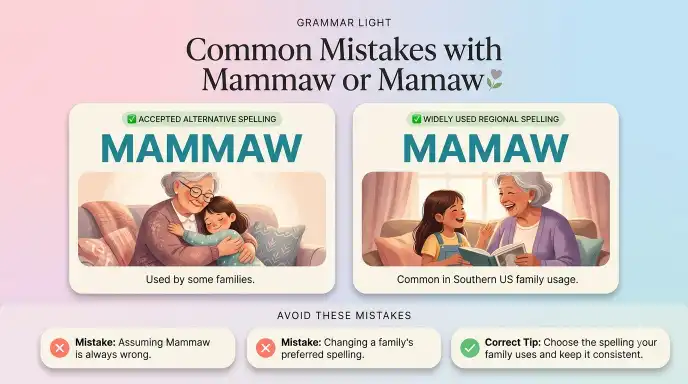
Although these words are easy to understand, writers can make mistakes when deciding how to spell or capitalize them. A few simple guidelines can help.
Mistake 1: Assuming Mammaw Is Always Wrong
Some people assume that the extra m makes Mammaw incorrect. However, alternative spellings of informal family names can become established within particular households and communities.
Incorrect assumption: “Mammaw is always a spelling mistake.”
Better understanding: Mammaw is an alternative spelling used by some families. Follow the person’s preferred form.
Mistake 2: Assuming the Two Spellings Have Different Meanings
In ordinary family usage, Mammaw and Mamaw generally refer to the same relationship.
For example:
“My Mamaw is visiting us today.”
“My Mammaw is visiting us today.”
Both sentences can mean that the speaker’s grandmother is visiting. The spelling alone does not establish a different family relationship.
Mistake 3: Changing a Family Member’s affirming name,
Suppose a family has always written Mammaw on birthday cards and family photographs. Replacing it with Mamaw in every message might make the name look unfamiliar.
Correction: Respect the spelling used by the person or family.
Mistake 4: Forgetting Capitalization
Capitalize the word when it functions as a name or is used directly to address a grandmother.
Examples:
- “I am visiting Mamaw this afternoon.”
- “Thank you, Mammaw, for the lovely gift.”
When used as a general descriptive term rather than a name, lowercase may be appropriate.
Example:
- “My friend calls her grandmother Mamaw.”
In this sentence, Mamaw is still the actual family name, so it remains capitalized. By contrast, a general reference such as “She calls her grandmother Grandma” may capitalize Grandma because it identifies the chosen family name.
Mistake 5: Using Different Spellings Inconsistently
Writers sometimes alternate between Mammaw and Mamaw while referring to the same person.
For example:
“My Mammaw loves gardening. Mamaw also enjoys growing flowers.”
If both references identify the same grandmother, the spelling change may confuse readers.
Correction: Choose one spelling for the person and use it consistently.
Mammaw or Mamaw in Everyday Examples
Everyday examples show how these family names fit naturally into conversations, messages, social media captions, and personal stories.
Examples in Family Conversations
Example 1:
“I am going to Mamaw’s house after school.”
The speaker is talking about visiting their grandmother.
Example 2:
“Mammaw said she would teach me how to make her famous cookies.”
The speaker uses Mammaw as the grandmother’s familiar family name.
Example 3:
“Can we invite Mamaw to Sunday dinner?”
The word identifies the family member whom the speaker wants to invite.
Examples in Birthday Cards
Example 1: A message using Mamaw
“Happy birthday, Mamaw! Your kindness and love make every family gathering special.”
Example 2: A message using Mammaw
“Happy birthday to our beautiful Mammaw! Thank you for all the wonderful memories and lessons you have given us.”
Both messages are appropriate. The spelling should match the recipient’s preferred family name.
Examples in Social Media Captions
Example 1:
“Sunday afternoons with Mamaw are always special.”
Example 2:
“Nothing compares to Mammaw’s homemade apple pie.”
Example 3:
“Making memories with Mamaw, one family gathering at a time.”
These captions use the terms affectionately and naturally.
Examples in Personal Stories
Example 1:
“When I was a child, my Mamaw always told me stories about growing up in the country.”
Example 2:
“My Mammaw kept old photographs in a wooden box, and every picture had a story behind it.”
Example 3:
“Whenever we visited Mamaw, the kitchen smelled of freshly baked bread.”
These sentences demonstrate how either spelling can appear in storytelling. The choice depends on the name used by the family.
Frequently Asked Questions ABOUT mammaw or mamaw
Q1. Is Mammaw or Mamaw the correct spelling?
Both spellings are used. Mamaw is a widely recognized regional form, while Mammaw is an alternative used by some families. Choose the spelling that matches the person or family’s preference.
Q2. What does Mamaw mean?
Mamaw is an affectionate name for a grandmother in many Southern American and Appalachian communities. It can refer to a maternal or paternal grandmother.
Q3. What does Mammaw mean?
Mammaw generally has the same meaning as Mamaw: an affectionate family name for a grandmother. The additional letter does not usually change the meaning.
Q4. Is Mamaw a Southern word?
Yes. Mamaw is particularly associated with Southern American and Appalachian speech. Its use can vary by community and family.
Q5. Do British people use Mamaw?
Mamaw is less familiar in British English than terms such as Grandma, Granny, and Nan. However, individual British families may use it as a personal or inherited family name.
Q6. Should Mamaw be capitalized?
Capitalize Mamaw when it functions as a person’s family name or is used to address the grandmother directly. Follow the family’s preferred spelling and capitalization in personal writing.
Q7. Are Mamaw and Meemaw the same?
They can serve the same purpose, but they are different forms. Some families use Mamaw, while others use Meemaw, Memaw, Mawmaw, or another affectionate name. The preferred form depends on regional and family tradition.
Final Thoughts
The choice between Mammaw and Mamaw comes down mainly to family tradition and regional usage. Both forms are used affectionately for grandmothers, especially in parts of the American South and Appalachia.
Mamaw is a practical general choice for discussing this regional family term, while Mammaw is appropriate when that is the spelling a particular family uses. Neither spelling should automatically be treated as a mistake.
When writing a birthday message, a family story, a social media caption, or an article, focus on consistency and respect for personal preference. A family name often carries memories, affection, and cultural meaning that go beyond its spelling.
The simplest rule is to use the spelling your grandmother or family prefers. After all, both forms can express the same love and respect for a beloved grandmother.
READ MORE!

I’m a grammar writer focused on making English rules, word usage, and sentence structure simple and easy to understand.





1 thought on “Mammaw or Mamaw? Explore Their Meaning and Family Traditions”